AL-181
Featured
Alabama sent Apollo to the moon and conscience to the law — sometimes in the same decade. Saturn V was built at Huntsville and lifted Armstrong into orbit; Rosa Parks refused to stand on a Montgomery bus, and 381 days later the seats were integrated. Five years after that, marchers crossed the Edmund Pettus Bridge into the televised violence that became the Voting Rights Act. Helen Keller learned to speak in Tuscumbia. The Heart of Dixie carries achievements no single sentence can hold.
Alabama stretches from the Tennessee River hills of the north — the Appalachian tail of Appalachia — through the Black Belt prairie and Piney Woods to the Mobile Bay Delta and Gulf shore. Its 67 counties span every terrain between the mountains and the sea.
Begin with the territory that calls to you — your homeland, a frontier you love, or simply somewhere your story belongs.
Each hex is a sovereign coordinate. Pick a coastline, a valley, a city block — anywhere on the grid that resonates with your roots or your dream.
A photograph, a paragraph, a name. Your hex becomes a permanent thread in the larger national tapestry — the 250-year-old story of America, continued.
Your inscription becomes a permanent thread in the American story — and a keepsake you can print, frame, and hold.
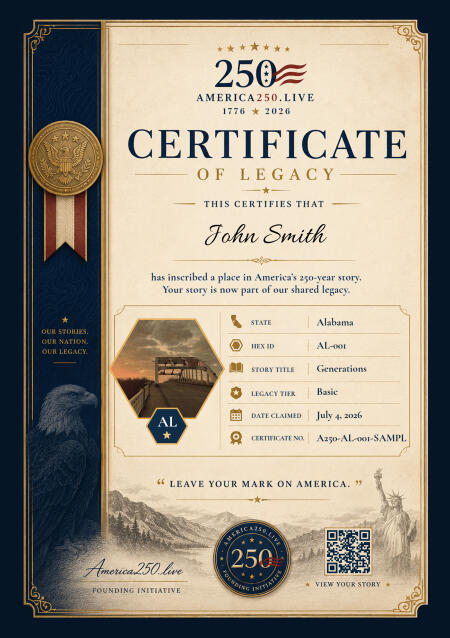
Your Commemorative Certificate
Print it. Frame it. Pass it down.
High-resolution digital certificate, custom to your state, delivered the moment your inscription is complete.
Digital Hex
Living Legacy
Your Inscription
$99 one-time · yours forever
Founder price, held through July 11. $199 afterward — and it stays there.
The Muscogee (Creek), Cherokee, Chickasaw, Choctaw, and Alabama peoples inhabited the region for thousands of years, building complex societies along the Tennessee, Coosa, and Alabama rivers. Hernando de Soto’s expedition reached Alabama in 1540, and the French established Mobile in 1702 as the first permanent European settlement in the region. Control passed from France to Britain and then to the United States, but the native nations held on until Andrew Jackson’s forced removal in the 1830s — the Trail of Tears — cleared the land for cotton planters.
Alabama entered the Union on December 14, 1819 as the twenty-second state. The Black Belt — named for its rich dark topsoil — became the engine of Alabama’s antebellum economy, its cotton fields worked by hundreds of thousands of enslaved people. Montgomery served as the first capital of the Confederacy in 1861, and Jefferson Davis was inaugurated on the steps of the Alabama State Capitol. The state suffered enormously during the Civil War and even more during the violent dismantling of Reconstruction that followed.
The twentieth century brought industry to north Alabama — textile mills in the Tennessee Valley, steel in Birmingham, which grew so fast it was called “the Pittsburgh of the South.” Birmingham’s iron and steel industry made it the most industrialized city in the Deep South, but also one of the most rigidly segregated. The city’s brutality toward civil rights demonstrators — Bull Connor’s fire hoses and police dogs turned on children in 1963 — shocked the world and accelerated the Civil Rights Act.
The Civil Rights Movement found its defining geography in Alabama. Rosa Parks refused to give up her seat on a Montgomery bus on December 1, 1955, launching a boycott that lasted 381 days and ended bus segregation. In Selma, marchers attempting to cross the Edmund Pettus Bridge on March 7, 1965 — Bloody Sunday — were beaten by state troopers on national television. Two weeks later, President Johnson signed the Voting Rights Act. The 16th Street Baptist Church bombing in Birmingham in 1963 killed four girls and became one of the movement’s most devastating losses and most powerful calls to action.
Today Alabama balances its civil rights legacy with a diversified economy. The Marshall Space Flight Center in Huntsville built the Saturn V rockets that carried Apollo astronauts to the moon, and the city now anchors a major aerospace and defense corridor. The Port of Mobile handles more tonnage than most American ports. Auburn and Alabama universities sustain an SEC football rivalry that divides the state every November with a ferocity that outsiders find difficult to overstate. The Edmund Pettus Bridge still stands in Selma, and every year thousands walk across it to remember.
Hernando de Soto’s expedition battles the Choctaw at Mabila — a devastating engagement that leaves hundreds dead on both sides and sends the Spaniards retreating toward the Mississippi.
Jean-Baptiste Le Moyne de Bienville establishes Mobile on the bay — the first permanent European settlement in Alabama and one of the oldest cities in the southeastern United States.
Alabama enters the Union on December 14 as the twenty-second state, with Huntsville briefly serving as its first capital before Montgomery takes over in 1846.
Montgomery serves as the Confederacy’s first capital. Jefferson Davis is inaugurated on the steps of the Alabama State Capitol — the same steps where George Wallace will shout “segregation forever” a century later.
Birmingham is incorporated at the crossing of two railroad lines near iron ore, coal, and limestone deposits. Within twenty years it is the fastest-growing industrial city in the South.
Rosa Parks is arrested for refusing to give up her seat on December 1. The 381-day boycott that follows ends bus segregation and launches Martin Luther King Jr. onto the national stage.
Klansmen bomb the 16th Street Baptist Church in Birmingham on September 15, killing four girls: Addie Mae Collins, Cynthia Wesley, Carole Robertson, and Carol Denise McNair.
State troopers attack marchers on the Edmund Pettus Bridge in Selma on March 7. The televised footage shocks the nation. President Johnson signs the Voting Rights Act five months later.
The Saturn V rocket, designed at NASA’s Marshall Space Flight Center in Huntsville, carries Apollo 11 astronauts to the moon. Alabama builds the machine that takes humanity to another world.
The Supreme Court guts the Voting Rights Act’s preclearance formula in a case brought by Shelby County, Alabama — the state where the act was born returns to the court to dismantle it.
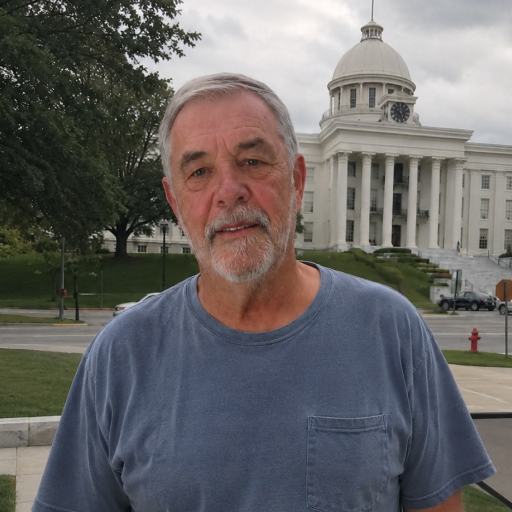
Real Alabama people who have placed their names — and their stories — into the hex grid. Each square mile, a chapter.
My grandmother used to make pierogi every Christmas Eve in her kitchen in Birmingham. She would sit at the round table, four hours straight,...
View StoryMy grandfather came to Alabama in 1953 with nothing but a suitcase and a job offer at the steel mill in Birmingham. He worked there for fort...
View StoryFor Pop. Sweetest dad in Alabama. Gone five years now and I still hear his laugh in the kitchen every Sunday morning.
View StoryMy grandmother Etta was born in Birmingham in 1924 to parents who had come up from Mississippi three years earlier as part of what they used...
View StoryMy great-grandmother Mary was born on a farm outside Birmingham in 1903. Her mother was Cherokee — full-blood, born on the Qualla Boundary i...
View Story
From the Saturn V at Huntsville to the Edmund Pettus Bridge at Selma, from the steel furnaces of Birmingham to the Gulf at Mobile Bay — sixty-seven counties of a state that built the rocket and bent the law in the same century. The bridge is still there. So is the rocket. Find your place.
Reserve your place on the Alabama map and receive your personalized Certificate of Legacy — your name, your place, preserved for the next 250 years.
We'll save your progress. We won't share your email.
Appears on the map and on your Certificate of Legacy.
We'll email you a private link to add your story and photo anytime after payment. Add your subtitle, story, and photo below before payment.
Ready · 1024 × 1024
Pick the square that lives on the map
Founder price through July 11. It becomes $199 after — and stays there.
Please accept the terms to proceed with payment.
No account needed — we'll email a secure link after payment.
Your hex is reserved immediately.
★ Limited availability per state ★
Processing
Securing your place on the map…
Check your email to complete your story and finalize your place on the map.
Can't find it? Check your spam or junk folder — and add [email protected] to your contacts so future messages reach your inbox.
Limited availability per state