America / States / Arkansas
25th State · Est. 1836

Arkansas.
The Natural
State.

Hot Springs became America’s first federally protected land in 1832 — forty years before Yellowstone, ninety-four years before the National Park Service existed. Hernando de Soto crossed the Mississippi into Arkansas in 1541 and met the Quapaw, whose name the state still carries. The Buffalo became the first national river in 1972. The Little Rock Nine integrated Central High in 1957 under federal troops. The Natural State holds both the diamond field at Murfreesboro and the cotton-rich Delta against the Mississippi.

53k
Square Miles
3.1M
Population
1836
Statehood
The Living Map

Find Your Place
on the Map.

Arkansas divides cleanly along its geography: the Mississippi Alluvial Plain fills the east, the Arkansas River valley bisects the center, the Ozark Plateau rises in the north, and the Ouachita Mountains spread across the southwest. Its 75 counties span every terrain.

Arkansas · Live Grid
AR · Hex 0 · 0 Open · 0 Inscribed
N AR
AR-000 Open
Open Featured Inscribed Click any hex to inspect
How It Works

Three steps to your hex.

01

Choose a state

Begin with the territory that calls to you — your homeland, a frontier you love, or simply somewhere your story belongs.

02

Select a hex

Each hex is a sovereign coordinate. Pick a coastline, a valley, a city block — anywhere on the grid that resonates with your roots or your dream.

03

Add your story

A photograph, a paragraph, a name. Your hex becomes a permanent thread in the larger national tapestry — the 250-year-old story of America, continued.

What You Receive

More than a hex.
A piece of history.

Your inscription becomes a permanent thread in the American story — and a keepsake you can print, frame, and hold.

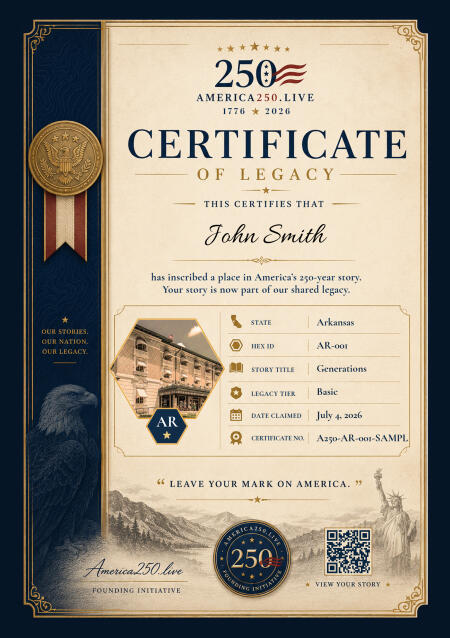
Sample America 250 commemorative certificate for Arkansas

Your Commemorative Certificate

Print it. Frame it. Pass it down.

High-resolution digital certificate, custom to your state, delivered the moment your inscription is complete.

Digital Hex

Forever on the Map

  • Your coordinate, permanently marked on the Arkansas map
  • Your name, your story, your photo — exactly as you choose
  • A shareable link to send family or post anywhere
  • Preserved on america250.live for the next 250 years

Living Legacy

Part of America's Story

  • A verified entry in the 250th anniversary digital memorial
  • Your story woven into Arkansas's permanent record
  • Discoverable by anyone exploring America's history
  • A coordinate your children — and theirs — can return to

Your Inscription

$99 one-time · yours forever

Founder price, held through July 11. $199 afterward — and it stays there.

One-time inscription No subscription, ever Certificate delivered instantly Yours for 250 years
Arkansas sits at the crossing of two American worlds — the Deep South of the Delta and the Upland South of the Ozarks — and has never fully belonged to either.

Between the Delta and the Highlands

Hernando de Soto’s expedition crossed the Mississippi into present-day Arkansas in 1541, encountering the Caddo, Quapaw, Osage, and other nations who had farmed and hunted these river valleys for millennia. The Quapaw, whose name gives Arkansas its sound, inhabited the lower Arkansas River. French explorer Robert de La Salle claimed the territory for France in 1682, and Arkansas Post — established in 1686 near the Arkansas-Mississippi confluence — became the first permanent European settlement in the lower Mississippi Valley.

The Louisiana Purchase of 1803 brought Arkansas under American control. Arkansas Territory was organized in 1819, with its capital at Arkansas Post before moving to Little Rock in 1821. Statehood came on June 15, 1836, as the twenty-fifth state. The Delta lowlands attracted cotton planters with enslaved labor from older Southern states, while Scots-Irish and German settlers pushed into the Ozark and Ouachita highlands, creating a cultural divide that persists today between the flat east and the hilly west.

Arkansas seceded from the Union in May 1861 after initial votes to stay. The state became a battleground: Pea Ridge (1862) and Prairie Grove (1862) were major Union victories in the northwest; the fall of Little Rock in 1863 put the capital under Union control for the rest of the war. Reconstruction was brief and violently ended, replaced by sharecropping and the plantation system reborn in cotton. The Delta became one of the poorest and most racially rigid regions in America, a condition that endured well into the twentieth century.

The twentieth century brought contradictions. Daisy Bates and the Little Rock Nine forced the integration of Central High School in 1957 under federal troops — one of the defining confrontations of the Civil Rights Movement. A generation later, Bill Clinton rose from Hope and Hot Springs through the University of Arkansas law school to the governorship and then the presidency, becoming the first president from Arkansas. Sam Walton opened his first discount store in Rogers in 1962 and built Walmart into the world’s largest retailer from Bentonville, transforming global supply chains from a town of 30,000.

Today Arkansas balances its natural inheritance against economic ambition. The Buffalo National River — the first national river in the U.S., designated in 1972 — draws paddlers and hikers into the unspoiled Ozark limestone country. The Walmart effect rippled through every supplier on earth from its Bentonville campus. The Marshes of Crystal Bridges Museum brought a billion-dollar art collection to the Ozarks. Arkansas remains one of the country’s most misunderstood states: poor on paper, rich in landscape, and quietly influential in ways that tend to surprise people who dismiss it.

1541

De Soto Crosses the Mississippi

Hernando de Soto’s expedition enters Arkansas, the first Europeans to see the interior. They encounter Quapaw and Caddo peoples and introduce diseases that devastate the native population.

1686

Arkansas Post Founded

Henri de Tonti establishes Arkansas Post near the Arkansas-Mississippi confluence — the first permanent European settlement in the lower Mississippi Valley.

1803

Louisiana Purchase

Arkansas passes to the United States. Explorers Dunbar and Hunter map the Ouachita River; Thomas Nuttall botanizes the Ozarks; the territory is open for American settlement.

1836

Statehood

Arkansas enters the Union on June 15 as the twenty-fifth state, with Little Rock as its capital — a site chosen partly because steamboats could reach it reliably on the Arkansas River.

1862

Battle of Pea Ridge

Union forces under Samuel Curtis defeat a Confederate army at Pea Ridge in the Ozarks, securing Missouri and setting up the Union’s eventual control of Arkansas.

1906

Diamonds at Murfreesboro

John Huddleston discovers diamonds on his Pike County farm — the only diamond-bearing volcanic pipe in North America. It becomes Crater of Diamonds State Park, open to public digging.

1957

Little Rock Central High

Nine Black students attempt to integrate Little Rock’s Central High School. Governor Orval Faubus calls out the National Guard to block them. President Eisenhower federalizes the Arkansas Guard and sends the 101st Airborne to enforce the court order.

1962

Walmart Opens in Rogers

Sam Walton opens his first Walmart discount store in Rogers, Arkansas. Within thirty years it becomes the world’s largest retailer, fundamentally restructuring global supply chains from its Bentonville headquarters.

1972

Buffalo National River

Congress designates the Buffalo River as the first national river in the United States, protecting 135 miles of free-flowing Ozark stream from impoundment.

1993

Clinton Inaugurated

Bill Clinton of Hope and Hot Springs is inaugurated as the forty-second president — the first from Arkansas. His wife Hillary Rodham Clinton becomes a major political figure in her own right.

Stories on the Map

Stories already on the map.

Real Arkansas people who have placed their names — and their stories — into the hex grid. Each square mile, a chapter.

Browse the map
WP
AR-290
Featured

For the name Pritchard

I started looking into our family after my uncle passed and nobody seemed to know much past my granddad. There are old cemetery records, a f...

View Story
By the Numbers

Arkansas, in facts.

Counties
75
the minimum required by Arkansas’s constitution
Diamonds
Only Mine
Crater of Diamonds — only public diamond mine in the world
Buffalo River
First
first national river designated in the United States (1972)
Statehood
Jun 15, 1836
25th state admitted to the Union
Highest Point
2,753 ft
Magazine Mountain, Logan County
Share Arkansas
Your Corner of the Natural State

Arkansas’s 75 Counties. Your One Hex.

Seventy-five counties from the Ozark highlands to the Delta. Hot Springs was the first federally protected land in America; Little Rock taught the federal government to enforce its own school integration. Pick your hex, dig your diamond on the Natural State map, and add your name to the long arc.