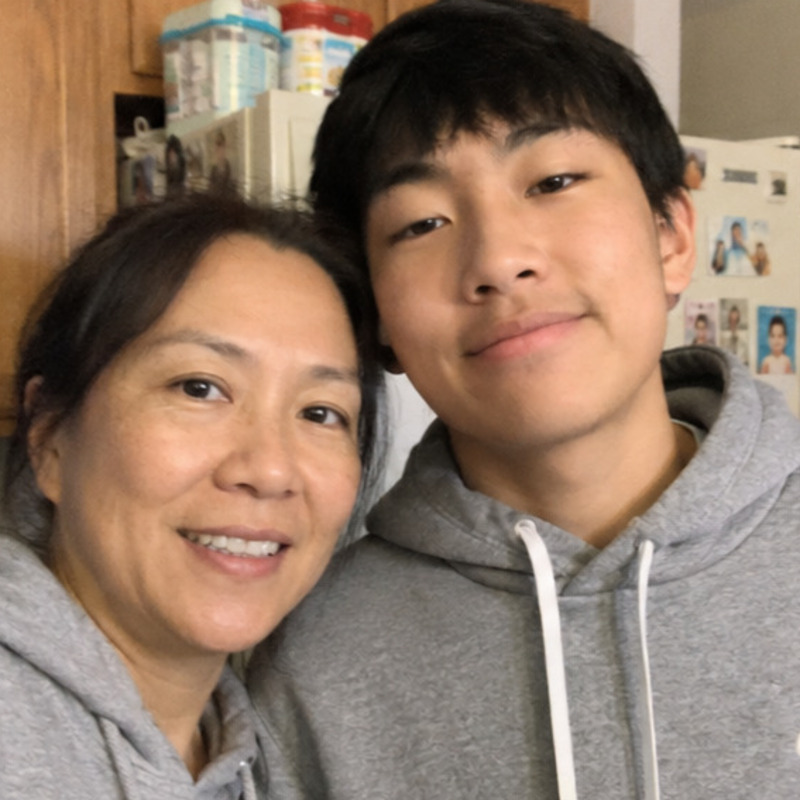
Generations
My family has called Connecticut home for five generations. My great-great-grandfather Anders arrived from Sweden in 1887 with seventeen dol...
View StoryConnecticut drafted the Fundamental Orders in Hartford in January 1639 — the first written constitution to derive authority from the people rather than from a crown or charter. The Pequot War of 1636-38 had nearly destroyed the indigenous Pequot in a campaign of calculated violence the colony spent centuries refusing to fully reckon with. Nathan Hale was captured as a spy in 1776 and refused to say where he’d hidden the intelligence. Eli Whitney’s interchangeable parts changed manufacturing. The Navy’s submarine fleet is still built at Groton.
Connecticut’s 8 counties span from the New York suburbs of Fairfield County east through the Connecticut River valley and Hartford to the old whaling coast of New London and the quiet Quiet Corner of Windham.
Begin with the territory that calls to you — your homeland, a frontier you love, or simply somewhere your story belongs.
Each hex is a sovereign coordinate. Pick a coastline, a valley, a city block — anywhere on the grid that resonates with your roots or your dream.
A photograph, a paragraph, a name. Your hex becomes a permanent thread in the larger national tapestry — the 250-year-old story of America, continued.
Your inscription becomes a permanent thread in the American story — and a keepsake you can print, frame, and hold.
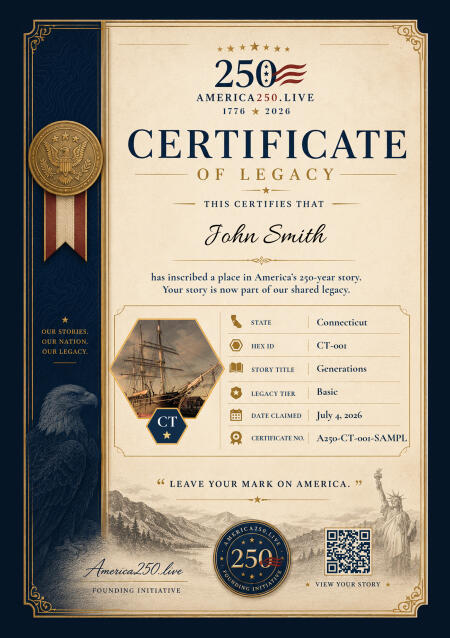
Your Commemorative Certificate
Print it. Frame it. Pass it down.
High-resolution digital certificate, custom to your state, delivered the moment your inscription is complete.
Digital Hex
Living Legacy
Your Inscription
$99 one-time · yours forever
Founder price, held through July 11. $199 afterward — and it stays there.
Connecticut’s claim to constitutional primacy rests on a document drafted in Hartford in January 1639. The Fundamental Orders of Connecticut established a government based on the will of the free men of the colony — not on royal charter, not on the authority of the Crown, but on the consent of the governed. It predated the U.S. Constitution by 149 years. When Connecticut adopted its state nickname “The Constitution State” in 1959, it was not being modest.
The colony’s early decades were defined by conflict. The Pequot War of 1636-38 nearly destroyed the indigenous Pequot people in a campaign of calculated violence that shocked even contemporary observers. Roger Williams, expelled from Massachusetts for his views, passed through; Anne Hutchinson’s followers settled the New Haven colony. Connecticut absorbed New Haven in 1665 and settled into a prosperous, self-governing colony that remained suspicious of outside authority in a way that persisted for centuries.
The Revolution found Connecticut thoroughly prepared. The colony had been quietly defying Crown authority for generations. Nathan Hale, schoolteacher and spy, was captured and hanged by the British in 1776, reportedly saying he regretted having only one life to give for his country. Benedict Arnold — before his infamous betrayal — was born in Norwich and led early patriot forces with genuine valor. Connecticut provided the Continental Army with gunpowder, cannon, and the stubborn infantry that Washington relied on through the darkest winters.
The 19th century made Connecticut an industrial laboratory. Eli Whitney’s concept of interchangeable parts, developed at his New Haven mill, transformed manufacturing. Samuel Colt’s Hartford factory invented the revolver and the modern production line. The Cheney Brothers silk mills in Manchester were the largest in America. P.T. Barnum built his circus empire from Bridgeport. Mark Twain wrote his greatest books in his Hartford mansion, complaining all the while about the weather.
Today Connecticut navigates the sharpest wealth gap of any state in America. Fairfield County’s Gold Coast — Greenwich, Darien, Westport — holds some of the highest concentrations of wealth on earth, while Bridgeport, Hartford, and New Haven struggle with the legacy of deindustrialization and concentrated poverty. Yale anchors New Haven’s revival. Casinos in Ledyard and Montville pour revenue into state coffers. Connecticut holds all of this in eight counties without ever quite resolving it, and has been doing so for four centuries.
Thomas Hooker leads a group of Massachusetts settlers south to found Hartford on the Connecticut River.
The Fundamental Orders of Connecticut, the world’s first written democratic constitution, is adopted in Hartford.
The Collegiate School — later renamed Yale — is established in Saybrook, eventually moving to New Haven.
Connecticut schoolteacher and Continental spy Nathan Hale is executed by the British in New York, reportedly declaring he regrets having only one life to give.
Eli Whitney establishes his musket factory near New Haven, pioneering the concept of interchangeable parts that transforms manufacturing.
Samuel Colt of Hartford receives a patent for his revolving firearm, launching an arms manufacturing dynasty that reshapes Hartford.
Enslaved Africans seize the Amistad slave ship; their case, argued by John Quincy Adams before the Supreme Court, becomes a landmark in abolitionist history.
Samuel Clemens settles in Hartford, where he will write The Adventures of Tom Sawyer, Adventures of Huckleberry Finn, and many other works.
USS Nautilus, the world’s first nuclear-powered submarine, is launched at Groton — beginning Connecticut’s modern submarine-building legacy.
Foxwoods Resort Casino opens on the Mashantucket Pequot reservation, becoming one of the largest casinos in the world.
Real Connecticut people who have placed their names — and their stories — into the hex grid. Each square mile, a chapter.
My family has called Connecticut home for five generations. My great-great-grandfather Anders arrived from Sweden in 1887 with seventeen dol...
View StoryIn September of 1987, my parents put me and my younger brother on a plane in Manila with two suitcases between us and exactly eight hundred....
View StoryThree sons. All served. All came home. This hex is for them, and for every parent who held their breath until the door opened.
View Story
In memory of my mother. She loved Connecticut more than she ever let on. The garden, the seasons, the quiet of a Sunday afternoon.
View StoryMy grandfather Eladio crossed the border at El Paso in 1944, on a temporary work visa under the Bracero Program. He was twenty-three years o...
View StoryMy grandmother taught me to fish on the Connecticut coast when I was six. She is gone now, but every time I cast a line, she is there with m...
View StoryEight counties between New York and Boston, the smallest after Rhode Island and Delaware. The Fundamental Orders, the Charter Oak, Yale’s first quad, Eli Whitney’s mill, and the submarines that hold the deterrent. Connecticut has been arguing about democracy on paper since 1639. Etch your order.
Reserve your place on the Connecticut map and receive your personalized Certificate of Legacy — your name, your place, preserved for the next 250 years.
We'll save your progress. We won't share your email.
Appears on the map and on your Certificate of Legacy.
We'll email you a private link to add your story and photo anytime after payment. Add your subtitle, story, and photo below before payment.
Ready · 1024 × 1024
Pick the square that lives on the map
Founder price through July 11. It becomes $199 after — and stays there.
Please accept the terms to proceed with payment.
No account needed — we'll email a secure link after payment.
Your hex is reserved immediately.
★ Limited availability per state ★
Processing
Securing your place on the map…
Check your email to complete your story and finalize your place on the map.
Can't find it? Check your spam or junk folder — and add [email protected] to your contacts so future messages reach your inbox.
Limited availability per state