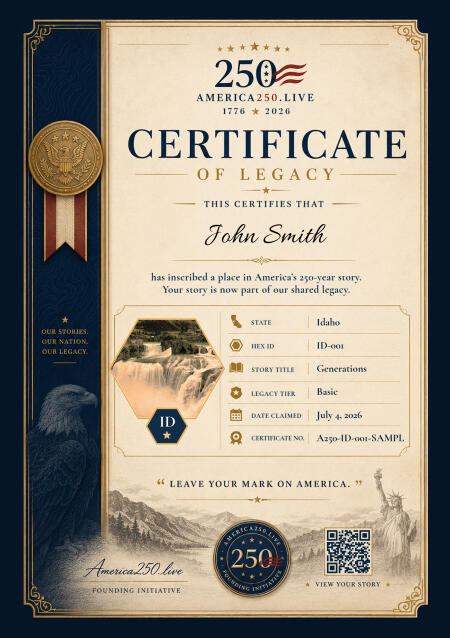
The Story of Idaho.
The Nez Perce, Shoshone-Bannock, Coeur d’Alene, and Paiute nations had lived across this landscape for thousands of years when Lewis and Clark crossed the Bitterroot Mountains in 1805, starving and lost, and were rescued by the Nez Perce — who fed them, gave them horses, and taught them to build the canoes that carried the expedition to the Pacific. The Nez Perce would receive nothing in return worth keeping.
The first permanent American settlement in Idaho was a Mormon farming community at Franklin in 1860 — the settlers thought they were in Utah. That same year, gold was struck in the Boise Basin and the rush began. Silver followed in the Coeur d’Alene mountains in the 1880s, producing mines so rich that the Bunker Hill and Sullivan alone yielded over a billion dollars in ore. The labor wars they spawned — bombings, assassinations, the Western Federation of Miners against the mine owners — were among the bloodiest in American history.
Idaho Territory was carved out of Washington Territory in 1863, a boundary drawn hastily around the mining camps. The Nez Perce War of 1877 ended with Chief Joseph’s surrender in Montana after a retreat that passed through Idaho. The Bannock War followed in 1878. By the time Idaho entered the union as the 43rd state in 1890, the Native nations that had governed this land had been confined to reservations a fraction of their original size.
The 20th century ran on three things: potatoes, timber, and federal money. The Snake River plain turned volcanic soil and irrigation water into the most productive potato farmland on earth. The federal government built dams on the Snake that powered the region and displaced the Shoshone-Bannock. Then, in 1949, the tiny town of Arco became the first city in the world to be powered entirely by nuclear energy, from a reactor at the National Reactor Testing Station outside town.
Modern Idaho is the fastest-growing state in the country, flooded by Californians and Oregonians priced out of their own cities. Boise has a Basque community — the largest outside the Basque Country — descended from shepherds brought over in the 1890s. Sun Valley, opened in 1936 as America’s first destination ski resort, buried Ernest Hemingway in its cemetery in 1961. The wilderness areas in the center of the state remain among the largest roadless landscapes in the contiguous US, and the argument over the four Snake River dams — whether to breach them to restore the salmon — has been running for thirty years without resolution.
Lewis & Clark Cross
The expedition crosses the Bitterroot Mountains near starvation. The Nez Perce feed them, provide horses, and teach them to build canoes. The Corps reaches the Pacific.
Gold in the Basin
Gold is struck in the Boise Basin, touching off a rush. The same year, Mormon settlers found Franklin — thinking they’re in Utah. Both events define Idaho’s split character.
The Nez Perce War
The Nez Perce are forced from the Wallowa Valley. Chief Joseph leads 800 people on a 1,170-mile retreat through Idaho and Montana before surrendering 40 miles from the Canadian border.
The 43rd State
Idaho enters the union on July 3 — one day before Wyoming and one day before the anniversary of Independence Day.
The Steunenberg Murder
Former Governor Frank Steunenberg is assassinated outside his gate in Caldwell. The trial of labor leader Big Bill Haywood — defended by Clarence Darrow — grips the nation.
Sun Valley Opens
Averell Harriman builds America’s first destination ski resort in the Wood River Valley for Union Pacific. Ernest Hemingway arrives. He never quite leaves.
Nuclear Arco
The town of Arco becomes the first in the world to be powered entirely by nuclear energy, from a reactor at the National Reactor Testing Station on the Snake River plain.
Bunker Hill Superfund
The Silver Valley’s Bunker Hill lead smelter is designated one of the nation’s largest Superfund sites. Cleanup costs exceed $700 million and continues for decades.
Snake Dam Decision
Federal agencies recommend breaching four lower Snake River dams to restore salmon. The debate — power vs. fish vs. agriculture — remains unresolved after thirty years.