GF
IL-098
Featured
Cahokia rose at the confluence of the Missouri and Mississippi rivers around 1100 CE — twenty thousand people living under earthen pyramids and lost to history by the time the French arrived. Illinois entered the Union in 1818, and Chicago was incorporated in 1833 at the portage between the Lakes and the Mississippi. The fire of 1871 leveled the city; it rebuilt taller and invented the skyscraper. The Great Migration brought hundreds of thousands of Black Southerners north. Springfield, in the middle, kept Lincoln. Obama came later.
Illinois runs from the Wisconsin border south to the confluence of the Ohio and Mississippi rivers at Cairo — nearly 400 miles of glacially flattened prairie. Chicago and its suburbs hold two-thirds of the population in the northeast corner; the remaining 100 counties spread across corn and soybean country to the far southern tip, where the state tapers to a point between two great rivers.
Begin with the territory that calls to you — your homeland, a frontier you love, or simply somewhere your story belongs.
Each hex is a sovereign coordinate. Pick a coastline, a valley, a city block — anywhere on the grid that resonates with your roots or your dream.
A photograph, a paragraph, a name. Your hex becomes a permanent thread in the larger national tapestry — the 250-year-old story of America, continued.
Your inscription becomes a permanent thread in the American story — and a keepsake you can print, frame, and hold.
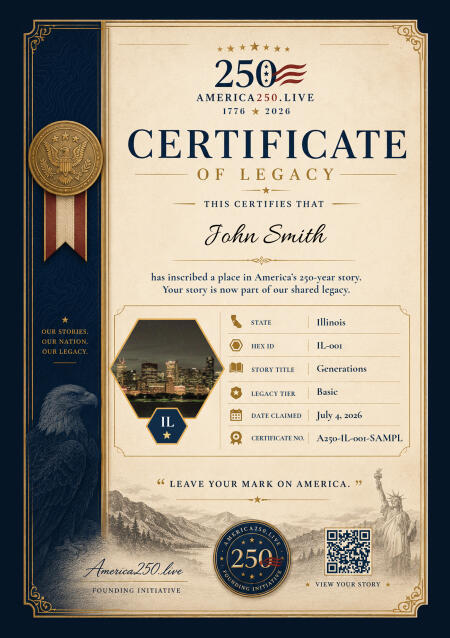
Your Commemorative Certificate
Print it. Frame it. Pass it down.
High-resolution digital certificate, custom to your state, delivered the moment your inscription is complete.
Digital Hex
Living Legacy
Your Inscription
$99 one-time · yours forever
Founder price, held through July 11. $199 afterward — and it stays there.
The Cahokia people built a city of 20,000 at the confluence of the Missouri and Mississippi rivers around 1100 CE — the largest pre-Columbian settlement north of Mexico. After Cahokia’s decline, the Illinois Confederation and later the Potawatomi, Sauk, Fox, Kickapoo, and Miami nations inhabited the land. French missionaries and traders arrived in the 1670s — Marquette and Jolliet paddled the Illinois River in 1673 — and France established a string of forts and missions including Fort de Chartres and Kaskaskia in the American Bottom, the rich floodplain east of the Mississippi.
Illinois became the twenty-first state on December 3, 1818. Chicago was incorporated as a town in 1833 on the portage between the Great Lakes and the Mississippi watershed — the geographic fulcrum of the continent — and grew with extraordinary speed as railroads made it the center of a national transportation network. Abraham Lincoln moved to Illinois from Indiana in 1830, read law in New Salem, served in the state legislature, and rode the Eighth Judicial Circuit as a prairie lawyer before the Lincoln-Douglas debates of 1858 brought him national attention and the presidency.
Chicago burned on October 8–10, 1871. The fire killed 300 people, destroyed 17,000 buildings, and left 100,000 homeless. The city rebuilt within two years — and this time built in masonry and steel. The Home Insurance Building, completed in 1885, is generally considered the world’s first skyscraper. By 1893 Chicago hosted the World’s Columbian Exposition, which introduced alternating current, the Ferris wheel, the zipper, and Cracker Jack to the world. The fair’s White City also inspired a generation of city planners — and, less fortunately, serial killer H.H. Holmes.
The labor movement found its defining moment in Illinois. The 1886 Haymarket affair in Chicago — a bomb thrown at police during a labor rally for the eight-hour workday — became the founding trauma of the international labor movement. The Pullman Strike of 1894 brought federal troops to Chicago. Jane Addams founded Hull House in 1889 and invented the settlement house movement. Upton Sinclair published The Jungle in 1906 about conditions in Chicago’s meatpacking plants, leading directly to the Pure Food and Drug Act. Illinois was where industrial capitalism and its discontents worked out their argument in public.
The Great Migration brought hundreds of thousands of Black Southerners to Chicago between 1910 and 1970, transforming the South Side into one of the great African American cultural centers on earth. Chicago blues — electrified, amplified, urban — emerged from this migration. Chess Records recorded Muddy Waters, Howlin’ Wolf, Chuck Berry, and Bo Diddley. Chicago became the jazz and blues capital of the North. Barack Obama organized on the South Side, taught constitutional law at the University of Chicago, represented Hyde Park in the state senate and then the U.S. Senate, and was inaugurated as the forty-fourth president in 2009.
Jacques Marquette and Louis Jolliet paddle the Illinois River, becoming the first Europeans to map the interior of what will become Illinois.
Illinois enters the Union on December 3 as the twenty-first state. Kaskaskia — a French colonial town on the Mississippi — briefly serves as capital before Vandalia, then Springfield.
Abraham Lincoln, 28, moves to Springfield to practice law. Over the next two decades he will try cases across the Eighth Circuit, serve in Congress, and emerge from the Lincoln-Douglas debates as a national figure.
Chicago burns on October 8–10. Three hundred people die. The city rebuilds immediately, this time in stone and steel, and invents the skyscraper within fourteen years.
A bomb kills seven police officers during a labor rally in Chicago’s Haymarket Square. The aftermath — a controversial trial and four executions — becomes the founding event of the international labor movement’s May Day commemorations.
Chicago hosts the World’s Fair celebrating 400 years since Columbus. Twenty-seven million people attend. The fair introduces AC electricity, the Ferris wheel, the zipper, and American planning ideology to the world.
Upton Sinclair publishes The Jungle, documenting conditions in Chicago’s meatpacking plants. Public outcry leads directly to the Pure Food and Drug Act and the Meat Inspection Act — the first major federal consumer protection laws.
Chess Records on South Michigan Avenue reaches its creative peak — Muddy Waters, Chuck Berry, Bo Diddley, and Howlin’ Wolf recording in the same studio, inventing electric blues and proto-rock-and-roll simultaneously.
The Sears Tower (now Willis Tower) is completed at 1,450 feet — the world’s tallest building for 25 years, a statement of Chicago ambition visible from 40 miles away on a clear day.
Barack Obama, a Chicago constitutional law professor and South Side community organizer, is inaugurated as the forty-fourth president — the first Black president of the United States.
Real Illinois people who have placed their names — and their stories — into the hex grid. Each square mile, a chapter.

I carry the strength of ancestors who endured; from Belleville to the national tapestry, my story becomes a living thread — a distinct Ameri...
View StoryMy father was nineteen years old when he landed in Korea in November of 1950. He was a corporal in the Second Infantry Division. He was at t...
View StoryMy grandfather John was arrested in 1962 in Birmingham, Alabama, for refusing to leave a lunch counter. He was eighteen years old. He spent....
View StoryFor my wife Elena, who passed in May after fifty-one years of marriage. We met in Chicago in 1973, at a wedding neither of us wanted to atte...
View Story
One hundred and two counties of prairie, river bottom, and rail yard. From the Cahokia mounds to the Chicago skyline, from Springfield’s Lincoln house to the Mississippi at Cairo — Illinois has been the heart of American ambition since before America had a name. Pick your hex and write your chapter.
Reserve your place on the Illinois map and receive your personalized Certificate of Legacy — your name, your place, preserved for the next 250 years.
We'll save your progress. We won't share your email.
Appears on the map and on your Certificate of Legacy.
We'll email you a private link to add your story and photo anytime after payment. Add your subtitle, story, and photo below before payment.
Ready · 1024 × 1024
Pick the square that lives on the map
Founder price through July 11. It becomes $199 after — and stays there.
Please accept the terms to proceed with payment.
No account needed — we'll email a secure link after payment.
Your hex is reserved immediately.
★ Limited availability per state ★
Processing
Securing your place on the map…
Check your email to complete your story and finalize your place on the map.
Can't find it? Check your spam or junk folder — and add [email protected] to your contacts so future messages reach your inbox.
Limited availability per state