Mom’s old recipe box
After my mom died we found her recipe box in the cabinet, full of cards with stains, notes, and little changes she made over the years. Some...
View StoryKansas rehearsed the Civil War before the country was ready to fight it. The Kansas-Nebraska Act of 1854 opened the territory to slavery by popular vote, and Bleeding Kansas — five years of guerrilla violence between pro-slavery Border Ruffians and free-soil settlers — followed. The state entered the Union in 1861 as a free state. Brown v. Board of Education was decided in Topeka in 1954, ending school segregation. The wheat the Mennonites brought from Russia in 1874 still feeds the world. Kansas looks flat. It is not simple.
Kansas, divided into a grid of sovereign hexes. 105 counties. The wheat. The prairie. The wind that never stops. Click a hex and leave your mark on the Sunflower State.
Begin with the territory that calls to you — your homeland, a frontier you love, or simply somewhere your story belongs.
Each hex is a sovereign coordinate. Pick a coastline, a valley, a city block — anywhere on the grid that resonates with your roots or your dream.
A photograph, a paragraph, a name. Your hex becomes a permanent thread in the larger national tapestry — the 250-year-old story of America, continued.
Your inscription becomes a permanent thread in the American story — and a keepsake you can print, frame, and hold.
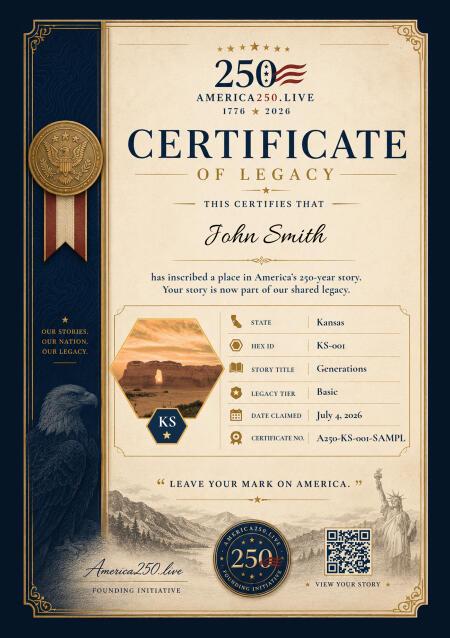
Your Commemorative Certificate
Print it. Frame it. Pass it down.
High-resolution digital certificate, custom to your state, delivered the moment your inscription is complete.
Digital Hex
Living Legacy
Your Inscription
$99 one-time · yours forever
Founder price, held through July 11. $199 afterward — and it stays there.
The Kansa, Wichita, Osage, Pawnee, and Comanche nations had held this prairie for centuries before Coronado crossed it in 1541 searching for Quivira — a city of gold that did not exist. The land entered American possession with the Louisiana Purchase in 1803 and was largely passed through rather than settled for fifty years, used as the corridor for the Santa Fe Trail and the Oregon Trail. Explorers called it the Great American Desert and marked it unfit for farming. The Mennonites who arrived in the 1870s with Turkey Red wheat seed from Ukraine proved them catastrophically wrong.
The Kansas-Nebraska Act of 1854 repealed the Missouri Compromise and left the question of slavery in the new territories to popular vote. What followed was five years of organized violence — pro-slavery “Border Ruffians” from Missouri flooding Kansas elections, free-soil settlers arming themselves with “Beecher’s Bibles” (rifles), and John Brown executing five pro-slavery settlers at Pottawatomie Creek in 1856. “Bleeding Kansas” was not a metaphor. Roughly 200 people died. The territory became the nation in miniature, rehearsing the war that was coming. Kansas entered the union as a free state on January 29, 1861 — ten weeks before Fort Sumter.
After the Civil War, Kansas became the end point of the great cattle drives. The Chisholm Trail ran from Texas to Abilene, then to Wichita and Dodge City, and the cow towns that grew around the railheads created the Wild West mythology that Hollywood has never stopped recycling. Wyatt Earp, Bat Masterson, and Doc Holliday all passed through. By 1880, the cattle era was over — barbed wire, homesteaders, and the railroads had fenced the open range. Wheat farming replaced cattle. The winter wheat strains the Mennonite settlers brought from Russia transformed western Kansas into one of the most productive grain regions in the world.
On May 17, 1954, the Supreme Court issued its decision in Brown v. Board of Education of Topeka — the unanimous ruling that declared racial segregation in public schools unconstitutional. The case had been filed by Oliver Brown on behalf of his daughter Linda, who was denied admission to a white elementary school seven blocks from their Topeka home. The decision overturned Plessy v. Ferguson and is regarded as the most important Supreme Court ruling of the 20th century. The school where Linda Brown was turned away still stands and is now a National Historic Site.
Kansas today is the breadbasket in full operation — the state produces enough wheat each year to provide every person on earth with six loaves of bread. Wichita’s aviation industry, built on the flat terrain and reliable winds, produced Cessna, Beechcraft, Learjet, and Boeing’s Spirit AeroSystems. The Flint Hills in the east hold the largest intact tallgrass prairie remaining in North America. The western High Plains sit above the Ogallala Aquifer, which is being depleted by irrigation at a rate that will exhaust it within decades — a slow-motion crisis that threatens to turn the bread basket into the desert the early explorers imagined.
The Kansas-Nebraska Act opens the territory to popular sovereignty on slavery. Five years of organized violence follow between pro-slavery and free-soil settlers — a rehearsal for the Civil War.
John Brown and his sons kill five pro-slavery settlers along Pottawatomie Creek. The act of violence that made Brown a martyr to abolitionists and a murderer to everyone else.
Kansas enters the union as a free state on January 29 — ten weeks before Confederate guns fire on Fort Sumter. The rehearsal is over.
The cattle drives begin reaching Abilene. Over the next fifteen years, five million Texas longhorns walk north to Kansas railheads, creating the Wild West mythology the country has been selling ever since.
Mennonite immigrants from Russia arrive in central Kansas with Turkey Red winter wheat seed. The variety transforms the western plains from “Great American Desert” into the breadbasket of the world.
The first documented cases of the 1918 influenza pandemic are reported at Fort Riley. The virus kills an estimated 50 million people worldwide — more than World War I.
The Supreme Court rules unanimously that racial segregation in public schools is unconstitutional. The case was filed in Topeka. It is the most important civil rights ruling in American history.
An F5 tornado destroys 95% of Greensburg in eleven minutes. The town votes to rebuild as a model green community — powered entirely by wind energy within five years.
NASA satellite data confirms the Ogallala Aquifer beneath western Kansas is depleting at rates that could exhaust it within fifty years, threatening the irrigation system that makes wheat farming possible.
Real Kansas people who have placed their names — and their stories — into the hex grid. Each square mile, a chapter.
After my mom died we found her recipe box in the cabinet, full of cards with stains, notes, and little changes she made over the years. Some...
View StoryOne hundred and five counties of prairie, wheat, cow town, and civil rights history. The state that argued out its worst contradictions and grows six loaves of bread for every person on earth. Pick your hex, plant your name in the tallgrass, and sow your wheat on the Sunflower State map.
Reserve your place on the Kansas map and receive your personalized Certificate of Legacy — your name, your place, preserved for the next 250 years.
We'll save your progress. We won't share your email.
Appears on the map and on your Certificate of Legacy.
We'll email you a private link to add your story and photo anytime after payment. Add your subtitle, story, and photo below before payment.
Ready · 1024 × 1024
Pick the square that lives on the map
Founder price through July 11. It becomes $199 after — and stays there.
Please accept the terms to proceed with payment.
No account needed — we'll email a secure link after payment.
Your hex is reserved immediately.
★ Limited availability per state ★
Processing
Securing your place on the map…
Check your email to complete your story and finalize your place on the map.
Can't find it? Check your spam or junk folder — and add [email protected] to your contacts so future messages reach your inbox.
Limited availability per state