RF
KY-070
Featured
Kentucky was contested ground long before Europeans arrived — Shawnee, Cherokee, and Chickasaw used these canebrake river valleys as hunting territory. Daniel Boone cut the Wilderness Road through the Cumberland Gap in 1775, opening the first state carved from the West. Kentucky entered the Union in 1792. Abraham Lincoln was born here in 1809; Muhammad Ali was born here in 1942. The Kentucky Derby has run every May at Churchill Downs since 1875. Ninety-five percent of America’s bourbon is still poured from the rickhouses of the Knobs.
Kentucky sweeps from the Cumberland Mountains and the Daniel Boone National Forest in the east through the Knobs, the Bluegrass, the Pennyroyal plateau, and the Western Coal Fields to the Jackson Purchase in the far west, where the Ohio and Mississippi rivers define the state’s borders. Its 120 counties span every landscape.
Begin with the territory that calls to you — your homeland, a frontier you love, or simply somewhere your story belongs.
Each hex is a sovereign coordinate. Pick a coastline, a valley, a city block — anywhere on the grid that resonates with your roots or your dream.
A photograph, a paragraph, a name. Your hex becomes a permanent thread in the larger national tapestry — the 250-year-old story of America, continued.
Your inscription becomes a permanent thread in the American story — and a keepsake you can print, frame, and hold.
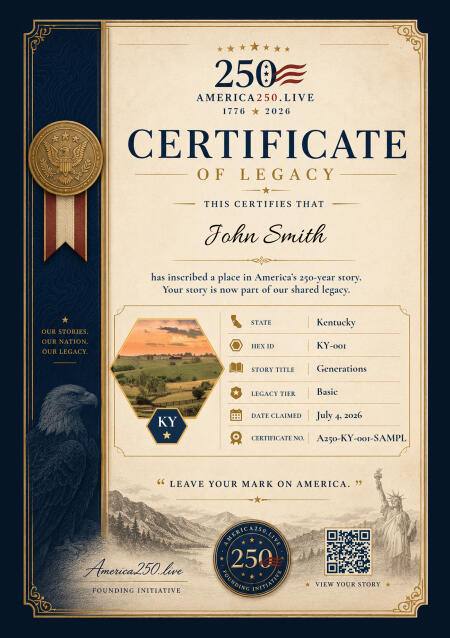
Your Commemorative Certificate
Print it. Frame it. Pass it down.
High-resolution digital certificate, custom to your state, delivered the moment your inscription is complete.
Digital Hex
Living Legacy
Your Inscription
$99 one-time · yours forever
Founder price, held through July 11. $199 afterward — and it stays there.
Kentucky was contested ground long before Europeans arrived. The Shawnee, Cherokee, Chickasaw, and other nations used its river valleys and canebrakes as prime hunting territory but resisted permanent settlement, calling it “the dark and bloody ground.” Daniel Boone led the first group of settlers through the Cumberland Gap in 1775, cutting the Wilderness Road and founding Boonesborough. Within a decade, tens of thousands of settlers had poured through the gap, and the Cherokee, Shawnee, and other nations who had held the land for generations were pushed out by force and treaty.
Kentucky became the fifteenth state on June 1, 1792 — the first state carved from the territory west of the Appalachians. Its position between North and South made it a border state of enormous strategic importance. Both Abraham Lincoln and Jefferson Davis were born in Kentucky within a hundred miles and a year of each other — Lincoln in a log cabin in Hardin County in 1809, Davis in Christian County in 1808. When the Civil War came, Kentucky tried to stay neutral, then split: the state government stayed in the Union while a shadow Confederate government claimed the state simultaneously.
The Bluegrass region’s deep limestone-filtered water and mineral-rich grasses — which give the region its name and a faint blue tinge at flowering — proved ideal for raising thoroughbred horses. The first Kentucky Derby was run at Churchill Downs in Louisville on May 17, 1875. The bourbon whiskey industry, also dependent on Kentucky’s limestone water and white oak barrels, grew alongside the horse culture. Today 95% of the world’s bourbon is made in Kentucky, and the Kentucky Bourbon Trail draws visitors from every continent.
Eastern Kentucky’s coal seams powered American industrialization. The coalfields of Harlan, Pike, Letcher, and adjacent counties fueled steel mills and generated electricity for a century, while the miners who extracted it lived in company towns, fought union battles at places like Bloody Harlan, and built a mountain culture of extraordinary music, craftsmanship, and pride. The decline of coal has left eastern Kentucky with some of the highest poverty rates in America, and the opioid crisis hit the region with particular devastation — but the culture and the landscape remain fierce and beautiful.
Muhammad Ali was born Cassius Clay in Louisville in 1942, won Olympic gold in Rome in 1960, and became the most famous athlete — and perhaps the most famous American — of the twentieth century. The Muhammad Ali Center in Louisville celebrates his life and the principles he embodied: confidence, conviction, dedication, giving, respect, and spirituality. Kentucky produces bourbon that sells for thousands a bottle, horses that run for millions, coal that powered a century of industry, and people who punch above their weight in every arena they enter.
Daniel Boone leads thirty axemen through the Cumberland Gap, cutting the Wilderness Road to Boonesborough. Within a decade 200,000 settlers will follow this path to the trans-Appalachian frontier.
Kentucky enters the Union on June 1 as the fifteenth state — the first carved from the western territories. Isaac Shelby becomes the first governor. Frankfort is chosen as the capital because it offended the fewest rival towns.
Abraham Lincoln is born in a one-room log cabin on Sinking Spring Farm in Hardin County on February 12. Jefferson Davis had been born 100 miles away in Christian County the previous year. Kentucky will produce both presidents of the Civil War.
Aristides wins the first Kentucky Derby at Churchill Downs on May 17. The race will run every year without interruption — through wars, depressions, and pandemics — for the next 150 years.
Kentucky declares neutrality in the Civil War. Both sides ignore it. By September, Confederate and Union forces have both invaded. The state produces generals and soldiers for both armies simultaneously.
The Harlan County coal wars peak as miners strike for union recognition. Private deputies and state troopers fight pitched battles with miners. “You’ll either work for gun-thugs or you won’t work at all,” a miner says. The union eventually wins.
Cassius Clay is born in Louisville on January 17. He will win Olympic gold in 1960, the heavyweight championship three times, and become the most recognized face on earth.
Mammoth Cave — the world’s longest known cave system at over 400 miles of explored passages — becomes a UNESCO World Heritage Site and International Biosphere Reserve.
Thirty years after Secretariat’s 1973 Derby, his record time of 1:59⅖ remains unbroken — the only sub-two-minute Kentucky Derby in history, set by a horse that may never be equaled.
Catastrophic flooding in July kills 44 people in eastern Kentucky — the deadliest natural disaster in state history — hitting communities already struggling with coal’s decline and the opioid crisis.
Real Kentucky people who have placed their names — and their stories — into the hex grid. Each square mile, a chapter.
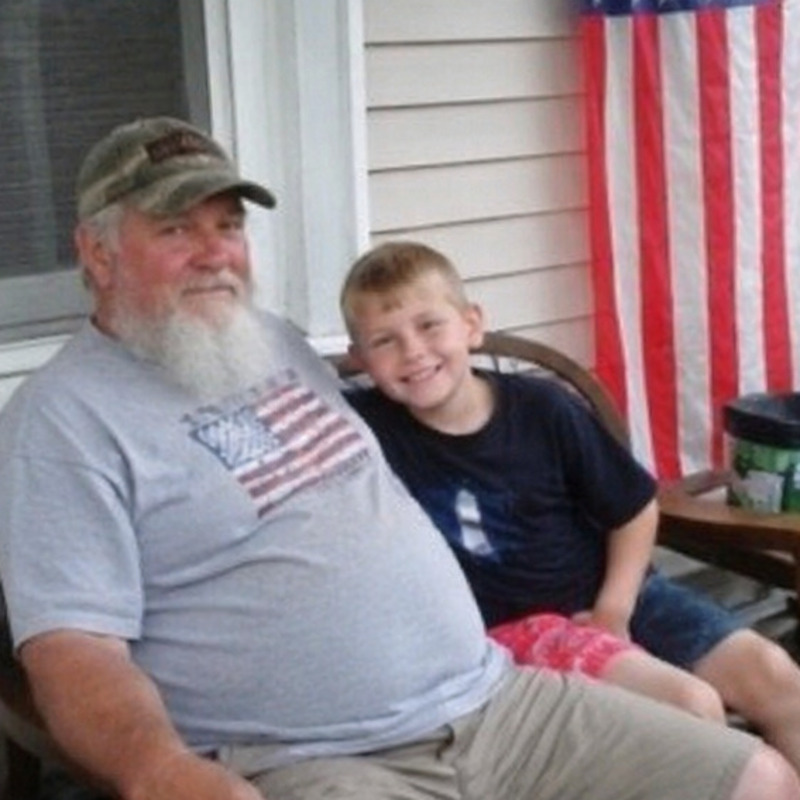
In memory of my mother. She loved Kentucky more than she ever let on. The garden, the seasons, the quiet of a Sunday afternoon.
View StoryMy grandmother Etta was born in Louisville in 1924 to parents who had come up from Mississippi three years earlier as part of what they used...
View StoryMy grandfather came to Kentucky in 1953 with nothing but a suitcase and a job offer at the steel mill in Louisville. He worked there for for...
View StoryFor my son Jacob, who deployed to Afghanistan three times between 2009 and 2014 and came home different each time. He does not talk about wh...
View StoryMy grandmother used to make pierogi every Christmas Eve in her kitchen in Louisville. She would sit at the round table, four hours straight,...
View Story
One hundred and twenty counties from the Cumberland Gap where Boone cut the Wilderness Road to the bourbon rickhouses of the Knobs. Lincoln’s birthplace, Ali’s hometown, the most famous race on earth, and ninety-five percent of America’s whiskey. Pour your bourbon on the Bluegrass State map.
Reserve your place on the Kentucky map and receive your personalized Certificate of Legacy — your name, your place, preserved for the next 250 years.
We'll save your progress. We won't share your email.
Appears on the map and on your Certificate of Legacy.
We'll email you a private link to add your story and photo anytime after payment. Add your subtitle, story, and photo below before payment.
Ready · 1024 × 1024
Pick the square that lives on the map
Founder price through July 11. It becomes $199 after — and stays there.
Please accept the terms to proceed with payment.
No account needed — we'll email a secure link after payment.
Your hex is reserved immediately.
★ Limited availability per state ★
Processing
Securing your place on the map…
Check your email to complete your story and finalize your place on the map.
Can't find it? Check your spam or junk folder — and add [email protected] to your contacts so future messages reach your inbox.
Limited availability per state