J(
MA-038
The Wampanoag had lived along these shores for thousands of years when the Pilgrims stepped off the Mayflower in 1620 — not the first Europeans on the coast, but the ones whose story stuck. Harvard opened its doors in 1636. The Stamp Act riots, the Tea Party, and the shot heard round the world at Lexington Green in 1775 all ran through Boston. William Lloyd Garrison printed The Liberator here; the 54th Massachusetts marched into history at Fort Wagner. The Bay State has been writing first chapters ever since.
Massachusetts spans from the Berkshire Hills in the west through the Connecticut River valley and Greater Boston to Cape Cod’s arm curling into the Atlantic, with 14 counties holding more history per square mile than almost any ground on earth.
Begin with the territory that calls to you — your homeland, a frontier you love, or simply somewhere your story belongs.
Each hex is a sovereign coordinate. Pick a coastline, a valley, a city block — anywhere on the grid that resonates with your roots or your dream.
A photograph, a paragraph, a name. Your hex becomes a permanent thread in the larger national tapestry — the 250-year-old story of America, continued.
Your inscription becomes a permanent thread in the American story — and a keepsake you can print, frame, and hold.
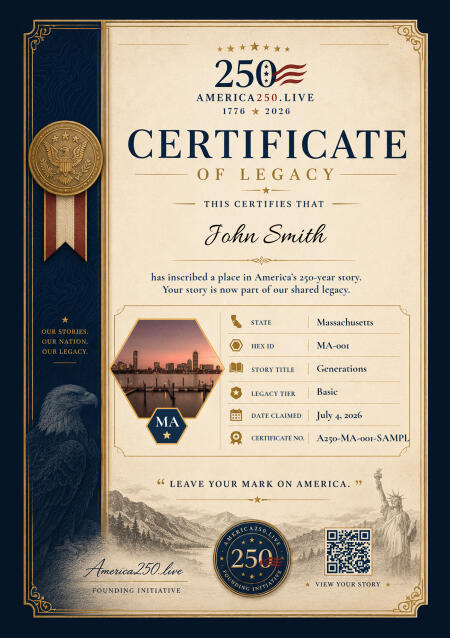
Your Commemorative Certificate
Print it. Frame it. Pass it down.
High-resolution digital certificate, custom to your state, delivered the moment your inscription is complete.
Digital Hex
Living Legacy
Your Inscription
$99 one-time · yours forever
Founder price, held through July 11. $199 afterward — and it stays there.
Massachusetts begins at Plymouth Rock — or so the story goes. The Pilgrims who stepped ashore in 1620 were not the first Europeans in the region, nor even the first English settlers, but their story of religious exile, brutal first winter, and tentative peace with the Wampanoag people became the founding myth Americans reach for every November. What the myth elides is the century of conflict that followed: King Philip’s War in 1675, the bloodiest per-capita conflict in American history, nearly destroyed both sides.
Boston became the nerve center of colonial grievance. The Stamp Act riots, the Boston Massacre, the Boston Tea Party — each outrage was concentrated and amplified in this tight harbor city of printers, merchants, and Calvinist ministers who believed they were engaged in something close to a holy cause. Paul Revere rode. Sam Adams organized. On April 19, 1775, the shot heard round the world was fired at Lexington and Concord, and the revolution Massachusetts had been building for a decade became a war.
The 19th century made Massachusetts an intellectual and industrial powerhouse simultaneously. Lowell’s textile mills, powered by the Merrimack River, were the first large-scale factories in North America, drawing farm girls from across New England and immigrants from across the world. At the same time, Concord was producing Emerson, Thoreau, and Hawthorne. Boston’s Brahmin class built the Museum of Fine Arts and the Boston Symphony and Harvard Medical School. The state held both the loom and the library.
The abolition movement burned hottest in Massachusetts. William Lloyd Garrison published The Liberator in Boston. Frederick Douglass gave his most important early speeches here. The 54th Massachusetts Infantry, one of the first Black regiments in the Union Army, marched from Boston in May 1863 and led the assault on Fort Wagner with a valor that changed the debate about African American soldiers. Their story is carved in bronze on the Boston Common by Augustus Saint-Gaudens.
Today Massachusetts packs seven million people into 10,600 square miles and produces a disproportionate share of America’s medical research, higher education, biotechnology, and political talent. The Route 128 corridor and the Kendall Square biotech hub have made Greater Boston a global center of innovation. Cape Cod fills every summer with the world. The Berkshires attract artists and tourists year-round. And Boston remains exactly what it has always been: argumentative, proud, certain it is right, and usually closer to right than it has any business being.
The Mayflower arrives at Plymouth in November; the Pilgrims sign the Mayflower Compact, an early model of self-governance.
Harvard College is established in Cambridge, the first institution of higher education in British North America.
British soldiers kill five colonists on King Street in Boston, galvanizing anti-British sentiment across the colonies.
Colonists dump 342 chests of British East India Company tea into Boston Harbor, a defining act of colonial defiance.
The first shots of the American Revolution are fired at Lexington Green and Concord’s North Bridge on April 19.
Massachusetts ratifies the Constitution as the sixth state, after demanding and receiving a promise of a Bill of Rights.
The 54th Massachusetts Infantry, one of the first Black Union regiments, leads the assault on Fort Wagner in South Carolina.
The first Boston Marathon is run on Patriots’ Day — it will become the world’s oldest annual marathon.
John F. Kennedy of Brookline becomes the first Catholic president, elected on a narrow margin over Richard Nixon.
Massachusetts becomes the first U.S. state to legalize same-sex marriage, following the Supreme Judicial Court’s Goodridge decision.
Real Massachusetts people who have placed their names — and their stories — into the hex grid. Each square mile, a chapter.
This is for the small towns of Massachusetts. The ones nobody writes songs about. The ones that raised us anyway.
View StoryMy daughter Emma was born on October 14, 2014, at thirty-one weeks gestation, weighing two pounds and eleven ounces. She was diagnosed in th...
View StoryFor my wife Elena, who passed in May after fifty-one years of marriage. We met in Boston in 1973, at a wedding neither of us wanted to atten...
View StoryMy grandmother Hannah arrived in Massachusetts in November of 1947. She was nineteen years old. She had spent the previous five years in Aus...
View StoryMy great-grandfather Henrik arrived from Norway in 1898. He worked the railroads through Massachusetts and saved for sixteen years before he...
View Story
Fourteen counties from the Berkshires to the Cape. The first university, the first revolution, the first abolitionist printing press, and the first state to legalize marriage equality. Massachusetts has been first at most of the arguments that defined the republic. Sign your compact on the Bay State map.
Reserve your place on the Massachusetts map and receive your personalized Certificate of Legacy — your name, your place, preserved for the next 250 years.
We'll save your progress. We won't share your email.
Appears on the map and on your Certificate of Legacy.
We'll email you a private link to add your story and photo anytime after payment. Add your subtitle, story, and photo below before payment.
Ready · 1024 × 1024
Pick the square that lives on the map
Founder price through July 11. It becomes $199 after — and stays there.
Please accept the terms to proceed with payment.
No account needed — we'll email a secure link after payment.
Your hex is reserved immediately.
★ Limited availability per state ★
Processing
Securing your place on the map…
Check your email to complete your story and finalize your place on the map.
Can't find it? Check your spam or junk folder — and add [email protected] to your contacts so future messages reach your inbox.
Limited availability per state