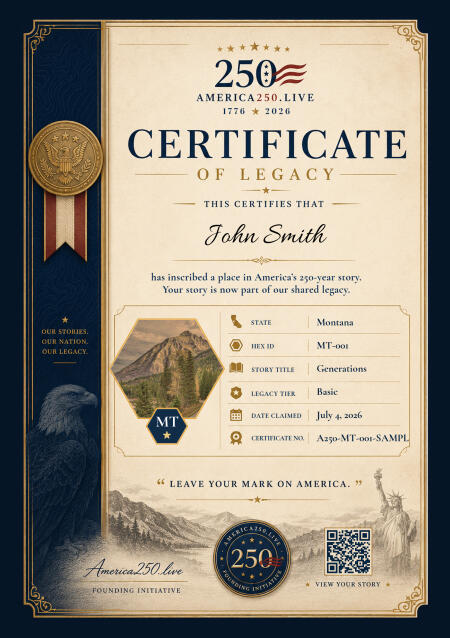
The Story of Montana.
Before Lewis and Clark came through in 1805, before the gold rush pulled fortune-seekers into Alder Gulch and Last Chance Gulch, Montana belonged to the Blackfeet, the Crow, the Assiniboine, the Salish, the Kootenai, and half a dozen other nations who had built their lives around the buffalo and the mountain seasons for thousands of years. The names still mark the land: Missoula, Billings, the Marias River.
Gold made the territory. Copper made it a state. Anaconda’s smelter stack — the tallest masonry structure in the world when it was built — dominated Butte’s skyline and dominated Montana’s politics for most of a century. The Company, as everyone called Anaconda, owned the newspapers, the politicians, and large portions of the sky. Montana became the 41st state in 1889, but the real power in Helena was usually in Butte.
The homestead boom of the early 1900s brought tens of thousands of families to the Hi-Line and the eastern plains, promising 320 acres of dryland wheat country. The drought of the 1910s broke most of them. But the ones who stayed — ranchers, miners, railroaders, and the occasional writer who came for a summer and never left — built a culture as stubborn and spare as the landscape that shaped it. Montana is still arguing about what it is, and that argument is part of what makes it worth claiming.
Lewis and Clark
The Corps of Discovery crosses the Continental Divide at Lemhi Pass and descends into the headwaters country. Clark carves his name on Pompeys Pillar — it’s still there.
Gold at Bannack
The first major gold strike brings thousands of prospectors. Bannack becomes the first territorial capital. Within two years, Virginia City eclipses it.
Little Bighorn
Lt. Colonel Custer’s 7th Cavalry is destroyed by Lakota and Northern Cheyenne warriors led by Sitting Bull and Crazy Horse — the last major Native victory of the Plains Wars.
The 41st Star
Montana enters the Union on November 8th — the same day as North Dakota, South Dakota, and Washington. Four states in a single day, the biggest expansion since the original thirteen.
Glacier National Park
Congress establishes Glacier as a national park, preserving the Crown of the Continent: a million acres of peaks, glaciers, and Going-to-the-Sun Road country.