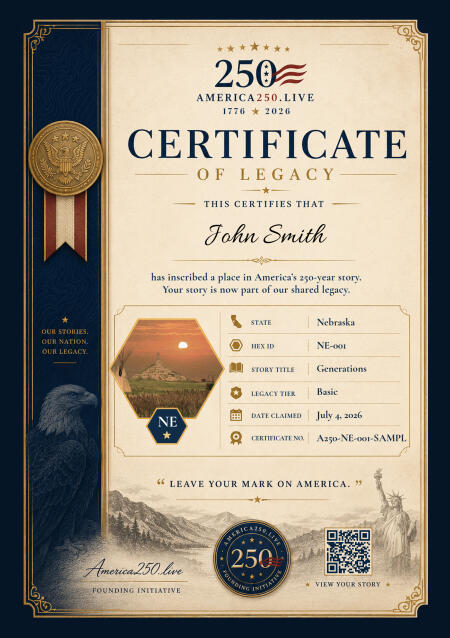
The Story of Nebraska.
The Pawnee, Omaha, Ponca, Otoe-Missouria, and Lakota nations had governed the Platte River valley and the surrounding plains for centuries before Lewis and Clark paddled the Missouri in 1804, cataloguing the land and its peoples with the careful eye of men who knew they were describing something about to change. The Platte River — “too thin to plow, too thick to drink” — was the highway of the Great Plains migration, a shallow, braided stream that emigrants could follow west from the Missouri to the Rockies without losing their way.
The Kansas-Nebraska Act of 1854 opened the territory to settlement and set off the same violence in Kansas that left Nebraska comparatively calm — Nebraska had few slaveholders to argue with. The Homestead Act of 1862 brought the settlers in earnest: 160 free acres to anyone who would live on the land for five years. The first homestead claim in American history was filed on January 1, 1863, in Gage County, Nebraska, by Daniel Freeman, who reportedly persuaded a land office clerk to open at midnight on New Year’s Eve so he could file before shipping out with his Union regiment.
Nebraska became the 37th state on March 1, 1867, two years after the Civil War ended. That same year, the Union Pacific — racing west from Omaha to meet the Central Pacific racing east from Sacramento — was pushing across Nebraska toward the hundredth meridian. The transcontinental railroad, completed in 1869 at Promontory Summit in Utah, began in Omaha, and the Union Pacific headquarters have been there ever since. The cattle drives that followed the railroad up from Texas briefly made Nebraska range country before barbed wire and homesteaders fenced it off.
The Populist movement was born in Nebraska’s farm crisis of the 1880s and 1890s, when falling commodity prices, railroad monopolies, and drought pushed thousands of homesteaders off their land. William Jennings Bryan, from Lincoln, gave his “Cross of Gold” speech in 1896 and ran for president three times on the strength of it. He lost three times. The movement he represented — farmers against railroads, debtors against creditors, the plains against the coasts — never fully won, but it shaped American progressive politics for a generation.
Nebraska today runs on corn, cattle, and a financial industry centered in Omaha that Warren Buffett built into the second-largest investment conglomerate in the world from a modest office on Farnam Street. Every March, half a million sandhill cranes descend on an eighty-mile stretch of the Platte River during their northward migration — the largest concentration of cranes on earth, staging in Nebraska for three weeks before continuing to their Arctic breeding grounds. The Ogallala Aquifer that irrigates the corn belt is depleting. The cranes keep coming anyway.
The Great Migration
The first large wagon train departs Independence, Missouri, following the Platte River Road across Nebraska. Over the next twenty-six years, roughly 400,000 emigrants will follow the same route.
The Homestead Act
Congress passes the Homestead Act. The first claim is filed in Gage County, Nebraska on January 1, 1863, by Daniel Freeman — reportedly at midnight, before shipping out with the Union Army.
The 37th State
Nebraska enters the union on March 1. The Union Pacific is already pushing across the state toward the hundredth meridian, racing the Central Pacific to the middle of the continent.
The Railroad Completes
The transcontinental railroad is finished at Promontory Summit, Utah. The Union Pacific began in Omaha. Its headquarters remain there today.
Arbor Day
J. Sterling Morton of Nebraska City proposes a tree-planting holiday. One million trees are planted in Nebraska on the first Arbor Day. The holiday spreads to every state and eventually every continent.
Cross of Gold
William Jennings Bryan of Lincoln delivers his “Cross of Gold” speech at the Democratic National Convention, winning the nomination. He loses the election — and two more — but defines prairie populism for a generation.
Unicameral Legislature
Nebraska votes to replace its two-chamber legislature with a single nonpartisan unicameral body — the only state in the union to do so, and still the only one.
SAC at Offutt
Strategic Air Command formally establishes its headquarters at Offutt Air Force Base near Omaha, placing the command center for America’s nuclear arsenal in the middle of the Great Plains.
The Bomb Cyclone
A historic bomb cyclone flood inundates a third of Nebraska, killing livestock, destroying grain stores, and causing over $1.4 billion in agricultural losses — the worst natural disaster in state history.