J(
NH-216
New Hampshire was the first colony to establish an independent government, doing so in January 1776 — six months before the Declaration. It was the ninth state to ratify the Constitution, the vote that made the document operational. “Live Free or Die” came from an 1809 toast and stuck. Mt. Washington at 6,288 feet recorded a 231-mile-per-hour wind in 1934 — the worst weather ever measured at the time. Manchester’s Amoskeag mills were the world’s largest. The Granite State holds the first-in-the-nation presidential primary.
New Hampshire’s 10 counties run from 18 miles of Atlantic coastline north through the Lakes Region and White Mountains to the Connecticut Lakes on the Canadian border.
Begin with the territory that calls to you — your homeland, a frontier you love, or simply somewhere your story belongs.
Each hex is a sovereign coordinate. Pick a coastline, a valley, a city block — anywhere on the grid that resonates with your roots or your dream.
A photograph, a paragraph, a name. Your hex becomes a permanent thread in the larger national tapestry — the 250-year-old story of America, continued.
Your inscription becomes a permanent thread in the American story — and a keepsake you can print, frame, and hold.
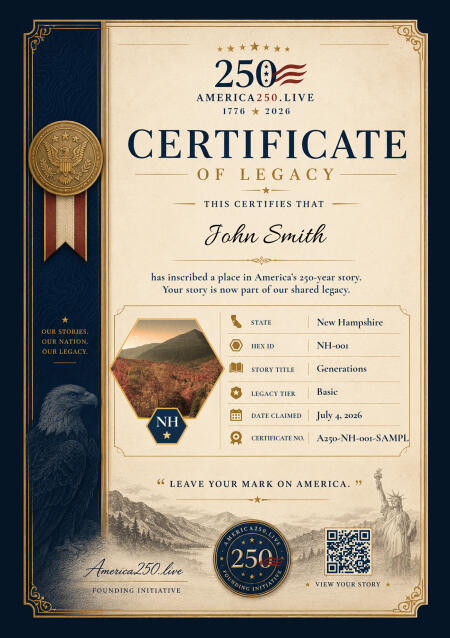
Your Commemorative Certificate
Print it. Frame it. Pass it down.
High-resolution digital certificate, custom to your state, delivered the moment your inscription is complete.
Digital Hex
Living Legacy
Your Inscription
$99 one-time · yours forever
Founder price, held through July 11. $199 afterward — and it stays there.
New Hampshire was among the most combative of the original colonies. Its settlers arrived in the 1620s and immediately began arguing — with Massachusetts over boundaries, with each other over land grants, with the Crown over governance. Portsmouth grew into a prosperous port town on timber and cod, and New Hampshire’s sawmills supplied masts for the Royal Navy. When the Navy tried to monopolize the best white pines, the colonists rioted. The Mast Tree Riot of 1772 was one of the early sparks of colonial fury.
New Hampshire was the first colony to establish an independent government, doing so in January 1776, six months before the Declaration of Independence. Its men fought at Bunker Hill, at Saratoga, at Valley Forge. John Stark, who commanded at the Battle of Bennington, coined the phrase that became the state motto: “Live free or die; death is not the worst of evils.” The full sentence matters as much as the motto.
The 19th century brought the mills. Manchester’s Amoskeag Manufacturing Company became the largest textile complex in the world, its red-brick mill buildings stretching a mile along the Merrimack River. At its peak, Amoskeag employed 17,000 workers and produced enough cloth each year to circle the globe twice. When it closed in 1936, it took the city’s economy with it. Manchester spent decades learning to be something other than a mill town.
Mount Washington loomed over all of it. At 6,288 feet the highest peak in the Northeast, it generates weather so violent that the summit observatory recorded a wind gust of 231 mph in April 1934 — the fastest surface wind speed ever measured at that time. The Cog Railway has climbed it since 1869. The auto road has tempted drivers since 1861. The mountain claims lives every year and humbles everyone who approaches it.
New Hampshire’s modern identity is built on three unusual pillars: the first-in-the-nation presidential primary, which has given it disproportionate national influence since 1920; a fiercely low-tax, libertarian political culture that has resisted a state income tax and sales tax for generations; and a tourism economy anchored in the White Mountains, the Lakes Region, and eighteen miles of Atlantic coastline at Hampton Beach. The Granite State is harder than it looks.
English settlers establish fishing camps at Little Harbor near present-day Rye, among the first European settlements in New England.
New Hampshire colonists riot against British enforcement of the Broad Arrow Policy reserving white pines for the Royal Navy.
New Hampshire adopts its own constitution in January, becoming the first colony to establish an independent government.
New Hampshire ratifies the Constitution on June 21, providing the ninth and deciding vote that puts the document into effect.
Amoskeag Manufacturing Company begins its expansion into the world’s largest textile complex along the Merrimack in Manchester.
The Mount Washington Cog Railway opens, the first mountain-climbing cog railway in the world, still operating today.
The Mount Washington Observatory records a wind gust of 231 mph, the fastest surface wind speed ever measured on earth at that time.
The Amoskeag Manufacturing Company closes after a bitter strike, devastating Manchester’s economy and ending an industrial era.
New Hampshire holds its first modern presidential primary, beginning a tradition of first-in-the-nation influence that shapes every presidential race.
The Old Man of the Mountain, New Hampshire’s iconic rock profile on Cannon Mountain, collapses on May 3, ending a 12,000-year-old landmark.
Real New Hampshire people who have placed their names — and their stories — into the hex grid. Each square mile, a chapter.
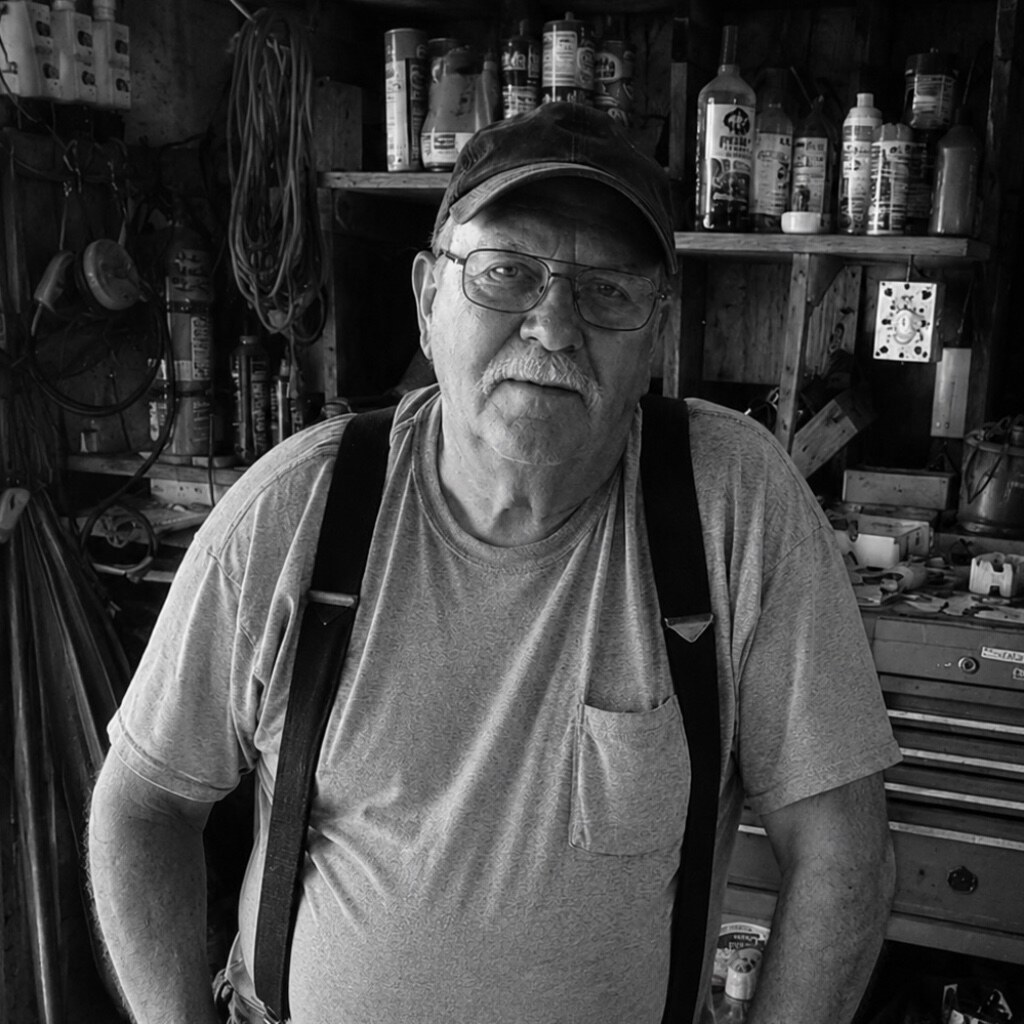
My father was nineteen years old when he landed in Korea in November of 1950. He was a corporal in the Second Infantry Division. He was at t...
View StoryMy grandmother Etta was born in Manchester in 1924 to parents who had come up from Mississippi three years earlier as part of what they used...
View StoryMy family has called New Hampshire home for five generations. My great-great-grandfather Anders arrived from Sweden in 1887 with seventeen d...
View Story
My family has owned a small farm outside Manchester since 1907. Four generations have worked that land — corn, wheat, soybeans, depending on...
View Story
Ten counties from the Connecticut River to the Atlantic. The state with the ninth vote that made the Constitution real, the first primary every four years, the highest wind ever recorded, and a license-plate motto every Granite Stater means. Quarry your granite on the Live Free or Die map.
Reserve your place on the New Hampshire map and receive your personalized Certificate of Legacy — your name, your place, preserved for the next 250 years.
We'll save your progress. We won't share your email.
Appears on the map and on your Certificate of Legacy.
We'll email you a private link to add your story and photo anytime after payment. Add your subtitle, story, and photo below before payment.
Ready · 1024 × 1024
Pick the square that lives on the map
Founder price through July 11. It becomes $199 after — and stays there.
Please accept the terms to proceed with payment.
No account needed — we'll email a secure link after payment.
Your hex is reserved immediately.
★ Limited availability per state ★
Processing
Securing your place on the map…
Check your email to complete your story and finalize your place on the map.
Can't find it? Check your spam or junk folder — and add [email protected] to your contacts so future messages reach your inbox.
Limited availability per state