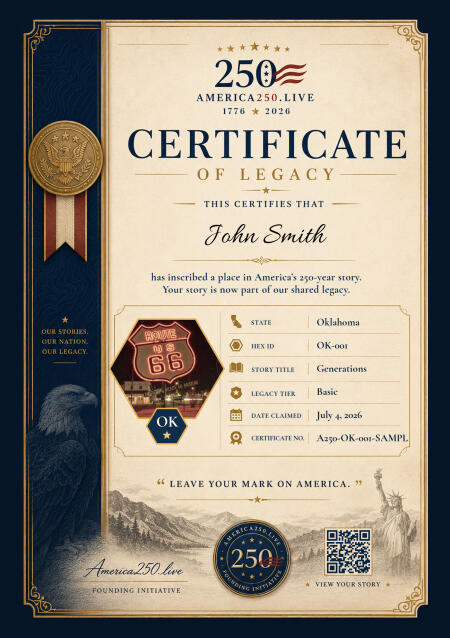
The Story of Oklahoma.
The land that became Oklahoma was home to the Wichita, Caddo, Osage, Comanche, Kiowa, and many other nations before the United States formally organized Indian Territory in the 1830s as a receiving ground for the peoples it was removing from the east. The Five Civilized Tribes — Cherokee, Choctaw, Chickasaw, Creek, and Seminole — were marched here at gunpoint along routes that became known collectively as the Trail of Tears. The Cherokee alone lost an estimated four thousand people on the march. They were promised the land forever.
The promise lasted until oil was found and settlers wanted in. In 1889, the federal government opened the Unassigned Lands — land the government had taken back from the Five Tribes — to homesteaders in a racing land run. At noon on April 22, 50,000 settlers lined up and ran for claims. The “Sooners” who jumped the start and hid in the territory beforehand gave the state its nickname. Six more runs followed, the largest in 1893 when the Cherokee Strip drew 100,000 participants in a single day.
Oklahoma became the 46th state on November 16, 1907 — combining Oklahoma Territory (the settler-dominated west) with Indian Territory (the tribal-governed east) into a single state over the objections of tribal leaders who had proposed a separate Indian state called Sequoyah. The Curtis Act of 1898 had already dissolved tribal governments and allotted communal lands to individuals, making the Five Tribes’ legal defeat almost complete before statehood began.
On June 1, 1921, a white mob attacked the Greenwood District of Tulsa — known as Black Wall Street, the wealthiest Black community in the country. They burned 35 blocks, destroyed 1,256 homes, and killed an estimated 300 people. The massacre was covered up, erased from textbooks, and largely unacknowledged for eighty years. The Oklahoma Commission to Study the Tulsa Race Riot issued its report in 2001. Reparations have not been paid.
The Dust Bowl of the 1930s turned the southern Great Plains into a wasteland of blowing topsoil, the result of a decade of aggressive dry farming on marginal land combined with a severe drought. Hundreds of thousands of Oklahomans — the “Okies” of Steinbeck’s Grapes of Wrath — fled west to California. The state’s population dropped. The land recovered, slowly. The oil economy that had boomed through the 1920s became the state’s permanent economic foundation, punctuated by the 1995 bombing of the Alfred P. Murrah Federal Building in Oklahoma City, which killed 168 people in what was then the deadliest domestic terrorist attack in American history.
The Trail of Tears
The forced removal of the Five Civilized Tribes reaches Indian Territory. The Cherokee alone lose an estimated 4,000 people on the march from Georgia and the Carolinas.
The Land Run
On April 22, 50,000 settlers race for homestead claims in the Unassigned Lands. “Sooners” who sneak in early give the future state its nickname.
The Sequoyah Convention
The Five Tribes propose a separate Indian state called Sequoyah. Congress ignores it and combines Indian Territory with Oklahoma Territory for a single state.
The 46th State
Oklahoma enters the union on November 16, despite tribal opposition. The new constitution includes Jim Crow provisions before the ink is dry.
Tulsa Race Massacre
A white mob destroys the Greenwood District — Black Wall Street — killing an estimated 300 people and burning 35 blocks. The massacre is covered up and erased from textbooks for eighty years.
The Dust Bowl Begins
Drought and over-farming turn the southern plains to dust. Hundreds of thousands of Oklahomans flee west. Steinbeck calls them Okies. California calls them a problem.
Oklahoma City Bombing
Timothy McVeigh detonates a truck bomb at the Alfred P. Murrah Federal Building on April 19. 168 people die, including 19 children. It is the deadliest domestic terrorist attack in US history.
McGirt v. Oklahoma
The Supreme Court rules that eastern Oklahoma — nearly half the state — remains legally the Creek Nation reservation, never properly dissolved. It reshapes criminal jurisdiction across five tribal nations.