
SC-009
My Country
In honor of my grandparents, who fled Vietnam in 1979 and arrived in South Carolina with five children and almost nothing else. My grandfath...
View StoryThe Gullah Geechee of the Sea Islands speak a language and weave a basket whose lineage runs back to Senegal — preserved across three centuries of enslavement on the rice and indigo plantations that built the Low Country. Charleston rose on that labor in 1670 — the oldest city south of Virginia. Fort Sumter sits in its harbor, and the fire it took in 1861 is still echoing. Small, fierce, and never neutral, South Carolina has been making history for four centuries.
South Carolina slopes from the Blue Ridge escarpment in the northwest through the rolling Piedmont to the Fall Line, then spreads across the Coastal Plain to the Grand Strand, the ACE Basin marshes, and the Sea Islands along the Atlantic. Its 46 counties range from mountain to marsh.
Begin with the territory that calls to you — your homeland, a frontier you love, or simply somewhere your story belongs.
Each hex is a sovereign coordinate. Pick a coastline, a valley, a city block — anywhere on the grid that resonates with your roots or your dream.
A photograph, a paragraph, a name. Your hex becomes a permanent thread in the larger national tapestry — the 250-year-old story of America, continued.
Your inscription becomes a permanent thread in the American story — and a keepsake you can print, frame, and hold.
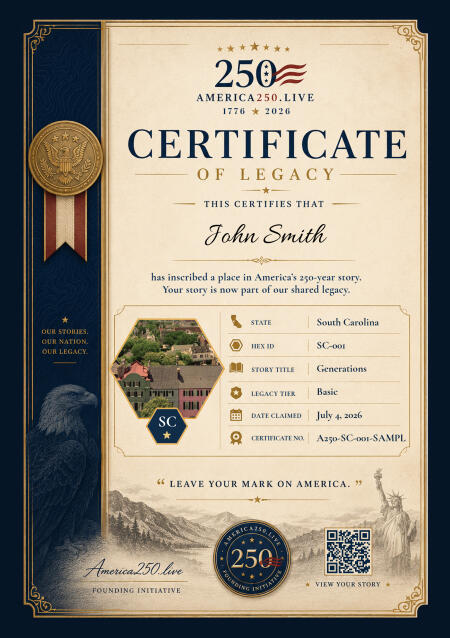
Your Commemorative Certificate
Print it. Frame it. Pass it down.
High-resolution digital certificate, custom to your state, delivered the moment your inscription is complete.
Digital Hex
Living Legacy
Your Inscription
$99 one-time · yours forever
Founder price, held through July 11. $199 afterward — and it stays there.
The Cherokee, Catawba, Yemassee, and dozens of smaller nations inhabited South Carolina’s varied landscapes before Spanish and French explorers arrived in the sixteenth century. The English established Charles Town in 1670 on the Ashley River — moving it to its present peninsula site in 1680 — and it quickly became the wealthiest city in British North America. That wealth was built on rice and indigo grown by enslaved Africans, many of them brought directly from the rice-growing regions of West Africa whose agricultural knowledge made the Low Country plantations possible.
South Carolina ratified the Constitution on May 23, 1788, becoming the eighth state. The plantation economy dominated by a small Low Country elite shaped its politics from the start. John C. Calhoun — vice president under both Adams and Jackson, senator, and nullification theorist — provided the intellectual framework for states’ rights that eventually justified secession. South Carolina called a Nullification Convention in 1832 to declare federal tariffs void within the state, a preview of 1860.
South Carolina was the first state to secede, on December 20, 1860, and Confederate batteries opened fire on Fort Sumter in Charleston Harbor on April 12, 1861. The fort fell after 34 hours of bombardment with no Union deaths — the bloodless beginning of the war that killed more Americans than any other. Sherman’s army burned Columbia to the ground in February 1865, in one of the war’s most controversial acts. Reconstruction produced Black political leadership: Joseph Rainey became the first Black congressman in 1870, and the state’s Reconstruction-era constitution was among the most progressive in the country.
The Gullah Geechee people of the Sea Islands — descendants of enslaved West Africans who developed a distinct language, cuisine, and culture in the relative isolation of the barrier islands — represent one of the most intact African-derived cultural traditions in North America. Their sweetgrass baskets, coiled from coastal grasses in patterns traced directly to Senegal and Sierra Leone, are sold along Highway 17 north of Charleston and displayed in the Smithsonian. The culture faces pressure from rising real estate values on the Sea Islands, but Gullah Geechee activists have won federal recognition and protections.
Modern South Carolina has diversified dramatically. BMW’s first American factory opened in Spartanburg in 1994; Boeing assembles 787 Dreamliners in North Charleston. Myrtle Beach’s Grand Strand draws 14 million visitors a year, more than Yellowstone and Grand Canyon combined. The Charleston tech and medical sectors grow steadily. In 2015, the Emanuel AME Church shooting in Charleston — nine Black parishioners killed during Bible study — and the subsequent removal of the Confederate battle flag from the State Capitol grounds marked a reckoning that reshaped South Carolina’s public identity, even if the deeper work continues.
English colonists establish Charles Town on the Ashley River — the first permanent English settlement in the Carolinas, soon the wealthiest city in British North America.
South Carolina ratifies the Constitution on May 23, becoming the eighth state. Its Low Country planter elite will dominate national politics for the next seventy years.
South Carolina’s legislature declares federal tariffs null and void within the state. President Jackson threatens military force. The crisis is resolved but the logic of secession is now in print.
South Carolina votes to leave the Union on December 20 — the first state to secede. The ordinance passes unanimously in a convention that meets in Columbia, then moves to Charleston when smallpox breaks out.
Confederate batteries open fire on Fort Sumter on April 12. The fort surrenders after 34 hours. No one dies in the bombardment. Over the next four years, 620,000 Americans will die in the war it starts.
Sherman’s army occupies Columbia on February 17. The city burns — whether by Confederate retreating forces, drunken Union soldiers, or accident remains disputed. The State House still bears bronze stars marking where Confederate shells struck it during the occupation.
Joseph Rainey of Georgetown becomes the first Black member of the U.S. House of Representatives, representing South Carolina’s first congressional district during Reconstruction.
BMW opens its first American manufacturing plant in Spartanburg — transforming the Upstate’s economy and beginning South Carolina’s emergence as a major automotive and aerospace manufacturing state.
A white supremacist kills nine Black parishioners during Bible study at Emanuel AME Church in Charleston. Governor Haley signs legislation removing the Confederate battle flag from the State Capitol grounds within weeks.
South Carolina holds its Republican presidential primary — the first in the South every cycle — cementing its outsized influence on the nominating process for both parties.
Real South Carolina people who have placed their names — and their stories — into the hex grid. Each square mile, a chapter.
In honor of my grandparents, who fled Vietnam in 1979 and arrived in South Carolina with five children and almost nothing else. My grandfath...
View Story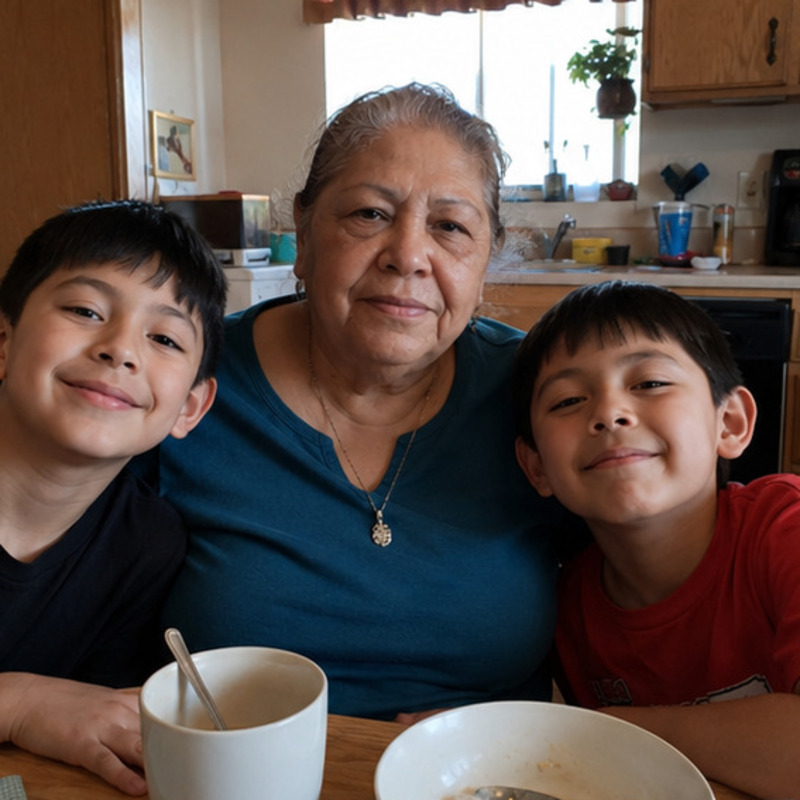
For my wife Elena, who passed in May after fifty-one years of marriage. We met in Charleston in 1973, at a wedding neither of us wanted to a...
View StoryIn September of 1987, my parents put me and my younger brother on a plane in Manila with two suitcases between us and exactly eight hundred....
View StoryIn memory of my sister Sarah, who died in a car accident in 2015 on her way home from work. She was thirty-one. She lived in Charleston her....
View StoryMy grandfather Eladio crossed the border at El Paso in 1944, on a temporary work visa under the Bracero Program. He was twenty-three years o...
View StoryMy great-grandmother Mary was born on a farm outside Charleston in 1903. Her mother was Cherokee — full-blood, born on the Qualla Boundary i...
View Story
From the Blue Ridge escarpment at Sassafras Mountain to the Gullah Sea Islands south of Beaufort, from Charleston Harbor to the BMW plant at Spartanburg — forty-six counties of the state that wove its first language in sweetgrass and has been making history for four centuries. Find your place in it.
Reserve your place on the South Carolina map and receive your personalized Certificate of Legacy — your name, your place, preserved for the next 250 years.
We'll save your progress. We won't share your email.
Appears on the map and on your Certificate of Legacy.
We'll email you a private link to add your story and photo anytime after payment. Add your subtitle, story, and photo below before payment.
Ready · 1024 × 1024
Pick the square that lives on the map
Founder price through July 11. It becomes $199 after — and stays there.
Please accept the terms to proceed with payment.
No account needed — we'll email a secure link after payment.
Your hex is reserved immediately.
★ Limited availability per state ★
Processing
Securing your place on the map…
Check your email to complete your story and finalize your place on the map.
Can't find it? Check your spam or junk folder — and add [email protected] to your contacts so future messages reach your inbox.
Limited availability per state