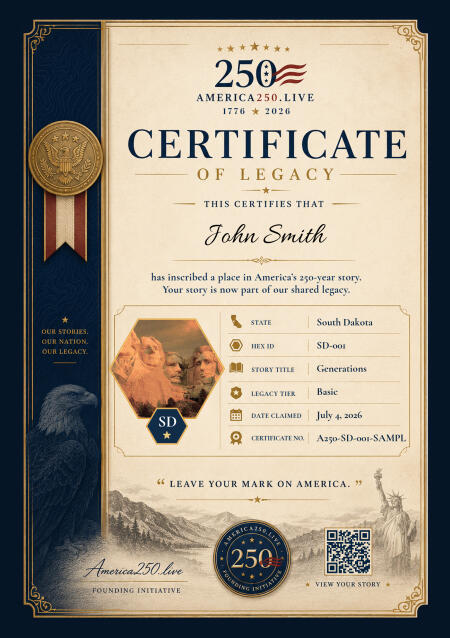
The Story of South Dakota.
The Oceti Sakowin — the Seven Council Fires of the Lakota, Dakota, and Nakota peoples — had lived across the northern plains for centuries, following the buffalo herds and governing through a sophisticated confederacy that European observers struggled to understand because they were looking for a king. The Missouri River was the spine of their world. The Black Hills — Paha Sapa — were sacred ground, used for ceremony and vision quests, not for habitation. Lewis and Clark traveled the Missouri through what is now South Dakota in 1804, encountering the Teton Sioux with enough tension that their journals read as the opening chapter of a long conflict.
The Fort Laramie Treaty of 1868 guaranteed the Great Sioux Reservation — including the Black Hills — to the Lakota “for as long as the grass shall grow and the rivers flow.” Six years later, General Custer led an expedition into the Black Hills and his geologists found gold. The rush that followed brought thousands of miners into territory the United States had promised to keep clear. By 1877, Congress had taken the Black Hills. The Supreme Court ruled in 1980 that the taking was unconstitutional. The Lakota refused the settlement. The money sits in trust. The land question remains open.
The decade of 1889 was violent and decisive. South and North Dakota entered the union on the same day, November 2, 1889 — President Harrison shuffled the papers so no one would know which was signed first. The following year, on December 29, 1890, the 7th Cavalry massacred an estimated 250 to 300 Lakota men, women, and children at Wounded Knee Creek in the Pine Ridge Reservation. Chief Sitting Bull had been killed by Indian police ten days earlier at Standing Rock. The Ghost Dance movement that triggered both events was a spiritual response to dispossession — a prayer for the old world to return.
Homesteaders flooded the eastern prairies after statehood, and the 20th century brought drought, the Dust Bowl, and the slow depopulation of the Great Plains. Gutzon Borglum began carving Mount Rushmore in 1927 — a monument to four presidents on land the Lakota had never stopped claiming. The Crazy Horse Memorial, begun by Korczak Ziolkowski in 1948 on a nearby mountain at the invitation of Lakota leaders, is still being carved by his family and has become larger than Rushmore without yet revealing the full face.
South Dakota today is the most overtly contradictory state in the Great Plains: home to the wealthiest corporate trust industry in the country (favorable laws draw trillions in assets to Sioux Falls), the Sturgis Motorcycle Rally that brings half a million riders every August, and the Pine Ridge Reservation — one of the poorest places in the United States, where unemployment runs above 80% and life expectancy is among the lowest in the Western Hemisphere. These facts coexist within 77,000 square miles without resolving each other.
Fort Laramie Treaty
The US guarantees the Great Sioux Reservation — including the Black Hills — to the Lakota “for as long as the grass shall grow.” The treaty lasts six years before gold is found.
Gold in the Black Hills
General Custer’s expedition finds gold in the Black Hills. Thousands of miners flood treaty land. The US demands the Hills. The Lakota refuse to sell. Congress takes them anyway in 1877.
Deadwood
Wild Bill Hickok is shot in the back of the head at a poker table in Deadwood on August 2, holding aces and eights — forever after called the Dead Man’s Hand.
Two States, One Day
South and North Dakota both enter the union on November 2. President Harrison shuffles the papers signing them so no one will ever know which came first.
Wounded Knee
The 7th Cavalry kills an estimated 250 to 300 Lakota men, women, and children at Wounded Knee Creek on December 29. The last major armed confrontation of the Indian Wars.
Mount Rushmore Begins
Sculptor Gutzon Borglum begins carving four presidents into a Black Hills granite face. The Lakota call it a desecration of sacred land. It takes fourteen years and 400 workers.
Crazy Horse Memorial
Korczak Ziolkowski begins carving Crazy Horse into a nearby mountain at the invitation of Lakota leaders. His family continues the work. It is still not finished. It will be larger than Rushmore.
Wounded Knee Occupation
Members of the American Indian Movement occupy Wounded Knee for 71 days in protest of tribal government corruption and broken treaties. Two occupiers are killed. The standoff ends without resolution.
The Award Refused
The Supreme Court awards the Sioux Nation $106 million for the illegal taking of the Black Hills. The tribes refuse. “The Black Hills are not for sale.” The money sits in trust, now over $1 billion.