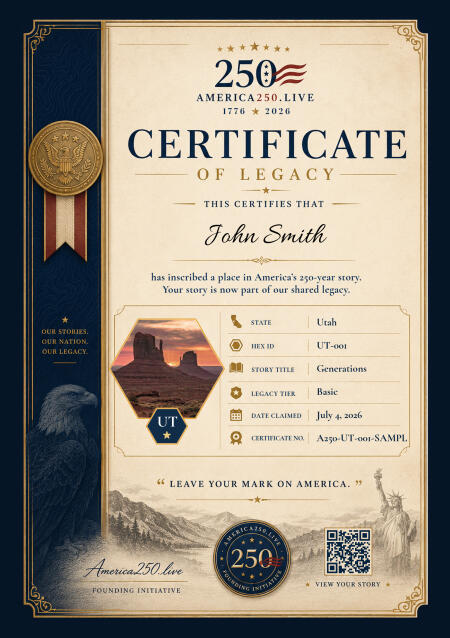
The Story of Utah.
The Ancestral Puebloans built cliff dwellings in the canyon country a thousand years before the first European arrived. The Fremont culture left petroglyphs across the rock faces of the Colorado Plateau. The Ute, Southern Paiute, Goshute, and Navajo nations held this landscape with a detailed knowledge of its water sources, seasonal routes, and resources that no map has ever fully captured. The Spanish explored it in 1776, looking for a route between Santa Fe and Monterey. They found the landscape formidable and moved on.
In July 1847, Brigham Young crested Emigration Canyon, looked across the valley of the Great Salt Lake, and said — according to tradition — “This is the place.” The Mormon pioneers who followed him were refugees from a nation that had driven them west through Ohio, Missouri, and Illinois, burning their settlements behind them. They intended to build Zion outside American jurisdiction. Within two years the Mexican Cession put them squarely back inside it. The tension between the LDS Church’s theocratic ambitions and the federal government’s authority would define Utah’s next fifty years.
The Utah War of 1857 sent a federal army marching toward Salt Lake City. The Mountain Meadows Massacre that same year — in which Mormon militiamen and Paiute allies killed 120 California-bound emigrants — remained one of the darkest unresolved chapters in the state’s history for generations. Congress created a territorial government that never quite governed, and the fight over polygamy lasted four decades. The LDS Church officially abandoned the practice in 1890, clearing the way for statehood. Utah entered the union on January 4, 1896, the 45th state.
The transcontinental railroad had already crossed the northern edge of the territory in 1869, the Golden Spike driven at Promontory Summit on May 10 in a ceremony that connected two oceans. The railroad brought miners, merchants, and non-Mormon settlers who created an entirely separate economy alongside the LDS communities. Copper mining at Bingham Canyon — which eventually became the largest open-pit mine in the world — provided the economic engine that diversified the state beyond agriculture.
Modern Utah is one of the most paradoxical states in the country: deeply conservative in its politics and culture, among the fastest-growing in population, and home to some of the most dramatic landscapes on earth that draw millions of visitors a year. The Silicon Slopes tech corridor between Salt Lake City and Provo has produced a cluster of billion-dollar companies. The Great Salt Lake has been shrinking for decades — its level dropping fourteen feet since 1980 — in a slow-motion crisis that threatens the ecology, the economy, and the air quality of the entire Wasatch Front.
This Is the Place
Brigham Young leads 148 Mormon pioneers into the Salt Lake Valley on July 24. They are refugees who have been driven west from four states. They intend to build a city in the desert outside American reach.
Mountain Meadows
Mormon militiamen and Paiute allies massacre 120 Arkansas emigrants at Mountain Meadows in southern Utah. It is the darkest episode in the state’s history and took 150 years to begin fully acknowledging.
The Golden Spike
The transcontinental railroad is completed at Promontory Summit on May 10. Leland Stanford drives the ceremonial last spike. The continent is connected for the first time.
The Manifesto
LDS Church President Wilford Woodruff issues the Manifesto officially ending polygamy. Congress had confiscated Church property. The deal opens the path to statehood.
The 45th State
Utah enters the union on January 4. After forty-six years as a territory and six rejected statehood applications, it is the last of the contiguous western states to join.
Bingham Canyon Mine
Open-pit copper mining begins at Bingham Canyon. Over a century it becomes the largest excavation in human history — a mile and a half wide, half a mile deep, visible from space.
Glen Canyon Dam
The dam is completed, flooding 186 miles of canyon and creating Lake Powell. Conservationists call it the greatest act of environmental destruction in US history. The debate never ends.
Winter Olympics
Salt Lake City hosts the Winter Olympics, the first in the American West. The games survive a bribery scandal and introduce Utah’s mountains to a global audience that has been booking ski trips ever since.
The Lake Recedes
Great Salt Lake reaches its lowest recorded level — a crisis declared by scientists. The exposed lakebed releases arsenic dust into the air of Salt Lake City. The state begins emergency water conservation measures.