B
WI-231
Featured
The Ho-Chunk, Ojibwe, Menominee, Potawatomi, and Dakota nations inhabited Wisconsin for millennia before Jean Nicolet stepped ashore in 1634. Statehood came in 1848 and German and Scandinavian immigrants poured in with dairy techniques from the old country. Robert La Follette built the Progressive Era out of Madison — direct primaries, workers’ compensation, the Wisconsin Idea. Frank Lloyd Wright was born in Richland Center in 1867 and built Taliesin near Spring Green. Aldo Leopold wrote A Sand County Almanac from a worn-out Sauk County farm. The Packers belong to their fans.
Wisconsin runs from the Lake Michigan shore in the east through the rolling dairy country of the Driftless Area in the west to the pine and birch lake country of the North Woods. Lake Superior borders the north, the Mississippi River the west. Its 72 counties cover every terrain from glacial drumlin fields to sandstone bluffs.
Begin with the territory that calls to you — your homeland, a frontier you love, or simply somewhere your story belongs.
Each hex is a sovereign coordinate. Pick a coastline, a valley, a city block — anywhere on the grid that resonates with your roots or your dream.
A photograph, a paragraph, a name. Your hex becomes a permanent thread in the larger national tapestry — the 250-year-old story of America, continued.
Your inscription becomes a permanent thread in the American story — and a keepsake you can print, frame, and hold.
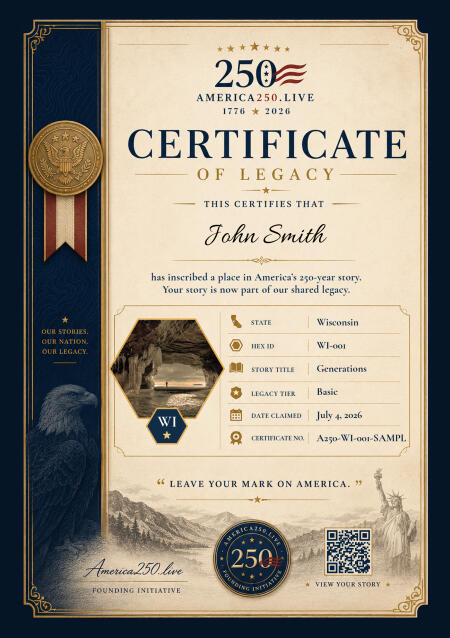
Your Commemorative Certificate
Print it. Frame it. Pass it down.
High-resolution digital certificate, custom to your state, delivered the moment your inscription is complete.
Digital Hex
Living Legacy
Your Inscription
$99 one-time · yours forever
Founder price, held through July 11. $199 afterward — and it stays there.
The Ho-Chunk (Winnebago), Ojibwe, Menominee, Potawatomi, and Dakota nations inhabited Wisconsin’s lakes, forests, and prairies for millennia before French explorers Jean Nicolet arrived at Green Bay in 1634. The fur trade dominated the region for two centuries — Wisconsin’s rivers and lakes made it one of the richest beaver-trapping grounds on the continent. Lead mining in the southwest brought a rush of settlers in the 1820s and 1830s; the miners who burrowed into hillsides for shelter gave Wisconsin its “Badger State” nickname.
Wisconsin entered the Union on May 29, 1848 as the thirtieth state. German and Scandinavian immigrants poured in during the 1850s and 1860s, bringing dairy farming techniques from Europe to the glacially shaped landscape that proved ideal for grassland and milk production. Milwaukee grew as a brewing capital — Pabst, Schlitz, Miller, and Blatz all operated major breweries — and as an industrial center on Lake Michigan. The Republican Party was founded in Ripon, Wisconsin in 1854 by anti-slavery Whigs, Free Soilers, and Democrats who could no longer stomach the Kansas-Nebraska Act.
The Progressive Era found its fullest expression in Wisconsin under Governor Robert “Fighting Bob” La Follette, who served from 1901 to 1906 and then as senator until 1925. La Follette’s Wisconsin Idea held that state government should draw on university expertise to solve social problems. Wisconsin pioneered the direct primary, workers’ compensation, railroad regulation, and income tax — reforms that spread to every other state and eventually the federal government. La Follette ran for president as a Progressive Party candidate in 1924 and won 17% of the popular vote, the best third-party presidential showing of the twentieth century.
Frank Lloyd Wright was born in Richland Center in 1867 and returned to Wisconsin to build Taliesin near Spring Green — his home, studio, and school for apprentice architects — after a scandal ended his first Chicago chapter. The Driftless Area’s limestone bluffs and river valleys became the landscape he returned to again and again, and the horizontal Prairie Style he developed there became the most influential American architectural movement of the twentieth century. Taliesin survived two fires and a triple murder and still operates today as an architecture school.
The Green Bay Packers, founded in 1919 and owned by their community of shareholders since 1923, are the only publicly owned major professional sports franchise in American history. Lambeau Field in Green Bay — where temperatures regularly drop below zero on January game days — has sold out every home game since 1960. Wisconsin’s dairy industry remains enormous: the state produces more cheese than any other and roughly a quarter of all American cheese. The Friday night fish fry — a Catholic Lenten tradition that became universal — is as close to a state religion as Wisconsin has.
Jean Nicolet lands at Green Bay wearing a Chinese damask robe — he believed he was arriving in Asia. Instead he finds the Ho-Chunk nation and the beginning of the French fur trade in the Great Lakes.
Wisconsin enters the Union on May 29 as the thirtieth state. German and Scandinavian immigrants are already pouring in, bringing dairy expertise that will transform the glacial landscape into America’s cheese bowl.
Anti-slavery activists meet in a Ripon schoolhouse on March 20 and form the Republican Party. Within six years their candidate, Abraham Lincoln, is president.
The Peshtigo fire kills an estimated 1,500 people in northeast Wisconsin on October 8 — the same night as the Great Chicago Fire. It is the deadliest wildfire in American history, largely forgotten because Chicago’s fire captured the headlines.
Robert “Fighting Bob” La Follette begins six years as governor, implementing the Wisconsin Idea: direct primaries, railroad regulation, workers’ comp, and income tax — a template for the Progressive Era nationwide.
Wisconsin’s workers’ compensation law — the first in the nation, passed in 1911 — becomes the model for labor protections nationwide, eventually covering every American worker.
Curly Lambeau founds the Green Bay Packers with $500 from the Indian Packing Company. The team becomes community-owned in 1923 — the only publicly owned major professional sports franchise in America.
Frank Lloyd Wright’s Guggenheim Museum opens in New York — the capstone of a career rooted in Wisconsin’s Driftless landscape. Wright dies six months later at 91, still working.
The NFL Championship Game between Green Bay and Dallas is played at Lambeau Field on December 31 in minus-13-degree temperatures. Bart Starr scores the winning touchdown. The game defines Green Bay football forever.
Tens of thousands of workers occupy the Wisconsin State Capitol to protest Governor Walker’s legislation eliminating collective bargaining rights for most public employees — the largest statehouse protest since the Vietnam era.
Real Wisconsin people who have placed their names — and their stories — into the hex grid. Each square mile, a chapter.
Seventy-two counties from Lake Superior to the Mississippi, Driftless bluffs to North Woods lake country. The state that built American conservation ethics at Aldo Leopold’s farm, drafted American architecture at Taliesin, and never sold the Packers to anyone but their fans. Carve your plan on the Badger State map.
Reserve your place on the Wisconsin map and receive your personalized Certificate of Legacy — your name, your place, preserved for the next 250 years.
We'll save your progress. We won't share your email.
Appears on the map and on your Certificate of Legacy.
We'll email you a private link to add your story and photo anytime after payment. Add your subtitle, story, and photo below before payment.
Ready · 1024 × 1024
Pick the square that lives on the map
Founder price through July 11. It becomes $199 after — and stays there.
Please accept the terms to proceed with payment.
No account needed — we'll email a secure link after payment.
Your hex is reserved immediately.
★ Limited availability per state ★
Processing
Securing your place on the map…
Check your email to complete your story and finalize your place on the map.
Can't find it? Check your spam or junk folder — and add [email protected] to your contacts so future messages reach your inbox.
Limited availability per state