JH
LA-019
Featured
In 1803 Napoleon sold Louisiana to the United States for three cents an acre — 828,000 square miles, doubling the country in a single transaction. The first capital under American flag was New Orleans, founded in 1718 on a crescent bend the engineers had advised against. Jazz was born in Congo Square. P.B.S. Pinchback was the country’s first Black governor, in 1872. The state still counts land in parishes, runs on Napoleonic Code, and remembers what the levees couldn’t hold in 2005.
Louisiana slopes from its northern uplands — the Kisatchie hills and the Red River valley — down through the pine belt and the Atchafalaya basin to the Gulf Coast marshes and the bird-foot delta. Its 64 parishes span every ecosystem from longleaf pine savanna to open water.
Begin with the territory that calls to you — your homeland, a frontier you love, or simply somewhere your story belongs.
Each hex is a sovereign coordinate. Pick a coastline, a valley, a city block — anywhere on the grid that resonates with your roots or your dream.
A photograph, a paragraph, a name. Your hex becomes a permanent thread in the larger national tapestry — the 250-year-old story of America, continued.
Your inscription becomes a permanent thread in the American story — and a keepsake you can print, frame, and hold.
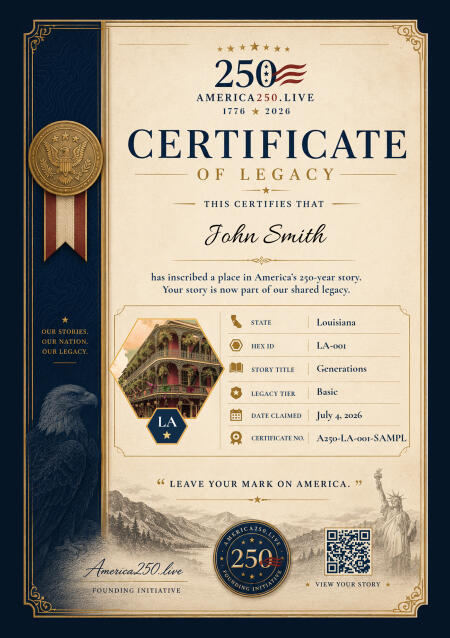
Your Commemorative Certificate
Print it. Frame it. Pass it down.
High-resolution digital certificate, custom to your state, delivered the moment your inscription is complete.
Digital Hex
Living Legacy
Your Inscription
$99 one-time · yours forever
Founder price, held through July 11. $199 afterward — and it stays there.
The Mississippi Delta was home to the Caddo, Natchez, Chitimacha, Tunica, Atakapa, and dozens of other nations for thousands of years before Europeans arrived. The Natchez people built temple mounds along the river; the Chitimacha wove the finest baskets in North America. Robert de La Salle claimed the entire Mississippi watershed for France in 1682, naming it Louisiana for King Louis XIV — a claim so vast it covered a third of the continent.
New Orleans was founded in 1718 by Jean-Baptiste Le Moyne de Bienville on a crescent bend of the Mississippi — a location engineers advised against and that flooded regularly, but that controlled access to the entire continental interior. France ceded Louisiana to Spain in 1762, Spain returned it to France in 1800, and Napoleon sold it to the United States in 1803. Through all these sovereignties, New Orleans absorbed French, Spanish, African, Caribbean, and eventually American cultures into a Creole identity unlike anything else in North America.
Louisiana entered the Union on April 30, 1812 as the eighteenth state — the first carved from the Louisiana Purchase. Its legal system was based on French and Spanish civil law rather than English common law, a distinction that survives in Louisiana’s Napoleonic Code today. The plantation system built on enslaved labor made the lower Mississippi one of the wealthiest regions in the antebellum world; New Orleans was the largest slave market in North America. Sugar and cotton made fortunes that built the Garden District mansions still standing today.
Reconstruction briefly produced Black political leadership unprecedented in the South — Louisiana had the first Black governor of any U.S. state, P.B.S. Pinchback, in 1872. But Reconstruction’s violent end produced decades of Jim Crow severity. Huey Long upended the old planter oligarchy in 1928, building roads, schools, and hospitals while governing as a populist strongman. His assassination in 1935 left a political style — colorful, corrupt, and surprisingly effective for the poor — that Louisiana politics has never fully abandoned.
Hurricane Katrina made landfall on August 29, 2005, breaching the levees that protected New Orleans and flooding 80% of the city. Over 1,800 people died; hundreds of thousands were displaced. The recovery was uneven — wealthy neighborhoods came back faster, poorer ones were cleared and not rebuilt. Today Louisiana contends with some of the fastest land loss on earth: the coastal marshes that buffer the state from storms are disappearing at the rate of a football field every 100 minutes, a slow-motion catastrophe that threatens the very ground the state stands on.
René-Robert Cavelier de La Salle paddles to the mouth of the Mississippi and claims the entire watershed for France — roughly a third of the North American continent — naming it Louisiana for Louis XIV.
Bienville establishes New Orleans on a crescent bend of the Mississippi, ignoring engineers who warned the site was unbuildalbe. Within decades it controls the trade of a continent.
France secretly cedes Louisiana to Spain in the Treaty of Fontainebleau. The Spanish govern for 38 years, leaving their architecture in the French Quarter — the “French” Quarter is actually mostly Spanish Colonial.
Napoleon, needing cash after Haiti’s revolution ended his New World dreams, sells Louisiana to the United States for $15 million. Jefferson doubles the size of the country overnight.
Louisiana enters the Union on April 30 as the eighteenth state — the first from the Louisiana Purchase territory, and the only one with a Napoleonic Code legal system.
Andrew Jackson’s motley army of regulars, pirates, free Black soldiers, and frontier riflemen defeats a British invasion force at Chalmette. The war is already over — the news just hasn’t arrived yet.
P.B.S. Pinchback becomes acting governor of Louisiana — the first Black governor in U.S. history. He serves 35 days before Reconstruction’s enemies remove him.
Oil is discovered in the Louisiana-Texas border region; within a generation, offshore drilling in the Gulf of Mexico makes Louisiana one of the nation’s top energy producers.
Huey Long wins the governorship on a Share Our Wealth platform, builds roads, schools, and LSU’s medical school, and dominates Louisiana politics as a populist autocrat until his assassination in 1935.
Katrina breaches New Orleans’s levees on August 29, flooding 80% of the city. Over 1,800 die. The storm reveals decades of deferred infrastructure investment and unequal recovery that define the city’s next twenty years.
Real Louisiana people who have placed their names — and their stories — into the hex grid. Each square mile, a chapter.
For Pop. Sweetest dad in Louisiana. Gone five years now and I still hear his laugh in the kitchen every Sunday morning.
View StoryMy grandfather came to Louisiana in 1953 with nothing but a suitcase and a job offer at the steel mill in New Orleans. He worked there for f...
View Story
My daughter Emma was born on October 14, 2014, at thirty-one weeks gestation, weighing two pounds and eleven ounces. She was diagnosed in th...
View StoryIn honor of my grandparents, who fled Vietnam in 1979 and arrived in Louisiana with five children and almost nothing else. My grandfather wo...
View StoryIn September of 1987, my parents put me and my younger brother on a plane in Manila with two suitcases between us and exactly eight hundred....
View Story
From the jazz clubs of the French Quarter to the cypress swamps of the Atchafalaya, from Tabasco at Avery Island to the brass bands of the Tremé — sixty-four parishes of the state that runs on Napoleonic Code and remembers everything the river has carried. Laissez les bons temps rouler.
Reserve your place on the Louisiana map and receive your personalized Certificate of Legacy — your name, your place, preserved for the next 250 years.
We'll save your progress. We won't share your email.
Appears on the map and on your Certificate of Legacy.
We'll email you a private link to add your story and photo anytime after payment. Add your subtitle, story, and photo below before payment.
Ready · 1024 × 1024
Pick the square that lives on the map
Founder price through July 11. It becomes $199 after — and stays there.
Please accept the terms to proceed with payment.
No account needed — we'll email a secure link after payment.
Your hex is reserved immediately.
★ Limited availability per state ★
Processing
Securing your place on the map…
Check your email to complete your story and finalize your place on the map.
Can't find it? Check your spam or junk folder — and add [email protected] to your contacts so future messages reach your inbox.
Limited availability per state