America / States / Michigan
26th State · Est. 1837

Michigan.
The Great
Lakes State.

The Ojibwe, Odawa, and Potawatomi — the Council of Three Fires — held Michigan’s lakeshores for centuries before the French built fur posts on the straits. Statehood came in 1837. Henry Ford opened Highland Park in 1910 and dropped the Model T’s build time from twelve hours to ninety-three minutes. Motown was recorded in a Detroit basement on Hitsville USA. Detroit’s 1967 unrest and the slow auto-industry collapse remade the city. Michigan touches more freshwater coastline than any state and is rebuilding itself again.

97k
Square Miles
10.0M
Population
1837
Statehood
The Living Map

Find Your Place
on the Map.

Michigan’s Lower Peninsula — shaped like a mitten — sits between Lakes Michigan, Huron, and Erie. The Upper Peninsula stretches west from the Straits of Mackinac to Lake Superior, connected to the Lower by the Mackinac Bridge. Its 83 counties span both peninsulas across terrain from sand dunes to copper mines.

Michigan · Live Grid
MI · Hex 0 · 0 Open · 0 Inscribed
N MI
MI-000 Open
Open Featured Inscribed Click any hex to inspect
How It Works

Three steps to your hex.

01

Choose a state

Begin with the territory that calls to you — your homeland, a frontier you love, or simply somewhere your story belongs.

02

Select a hex

Each hex is a sovereign coordinate. Pick a coastline, a valley, a city block — anywhere on the grid that resonates with your roots or your dream.

03

Add your story

A photograph, a paragraph, a name. Your hex becomes a permanent thread in the larger national tapestry — the 250-year-old story of America, continued.

What You Receive

More than a hex.
A piece of history.

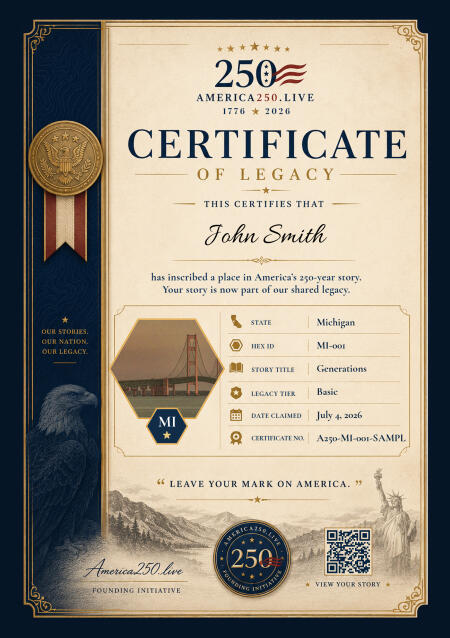
Your inscription becomes a permanent thread in the American story — and a keepsake you can print, frame, and hold.

Sample America 250 commemorative certificate for Michigan

Your Commemorative Certificate

Print it. Frame it. Pass it down.

High-resolution digital certificate, custom to your state, delivered the moment your inscription is complete.

Digital Hex

Forever on the Map

  • Your coordinate, permanently marked on the Michigan map
  • Your name, your story, your photo — exactly as you choose
  • A shareable link to send family or post anywhere
  • Preserved on america250.live for the next 250 years

Living Legacy

Part of America's Story

  • A verified entry in the 250th anniversary digital memorial
  • Your story woven into Michigan's permanent record
  • Discoverable by anyone exploring America's history
  • A coordinate your children — and theirs — can return to

Your Inscription

$99 one-time · yours forever

Founder price, held through July 11. $199 afterward — and it stays there.

One-time inscription No subscription, ever Certificate delivered instantly Yours for 250 years
Michigan surrounded by the Great Lakes holds more freshwater coastline than any other state — and in the twentieth century turned that geography into the industrial engine that won two world wars and put a car in every American driveway.

The Arsenal of Democracy and the Great Lakes Shore

The Ojibwe, Odawa, Potawatomi, Menominee, and other Anishinaabe nations inhabited Michigan’s lakeshores and forests for centuries, united in the Council of Three Fires. French explorer Étienne Brûlé reached the Sault Ste. Marie straits around 1620, and Father Jacques Marquette founded a mission there in 1668 — the first permanent European settlement in Michigan and one of the oldest in the Great Lakes. The straits connecting Lake Superior to the lower lakes made Michigan the pivot of the entire Great Lakes fur trade network.

Michigan became the twenty-sixth state on January 26, 1837. The opening of the Erie Canal in 1825 made Michigan accessible, and settlers poured in from New England and New York, bringing Yankee culture and abolitionist politics. Michigan was a crucial stop on the Underground Railroad — its long border with Canada via the Detroit River and Lake Erie gave freedom seekers a clear path to safety. Detroit became a major industrial city in the late nineteenth century, processing copper from the Upper Peninsula and manufacturing railroad cars, ships, and stoves.

Henry Ford opened his Highland Park plant in 1910 and introduced the moving assembly line in 1913 — dropping the time to build a Model T from 12 hours to 93 minutes and cutting the price from $850 to $300. The result transformed not just transportation but the entire structure of American industrial life: the $5 workday Ford instituted in 1914 created the consumer economy that the assembly line was producing goods for. By the 1920s Detroit was the fourth-largest city in America and the most important industrial city on earth. The Big Three — Ford, General Motors, and Chrysler — all operated from southeast Michigan.

During World War II, Michigan’s factories converted to war production with remarkable speed. The Willow Run plant, built by Ford in 43 days in 1941, eventually produced one B-24 Liberator bomber per hour. Detroit became known as the “Arsenal of Democracy.” The Great Migration brought hundreds of thousands of Black Southerners to work in the auto plants, transforming Detroit’s demographics and culture. Berry Gordy founded Motown Records in a Detroit row house in 1959 and produced the soundtrack of the 1960s: the Supremes, Stevie Wonder, Marvin Gaye, the Temptations, and the Four Tops all recorded on Hitsville U.S.A.’s cramped Studio A.

Detroit’s decline after the 1967 riot and the loss of automotive jobs to automation and foreign competition produced one of the most dramatic urban collapses in American history. The population fell from 1.8 million in 1950 to under 700,000 today. The city filed for bankruptcy in 2013 — the largest municipal bankruptcy in American history. But Detroit has also shown remarkable resilience: the downtown has been substantially rebuilt, the auto industry recovered from its 2009 federal bailout, and a generation of artists, entrepreneurs, and urban farmers have repopulated neighborhoods that were vacant for thirty years. Michigan remains the Great Lakes State — surrounded by more fresh water than any other place on earth, and still finding its way back to what that means.
1668

Sault Ste. Marie Founded

Father Jacques Marquette establishes a mission at Sault Ste. Marie — Michigan’s first permanent European settlement and one of the oldest cities in the Great Lakes region.

1837

Statehood

Michigan enters the Union on January 26 as the twenty-sixth state, after a border dispute with Ohio — the “Toledo War” — is resolved by giving Michigan the Upper Peninsula as compensation.

1844

Copper Rush

The first major American mineral rush begins in the Upper Peninsula’s Keweenaw Peninsula, where native copper deposits were mined for millennia by Native Americans and now draw speculators from across the country.

1913

Moving Assembly Line

Henry Ford introduces the moving assembly line at Highland Park, dropping Model T production time from 12 hours to 93 minutes. The industrial world is transformed overnight.

1935

UAW Founded

The United Auto Workers union is founded in Detroit. The 1937 Flint Sit-Down Strike forces General Motors to recognize the UAW — one of the most significant labor victories in American history.

1942

Arsenal of Democracy

Ford’s Willow Run plant produces one B-24 Liberator bomber per hour at its peak. Michigan’s factories outproduce the entire Axis powers in military hardware.

1959

Motown Founded

Berry Gordy borrows $800 and founds Motown Records at 2648 West Grand Boulevard in Detroit. Within five years he has the Supremes, Stevie Wonder, Marvin Gaye, and the Temptations recording in Studio A.

1967

Detroit Uprising

Five days of civil unrest in Detroit leave 43 dead and 2,000 buildings burned. The uprising accelerates white flight and deindustrialization, beginning Detroit’s long decline.

1957

Mackinac Bridge Opens

The Mackinac Bridge opens on November 1 — at 26,372 feet the longest suspension bridge in the Western Hemisphere, connecting the two peninsulas that had been linked only by ferry.

2013

Detroit Bankruptcy

Detroit files for Chapter 9 bankruptcy — the largest municipal bankruptcy in American history, with $18 billion in debt. The city emerges from bankruptcy in 2014 and begins a slow, uneven revival.

Stories on the Map

Stories already on the map.

Real Michigan people who have placed their names — and their stories — into the hex grid. Each square mile, a chapter.

Browse the map
Sean Connor
MI-216
Featured

Jackson County, Birthplace of the Republican Party

Jackson County, MI – Birthplace of the Republican Party Under the Oaks. Honoring liberty’s roots while building a stronger future for my son...

View Story
JF
MI-190
Featured

Shelby Township (Charter)

A place on the map. The story is yet to come.

View Story
By the Numbers

Michigan, in facts.

Counties
83
spanning two peninsulas and four Great Lakes shorelines
Freshwater Coast
3,288 miles
more Great Lakes shoreline than any other state
Mackinac Bridge
26,372 ft
longest suspension bridge in the Western Hemisphere
Statehood
Jan 26, 1837
26th state admitted to the Union
Highest Point
1,979 ft
Mount Arvon — in the Upper Peninsula’s Baraga County
Share Michigan
Your Corner of the Great Lakes State

Michigan’s 83 Counties. Your One Hex.

Eighty-three counties across two peninsulas, four Great Lakes, and the longest suspension bridge in the Western Hemisphere. From Hitsville USA in Detroit to the copper mines of the Keweenaw, from the Sleeping Bear Dunes to the Mackinac straits — Michigan built the modern American century. Drop your anchor.