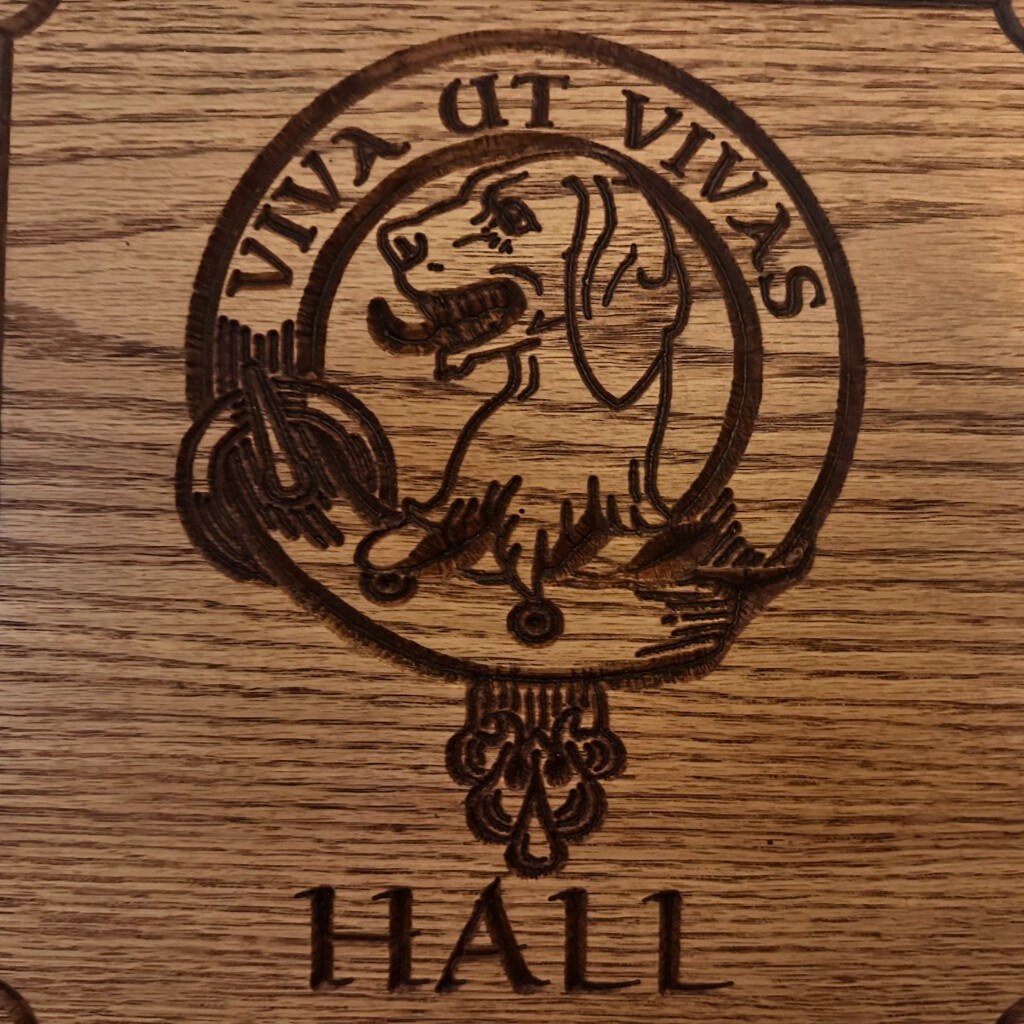
NC-036
Featured
England’s first attempt at a North American colony was made at Roanoke in 1585 and disappeared without trace. North Carolina has been trying first for four hundred years since. The Eastern Band of Cherokee held the western mountains; their cousins walked the Trail of Tears in 1838. On December 17, 1903, Orville Wright lifted off the Kill Devil Hills sands at Kitty Hawk for twelve seconds. Four students sat down at a Greensboro lunch counter on February 1, 1960. North Carolina spans more American landscape than any state.
North Carolina’s 100 counties stretch from the Atlantic barrier islands and coastal plain through the rolling Piedmont to the Southern Appalachian peaks of the Blue Ridge and Great Smokies.
Begin with the territory that calls to you — your homeland, a frontier you love, or simply somewhere your story belongs.
Each hex is a sovereign coordinate. Pick a coastline, a valley, a city block — anywhere on the grid that resonates with your roots or your dream.
A photograph, a paragraph, a name. Your hex becomes a permanent thread in the larger national tapestry — the 250-year-old story of America, continued.
Your inscription becomes a permanent thread in the American story — and a keepsake you can print, frame, and hold.
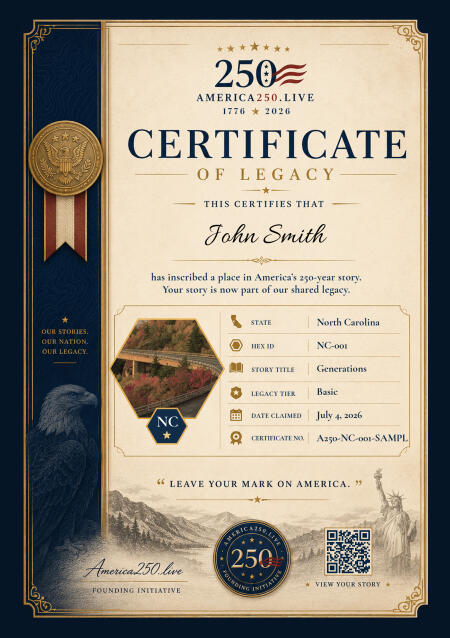
Your Commemorative Certificate
Print it. Frame it. Pass it down.
High-resolution digital certificate, custom to your state, delivered the moment your inscription is complete.
Digital Hex
Living Legacy
Your Inscription
$99 one-time · yours forever
Founder price, held through July 11. $199 afterward — and it stays there.
North Carolina’s colonial history began with failure and mystery. The Roanoke Colony of 1585 was England’s first serious attempt at settlement in North America; it vanished without explanation, leaving only the word “Croatoan” carved on a post. The Lost Colony remains one of America’s enduring mysteries. Settlers who arrived later were harder to dislodge, and by the early 18th century a rough, independent population had taken root in the coastal plain and piedmont.
The colony developed a reputation for stubbornness toward authority that it never entirely shook. North Carolina was among the last colonies to be organized under royal charter and among the most resistant to British taxation. Its backcountry Regulators staged one of pre-Revolutionary America’s first popular uprisings in the 1760s, and the state produced guerrilla fighters whose campaigns during the Revolution — at Kings Mountain in 1780, above all — helped turn the war in the South.
The 19th century brought tobacco, slavery, secession, and reconstruction in brutal succession. North Carolina’s yeoman farmers were ambivalent about secession — the western mountain counties often harbored Unionist sentiment — but the state sent more soldiers to the Confederate cause than any other Southern state. At Bentonville in 1865, the Confederacy’s last major offensive in the east was defeated on North Carolina soil.
On December 17, 1903, Orville Wright lifted off the Kill Devil Hills sands at Kitty Hawk for twelve seconds, covering 120 feet. It was the first powered, controlled, sustained flight in history. North Carolina adopted “First in Flight” as its motto and put it on its license plates, winning a decades-long argument with Ohio. The Wright Brothers chose the Outer Banks for its steady winds and soft landing surface.
Today North Carolina is one of the fastest-growing states in America, with Charlotte a major banking center, the Research Triangle anchoring a technology and biomedical economy, and the Blue Ridge and Outer Banks drawing visitors from across the country. The state holds its contradictions — tobacco and tech, mountains and coast, old South and new South — with the particular grace of a place that has always been too varied to be easily categorized.
England’s first American colony is established on Roanoke Island; it disappears by 1590, leaving the mystery of the Lost Colony.
North and South Carolina are formally separated into distinct royal provinces.
Royal Governor Tryon crushes the Regulator uprising at Alamance, suppressing one of America’s first popular revolts against government corruption.
Patriot militia defeat a Loyalist force at Kings Mountain, a turning point in the Southern campaign of the Revolutionary War.
North Carolina ratifies the Constitution and joins the union as the 12th state, after initially refusing over the absence of a Bill of Rights.
North Carolina reluctantly secedes after Fort Sumter, ultimately contributing more Confederate soldiers than any other Southern state.
Orville Wright makes the first powered airplane flight at Kill Devil Hills near Kitty Hawk on December 17.
Research Triangle Park is established between Raleigh, Durham, and Chapel Hill, launching North Carolina’s transformation into a technology hub.
Four Black students from A&T sit at a Woolworth’s lunch counter in Greensboro, igniting the sit-in movement that spreads across the South.
The Democratic National Convention nominates President Obama for re-election in Charlotte, marking the city’s arrival as a major American metropolis.
Real North Carolina people who have placed their names — and their stories — into the hex grid. Each square mile, a chapter.

My grandfather came to North Carolina in 1953 with nothing but a suitcase and a job offer at the steel mill in Charlotte. He worked there fo...
View StoryMy grandfather John was arrested in 1962 in Birmingham, Alabama, for refusing to leave a lunch counter. He was eighteen years old. He spent....
View StoryMy grandmother Etta was born in Charlotte in 1924 to parents who had come up from Mississippi three years earlier as part of what they used....
View Story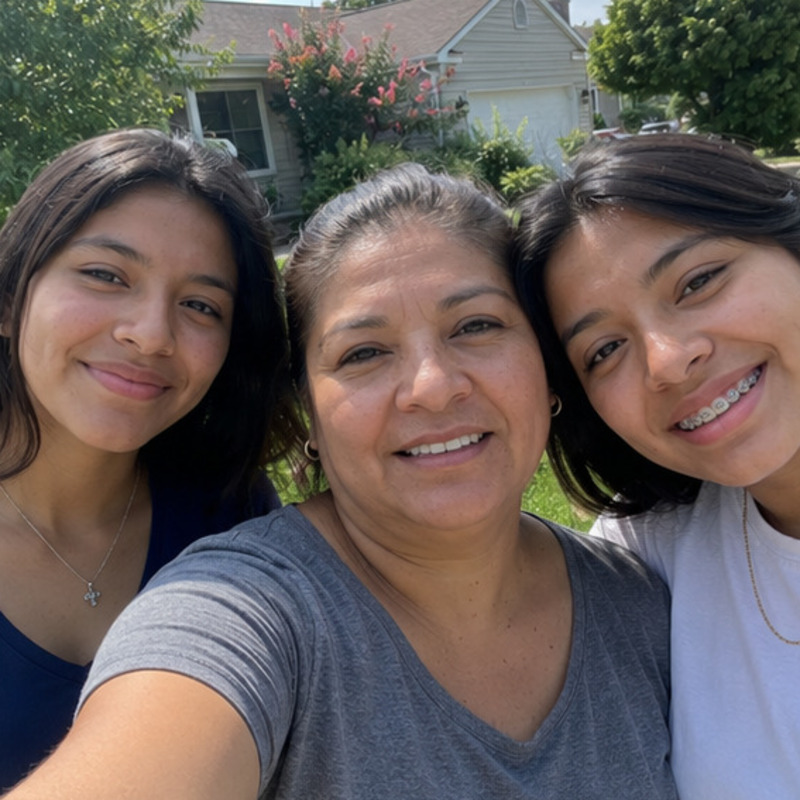
Came to America in 1987 from the Philippines with my mother and younger brother. We had eight hundred dollars and a phone number for a cousi...
View StoryMy grandmother used to make pierogi every Christmas Eve in her kitchen in Charlotte. She would sit at the round table, four hours straight,....
View Story
One hundred counties from the Outer Banks barrier islands to the Great Smoky peaks. The Lost Colony, the first flight, the Greensboro sit-in, and the Cherokee mountains still held by the Eastern Band — North Carolina has been trying first for four centuries. Raise your wings on the Tar Heel map.
Reserve your place on the North Carolina map and receive your personalized Certificate of Legacy — your name, your place, preserved for the next 250 years.
We'll save your progress. We won't share your email.
Appears on the map and on your Certificate of Legacy.
We'll email you a private link to add your story and photo anytime after payment. Add your subtitle, story, and photo below before payment.
Ready · 1024 × 1024
Pick the square that lives on the map
Founder price through July 11. It becomes $199 after — and stays there.
Please accept the terms to proceed with payment.
No account needed — we'll email a secure link after payment.
Your hex is reserved immediately.
★ Limited availability per state ★
Processing
Securing your place on the map…
Check your email to complete your story and finalize your place on the map.
Can't find it? Check your spam or junk folder — and add [email protected] to your contacts so future messages reach your inbox.
Limited availability per state