The Wright Brothers’ First Flight
On December 17, 1903, at Kill Devil Hills near Kitty Hawk, Orville Wright lifted off the sands for twelve seconds and 120 feet. Five years later, Wilbur flew for over an hour.
John F. Kennedy committed the country to the moon in a May 25, 1961 speech to Congress, six weeks after Yuri Gagarin’s orbital flight had given the Soviet Union the propaganda victory of the early space race. Kennedy did not live to see the program through; the program nearly did not survive the Apollo 1 fire that killed Gus Grissom, Ed White, and Roger Chaffee on the launch pad in January 1967. Eight years and $25 billion later — roughly $200 billion in 2023 dollars — Apollo 11 landed at the Sea of Tranquility on July 20, 1969 at 4:17 p.m. EDT.
“Here Men From The Planet Earth First Set Foot Upon the Moon, July 1969 A.D. We Came in Peace For All Mankind.”
— Plaque mounted on the Apollo 11 lunar module Eagle, left on the Moon, July 20, 1969
The Soviet Union had won every “first” of the early space race. Sputnik (1957) was the first artificial satellite; Laika (1957) the first animal in orbit; Yuri Gagarin (April 12, 1961) the first human in space; Valentina Tereshkova (1963) the first woman; Alexei Leonov (March 1965) the first spacewalker; Luna 9 (February 1966) the first soft Moon landing. The United States needed a goal that the Soviets had not yet achieved. The Moon — far enough away that lifting capacity would matter more than booster technology — was that goal.
The Apollo program employed 400,000 people at its peak. Margaret Hamilton, then twenty-five, led the team at the MIT Instrumentation Laboratory that wrote the Apollo Guidance Computer software. Hamilton coined the term “software engineering” partly in self-defense against engineers who didn’t consider her programming work to be engineering. Her code’s priority-scheduling algorithm prevented disaster during the lunar descent: the guidance computer was being overwhelmed by spurious radar data, and Hamilton’s code correctly dropped the lower-priority tasks to keep the critical landing software running.
Saturn V was the largest rocket ever flown: 363 feet tall, 6.5 million pounds at launch, producing 7.6 million pounds of thrust at liftoff. The Apollo 11 mission profile required the rocket to send three astronauts to lunar orbit, separate a lunar module that would descend to the surface with two of them, sustain them on the Moon, lift them back to lunar orbit, dock with the command module, and return to Earth at 25,000 miles per hour through atmospheric reentry. Every component had to work. Most had only one chance.
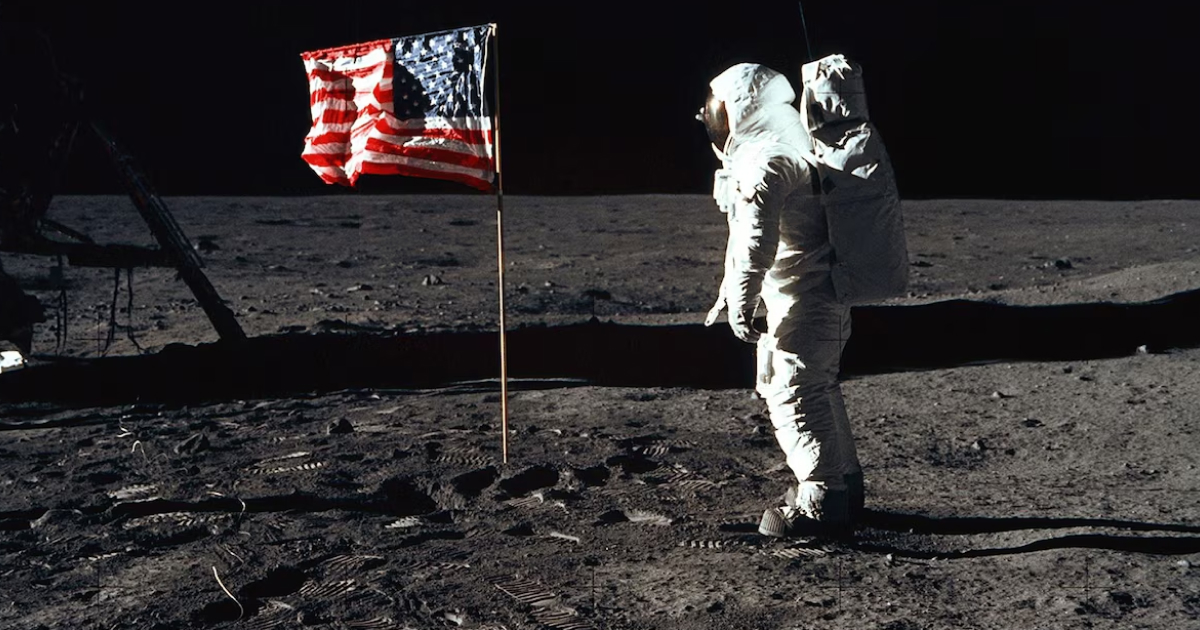
Armstrong and Aldrin landed in the Sea of Tranquility with less than thirty seconds of fuel remaining; Armstrong had taken manual control to avoid a boulder field at the computer’s targeted landing site. They spent 21 hours and 36 minutes on the surface. The first moonwalk lasted 2 hours and 31 minutes. They collected 47.5 pounds of lunar samples, planted a flag, deployed a seismometer and a laser retroreflector, and left the plaque mounted on the lunar module’s descent stage. Buzz Aldrin took communion using a kit provided by his Presbyterian pastor, the first religious sacrament performed beyond Earth.
The United States flew six successful Moon landings between 1969 and 1972 — Apollo 11, 12, 14, 15, 16, and 17. No human has been back since. Twelve men walked on the Moon; the youngest, Charles Duke (Apollo 16), is in his late eighties as of 2026. The Apollo Guidance Computer’s processing power was about a millionth of a modern smartphone. The plaque is still there. So are the bootprints — the Moon has no wind or water to erase them. The Cold War the program had been designed to win continued until 1991. The retroreflector Aldrin deployed is still used to measure the Moon’s distance from Earth, to the millimeter.
On December 17, 1903, at Kill Devil Hills near Kitty Hawk, Orville Wright lifted off the sands for twelve seconds and 120 feet. Five years later, Wilbur flew for over an hour.
In secret across 30 sites and 600,000 workers between 1939 and 1945, the United States built the first nuclear weapons. Trinity, July 16. Hiroshima, August 6. Nagasaki, August 9.
ARPANET sent its first message on October 29, 1969: “lo” — the system crashed before it finished “login.” The network was funded by the Pentagon to survive a nuclear war.