The Wright Brothers’ First Flight
On December 17, 1903, at Kill Devil Hills near Kitty Hawk, Orville Wright lifted off the sands for twelve seconds and 120 feet. Five years later, Wilbur flew for over an hour.
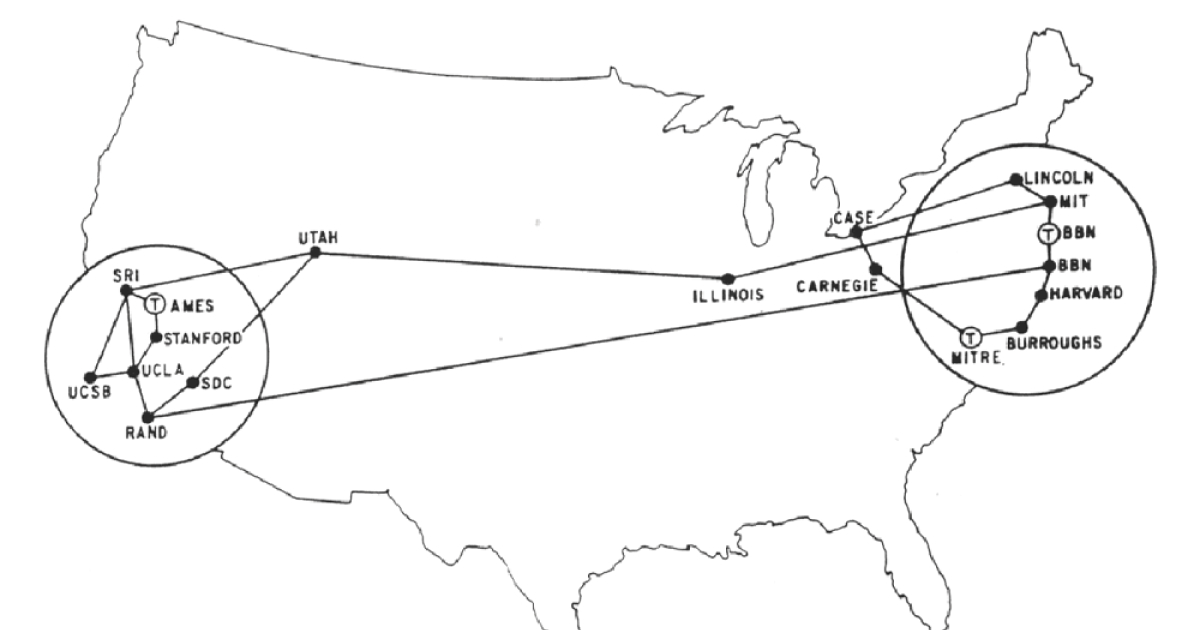
The Advanced Research Projects Agency Network was conceived inside the Pentagon’s Information Processing Techniques Office as a way to connect mainframe computers at research universities. The original four nodes were UCLA, Stanford Research Institute, UC Santa Barbara, and the University of Utah. On October 29, 1969, at 10:30 p.m. Pacific time, programmer Charley Kline at UCLA sent the first message to Stanford: he typed “lo” — the system crashed before completing “login.”
“I think that what we need is a network of networks.”
— J.C.R. Licklider, ARPA memorandum, April 1963, foreseeing the architecture twenty-five years before it existed
The architecture’s key design choice — packet switching — came from RAND Corporation researcher Paul Baran, who in 1964 published “On Distributed Communications” proposing a network that could route messages around damage in fragments rather than maintaining dedicated point-to-point connections. The Air Force was interested in Baran’s ideas because circuit-switched telephone networks would be destroyed in a nuclear war; a distributed packet-switched network might survive. ARPA, the Defense Department’s blue-sky research arm, picked up the idea. The military funding shaped the architecture but not the academic and research culture that developed around it.
The Interface Message Processor (IMP) at each node was a refrigerator-sized Honeywell DDP-516 minicomputer modified by the Cambridge company Bolt Beranek and Newman. The first IMP was delivered to UCLA on Labor Day 1969. The second went to Stanford Research Institute on October 1. They were connected by a 50-kilobit-per-second leased line. The first message attempt — “login” — crashed on the third character. An hour later they tried again and the full word transmitted successfully. Kline kept the log; the entry survives.
Vint Cerf and Bob Kahn developed TCP/IP — the protocol suite that lets different networks interconnect — in the early 1970s. The protocol was adopted as the ARPANET standard on January 1, 1983, in a transition known as “flag day.” Tim Berners-Lee, working at CERN in Switzerland in 1989-91, invented the World Wide Web on top of TCP/IP — HTML for documents, HTTP for retrieval, URLs for addressing. The first web page went live on August 6, 1991. The Mosaic browser, developed at the University of Illinois’s NCSA by Marc Andreessen in 1993, made the Web accessible to non-experts.
The internet went commercial in stages. The National Science Foundation backbone (NSFNET) had operated under an acceptable-use policy that banned commercial traffic; in 1995 the NSF retired NSFNET and lifted the restriction. Netscape’s IPO that August — the first major dot-com offering — opened the era. eBay, Amazon, Yahoo, Google, and Facebook were founded between 1995 and 2004. The architecture’s openness — anyone could connect to the network, run new protocols, build new services — enabled both the explosion of innovation and the eventual concentration into a few platforms.
The original ARPANET node at UCLA — Boelter Hall room 3420, where Charley Kline sent “lo” in 1969 — is now a museum exhibit. The Interface Message Processor that received it sits in the Computer History Museum in Mountain View. The protocols those four nodes ran on still route every packet of every web page on earth. The federal funding that built it — roughly $200 million in 1960s dollars over fifteen years — returned somewhere between $10 trillion and $50 trillion in economic value, depending on whose accounting you trust. The architecture survives. The openness is contested.
On December 17, 1903, at Kill Devil Hills near Kitty Hawk, Orville Wright lifted off the sands for twelve seconds and 120 feet. Five years later, Wilbur flew for over an hour.
In secret across 30 sites and 600,000 workers between 1939 and 1945, the United States built the first nuclear weapons. Trinity, July 16. Hiroshima, August 6. Nagasaki, August 9.
On July 20, 1969, at 4:17 p.m. EDT, Apollo 11 landed in the Sea of Tranquility. The race that put a flag there began with a Cold War deficit and ended with one footprint.