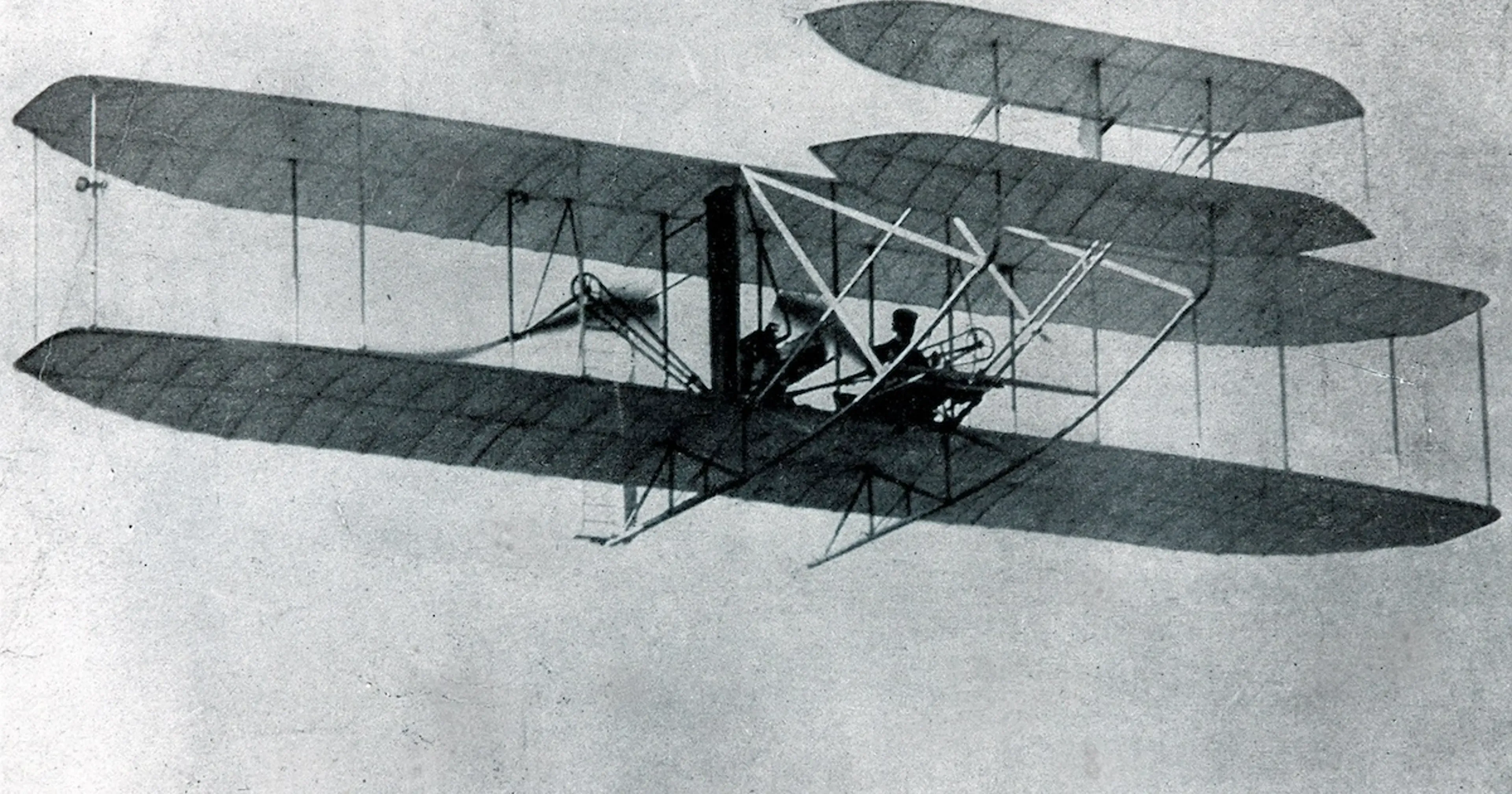
1903

The Wright Brothers’ First Flight

Wilbur and Orville Wright ran a bicycle shop in Dayton, Ohio. They had been working on flight for four years — building gliders, studying birds, designing a wind tunnel to test wing shapes when published aerodynamic tables turned out to be wrong. They chose Kitty Hawk, North Carolina for the test site because of its steady winds and soft sand. The Flyer was 605 pounds, powered by a 12-horsepower gasoline engine the brothers had designed themselves when no manufacturer would build to their specifications.

Innovation & Progress 3 min read · May 2, 2026 · Editorial Team

“Success four flights thursday morning all against twenty one mile wind started from level with engine power alone average speed through air thirty one miles longest 57 seconds inform Press home Christmas. Orevelle Wright.”

— Telegram from Orville Wright to Bishop Milton Wright, December 17, 1903 (Orville’s name misspelled by the telegraph operator)

The brothers had begun their aviation experiments in 1899, when Wilbur read about the death of German glider pioneer Otto Lilienthal and concluded that controlled flight was a problem to be solved. They spent three years building gliders at Kitty Hawk’s sand dunes, testing wing-warping for lateral control (which they had patented in 1903). They built their own wind tunnel in Dayton in 1901 when published aerodynamic data from previous experimenters proved inaccurate. They measured the lift and drag of more than 200 wing shapes — the most thorough aerodynamic research conducted to that point.

The Flyer was 21 feet long with a 40-foot wingspan, built from spruce and ash with a fabric covering. The engine — built by their bicycle-shop mechanic Charles Taylor in six weeks — weighed 180 pounds and produced 12 horsepower. The propellers were carved from laminated spruce; the brothers had to develop their own propeller theory because no useful one existed. The whole apparatus weighed 605 pounds with the pilot. They used a 60-foot wooden launching rail and a falling weight to give the aircraft the initial speed for takeoff.

The first flight on December 17, 1903 lasted twelve seconds and covered 120 feet. Orville was at the controls; Wilbur ran alongside. They made three more flights that day, alternating who flew. Wilbur’s fourth flight, at noon, covered 852 feet in 59 seconds. After that flight a gust of wind flipped the Flyer over and broke it. John T. Daniels of the Kill Devil Hills Life-Saving Station — who had never used a camera before — took the famous photograph of the first flight on Orville’s tripod-mounted glass-plate camera. The brothers folded up the broken Flyer and went home to Dayton.

The press was skeptical. The Dayton Daily News didn’t run the story. The Norfolk Virginian-Pilot ran an exaggerated account claiming the Flyer had flown three miles. The New York Times had previously editorialized that powered flight was a millennium away. Scientific American called the Wright reports “a fake.” The brothers retreated to Dayton and spent five years perfecting their designs in obscurity, conducting test flights at Huffman Prairie, a cow pasture eight miles from their shop, where Wilbur eventually flew for over half an hour at a time.

The 1908 public demonstrations finally convinced the world. Wilbur flew at Le Mans, France in August 1908, completing 100 flights including one of two hours and twenty minutes. Orville flew at Fort Myer, Virginia, in September 1908, where a propeller broke during a demonstration and killed his passenger Thomas Selfridge — the first powered-aviation fatality. The brothers spent the next decade in patent disputes with Glenn Curtiss that slowed American aviation development while European designers surpassed them. Wilbur died of typhoid fever in 1912 at age 45. Orville lived until 1948, long enough to see jet engines, supersonic flight, and the bombing of Hiroshima — all powered, sustained, heavier-than-air descendants of a 605-pound machine he had flown for twelve seconds on a beach.

Historical Record
Period
1903
Category
Innovation & Progress
Archive
America 250 — 1776–2026
Share this story
Continue Reading

More from Innovation & Progress

All Innovation & Progress →
1939–1945

The Manhattan Project

In secret across 30 sites and 600,000 workers between 1939 and 1945, the United States built the first nuclear weapons. Trinity, July 16. Hiroshima, August 6. Nagasaki, August 9.

1969

Apollo 11 and the Moon Landing

On July 20, 1969, at 4:17 p.m. EDT, Apollo 11 landed in the Sea of Tranquility. The race that put a flag there began with a Cold War deficit and ended with one footprint.

1969–1990s

The Internet’s American Origins

ARPANET sent its first message on October 29, 1969: “lo” — the system crashed before it finished “login.” The network was funded by the Pentagon to survive a nuclear war.

Explore More Stories