1939–1945

The Manhattan Project

On August 2, 1939, Albert Einstein signed a letter drafted by Hungarian physicist Leo Szilard warning Franklin Roosevelt that nuclear fission could be weaponized and that Nazi Germany might be ahead. Roosevelt authorized an exploratory committee. By 1942 the effort had become the largest secret industrial project in history. The Manhattan Engineer District — named for the borough where its early offices sat — eventually employed 600,000 people across 30 sites in 13 states and parts of Canada, at a cost equivalent to roughly $30 billion in 2023 dollars. Almost none of the workers knew what they were building.

Innovation & Progress 3 min read · May 5, 2026 · Editorial Team

“Now I am become Death, the destroyer of worlds.”

— J. Robert Oppenheimer, recalling Trinity (from the Bhagavad Gita), NBC interview, 1965

The project ran on three industrial fronts. Oak Ridge, Tennessee, enriched uranium-235 through gaseous diffusion and electromagnetic separation in plants larger than any factory then in existence. Hanford, on the Columbia River in Washington, produced plutonium-239 in three nuclear reactors built on a 586-square-mile site cleared of farms and the Wanapum people. Los Alamos, in the high desert of northern New Mexico, was the central laboratory where the bomb designs were assembled and tested. None of the three towns existed as a town in 1942.

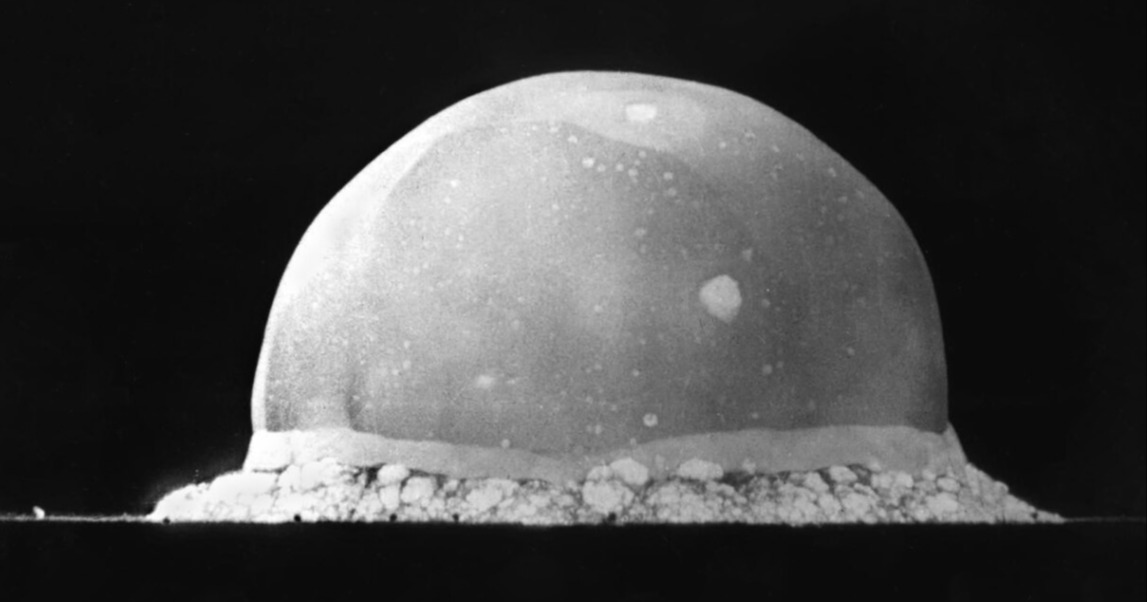
The Trinity test was conducted at 5:29:45 a.m. on July 16, 1945, on the Jornada del Muerto desert near Alamogordo. The plutonium implosion device — code-named the Gadget — produced a yield equivalent to roughly 21,000 tons of TNT. The fireball was visible from 200 miles away. Physicist Kenneth Bainbridge, the test director, turned to Oppenheimer afterward and said, “Now we are all sons of bitches.” Twelve thousand ranching families and Indigenous communities downwind of the test were not warned. Fallout drifted across New Mexico, Arizona, and Nevada.

The Interim Committee, chaired by Secretary of War Henry Stimson, recommended in May 1945 that the bomb be used against a Japanese city without warning. Some scientists — Szilard among them, the same physicist who had drafted the original Einstein letter — petitioned President Truman to demonstrate the weapon first to international observers. The petition was suppressed and Truman never saw it. On August 6, the Enola Gay dropped a uranium bomb on Hiroshima at 8:15 a.m. local time. Roughly 70,000 people were killed instantly. By December, deaths from injuries and radiation sickness brought the total to between 110,000 and 140,000.

On August 9, three days later, a plutonium bomb was dropped on Nagasaki, a backup target chosen when cloud cover obscured the primary city of Kokura. Between 40,000 and 80,000 people were killed by the end of 1945. Japan surrendered six days later, on August 14. Whether the bombings were the decisive factor in the surrender — versus the Soviet entry into the Pacific war on August 8 — remains contested among historians. Most American school curricula say one thing; most Japanese accounts say another.

The Hanford site in Washington produced plutonium for 41 years and is now the largest environmental cleanup project in American history; 56 million gallons of radioactive waste remain in aging underground tanks. The Trinity Site is open to the public twice a year. Downwinders of Trinity — most of them Hispanic and Indigenous families in central New Mexico — were not eligible for federal compensation under the 1990 Radiation Exposure Compensation Act until that exclusion was partially corrected in 2024. Hiroshima and Nagasaki each commemorate their anniversaries every August 6 and August 9. The cleanup will outlast the people who designed the bomb.

Historical Record
Period
1939–1945
Category
Innovation & Progress
Archive
America 250 — 1776–2026
Share this story
Continue Reading

More from Innovation & Progress

All Innovation & Progress →
1903

The Wright Brothers’ First Flight

On December 17, 1903, at Kill Devil Hills near Kitty Hawk, Orville Wright lifted off the sands for twelve seconds and 120 feet. Five years later, Wilbur flew for over an hour.

1969

Apollo 11 and the Moon Landing

On July 20, 1969, at 4:17 p.m. EDT, Apollo 11 landed in the Sea of Tranquility. The race that put a flag there began with a Cold War deficit and ended with one footprint.

1969–1990s

The Internet’s American Origins

ARPANET sent its first message on October 29, 1969: “lo” — the system crashed before it finished “login.” The network was funded by the Pentagon to survive a nuclear war.

Explore More Stories