1942

The Battle of Midway

The Battle of Midway was fought from June 4 to June 7, 1942, around a tiny atoll roughly 1,300 miles northwest of Hawaii. On one side was the Imperial Japanese Navy, fresh from six months of nearly unbroken victory, fielding four of the same aircraft carriers that had struck Pearl Harbor. On the other was a smaller, weaker U.S. Pacific Fleet under Admiral Chester Nimitz, holding one advantage the Japanese did not know about: American codebreakers had cracked the Japanese naval cipher and knew the attack was coming. By the time the smoke cleared on June 7, all four Japanese carriers were on the bottom of the ocean. So was an American one. The war in the Pacific had turned.

Conflict & Transformation 5 min read · June 6, 2026 · Editorial Team

“Perhaps we will be forgiven if we claim we are about midway to our objective.”

— Admiral Chester W. Nimitz, CINCPAC Communiqué No. 3, June 1942

In the spring of 1942, almost nothing had gone right for the United States in the Pacific. Pearl Harbor in December had crippled the battleship fleet. The Philippines had fallen. Guam, Wake, Singapore — gone. Japan held an empire that reached from the edge of India to the central Pacific, and its navy had not lost a major engagement in the war. Admiral Isoroku Yamamoto, who had planned Pearl Harbor, intended to finish the job at Midway: seize the atoll, force the remnants of the American fleet into a decisive battle, and destroy the U.S. aircraft carriers that had escaped in December. It very nearly worked.

What undid it was a windowless basement at Pearl Harbor. A team of Navy cryptanalysts under Commander Joseph Rochefort had been chipping away at the Japanese fleet code, known as JN-25, for months. By May they could read enough to know that a major operation was aimed at a target the Japanese called "AF." Washington was not convinced AF was Midway. Rochefort's team devised a ruse: they had the base at Midway send an uncoded message reporting that its fresh-water plant had broken down. Two days later they intercepted a Japanese signal noting that "AF" was short of fresh water. That settled it. Nimitz now knew where the Japanese were going, roughly when, and with what.

He gambled on it. He positioned his three available carriers — Enterprise, Hornet, and Yorktown — northeast of Midway at a spot the Americans called Point Luck, waiting in ambush for a fleet that believed it held the advantage of surprise. Yorktown should not have been there at all: she had been badly damaged at the Battle of the Coral Sea a month earlier and was expected to need months in dry dock. The Pearl Harbor Navy Yard patched her up in about seventy-two hours and sent her back to sea.

The battle opened on the morning of June 4, when the Japanese carriers launched their planes against Midway itself. As the Japanese commander, Vice Admiral Chuichi Nagumo, hesitated over whether to rearm his aircraft for a second strike on the island or hold them back for the American ships he was only beginning to suspect were near, the U.S. carriers launched everything they had. The first American planes to find the Japanese fleet were the torpedo bombers — slow, low-flying, and almost defenseless. Torpedo Squadron 8, flying off Hornet under Lieutenant Commander John Waldron, attacked without fighter cover and was annihilated. All fifteen of its planes were shot down. Of the thirty men aboard them, one survived: Ensign George Gay, who spent the rest of the battle floating in the water beneath a seat cushion, watching.

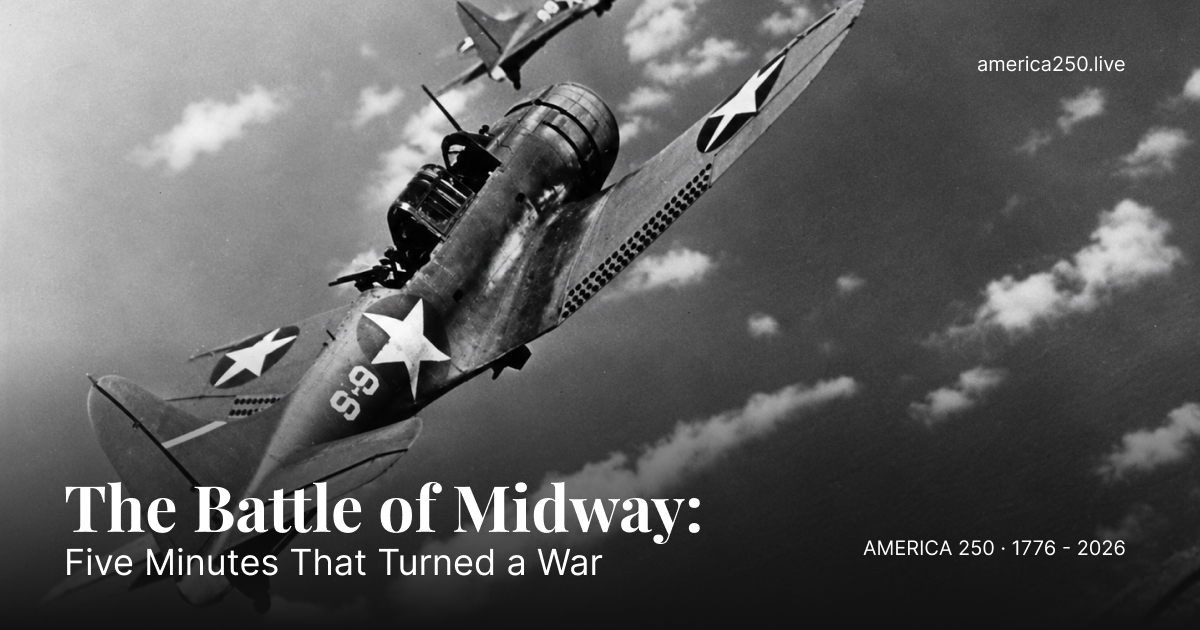
The torpedo squadrons scored no hits and paid with nearly everyone. But they did one thing without knowing it. They dragged the Japanese fighter cover down to sea level in pursuit, and they kept the carriers turning and dodging instead of launching. So when the American dive bombers arrived overhead a few minutes later — squadrons from Enterprise under Wade McClusky and from Yorktown under Maxwell Leslie — the sky above the Japanese carriers was empty, and the decks below were crowded with fueled, armed, half-rearmed aircraft. Between roughly 10:20 and 10:25 that morning, the dive bombers put their bombs into Akagi, Kaga, and Soryu. Within minutes, three of Japan's four carriers were burning wrecks. Naval historians have called it the most decisive five minutes in the history of war at sea.

The fourth carrier, Hiryu, fought on alone through the afternoon and twice found Yorktown, hitting her hard enough that her crew was ordered to abandon ship. Then Yorktown's own scout planes located Hiryu, and Enterprise's dive bombers finished her too. By nightfall on June 4, all four Japanese carriers — Akagi, Kaga, Soryu, Hiryu, every one of them a veteran of the Pearl Harbor strike — were sunk or sinking. Yorktown stayed stubbornly afloat for two more days, until a Japanese submarine, I-168, torpedoed her and the destroyer Hammann standing alongside. She finally went down on the morning of June 7. The battle was over.

The arithmetic was lopsided in a way that decided the war. Japan lost four fleet carriers, a heavy cruiser, more than 240 aircraft, and most of the elite naval aviators it could not quickly replace. The United States lost Yorktown, the destroyer Hammann, about 145 aircraft, and 307 men. Japan had spent a decade building the carrier force that died at Midway in a single morning, and it never recovered the initiative in the Pacific. From June 1942 onward, the United States was advancing and Japan was defending — a reversal that ran in a nearly straight line to Tokyo Bay three years later.

Midway is remembered as a miracle, and the codebreaking and the lucky timing make it easy to tell the story that way. But the men who flew the torpedo bombers were not lucky, and they were not a miracle. They flew straight at the most powerful fleet on earth, in aircraft they knew were too slow to survive, because someone had to — and the few minutes their deaths bought turned a losing war. Two hundred and fifty years of American history are full of moments that turned on people deciding the thing was worth doing even when the odds said it would cost them everything. Midway was four days of it, over open water, where almost no one was watching.

Historical Record
Period
1942
Category
Conflict & Transformation
Archive
America 250 — 1776–2026
Share this story
Continue Reading

More from Conflict & Transformation

All Conflict & Transformation →
1803

The Louisiana Purchase

On April 30, 1803, France sold 828,000 square miles for $15 million. Napoleon needed cash; Jefferson doubled the country. The land was already inhabited by dozens of nations.

1838–1839

The Trail of Tears

Between 1838 and 1839, the federal government forced 16,000 Cherokee from their ancestral lands to Indian Territory. Roughly 4,000 died on the 5,043-mile march.

1861–1865

The Civil War

Four years of war, roughly 750,000 dead — historian J. David Hacker’s revised estimate. Ended at Appomattox on April 9, 1865. Reconstruction lasted twelve.

Explore More Stories