The Louisiana Purchase
On April 30, 1803, France sold 828,000 square miles for $15 million. Napoleon needed cash; Jefferson doubled the country. The land was already inhabited by dozens of nations.
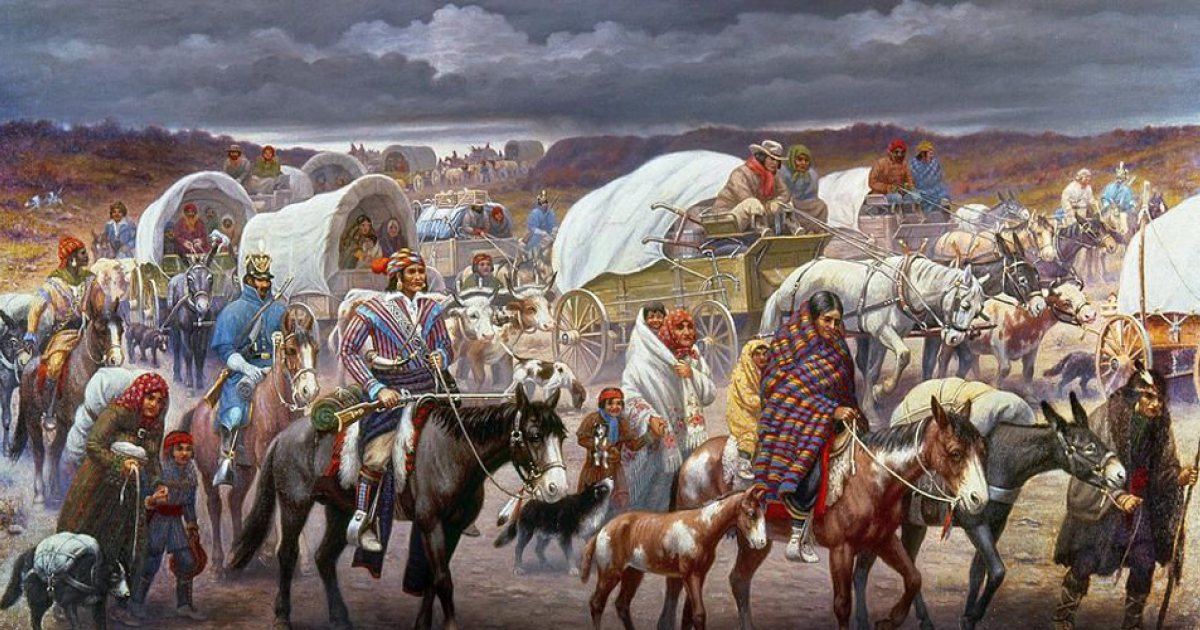
The Indian Removal Act passed Congress on May 28, 1830, by a margin of nine votes in the House. President Andrew Jackson signed it the same day. The law authorized the federal government to negotiate with the Five Tribes — Cherokee, Choctaw, Chickasaw, Creek, and Seminole — for the exchange of their ancestral lands east of the Mississippi for land in what is now Oklahoma. In practice, the negotiations were coerced and the removals violent. Between 1830 and 1850, roughly 60,000 people from the five nations were marched west. The Cherokee march of 1838-39 is the one history named the Trail of Tears.
“I fought through the Civil War and have seen men shot to pieces and slaughtered by thousands, but the Cherokee removal was the cruelest work I ever knew.”
— Private John G. Burnett, U.S. Army, 1890 memoir of his role in the 1838-39 removal
The Cherokee were not nomadic and they had not refused civilization on European terms. By 1830 they had a written constitution modeled on the U.S. one, a bilingual newspaper called the Cherokee Phoenix, schools, churches, plantations, and an alphabet invented by Sequoyah. The 1832 Supreme Court case Worcester v. Georgia affirmed Cherokee sovereignty and ruled that Georgia had no jurisdiction over Cherokee land. President Jackson reportedly said of the decision: “John Marshall has made his decision, now let him enforce it.” He did not.
In 1835 a faction of about 500 Cherokee — none authorized by the Cherokee National Council — signed the Treaty of New Echota, agreeing to removal in exchange for $5 million and land in Indian Territory. The Cherokee National Council, led by Principal Chief John Ross, repudiated the treaty. More than 15,000 Cherokee signed a petition opposing it. The Senate ratified the treaty anyway by a single vote in 1836. Three years of legal resistance followed. On May 23, 1838, when the deadline expired, General Winfield Scott arrived with 7,000 federal troops to enforce removal at bayonet point.
Cherokee families were arrested in their homes and herded into stockades through the summer. The first detachments left in June; conditions in the camps were so bad that Ross persuaded Scott to delay the main removal until autumn. The 13 detachments that followed walked or rafted west between August 1838 and March 1839. Disease, exposure, dysentery, and starvation killed an estimated 4,000 Cherokee along the route — about a quarter of the population removed. The Mississippi crossing was particularly deadly. Survivors arrived at Indian Territory in the late winter of 1839.
The Cherokee march is the one with a name. The Choctaw had been forced west under the Treaty of Dancing Rabbit Creek in 1830-31; perhaps a quarter died. The Creek were removed in 1836 after armed resistance failed. The Chickasaw were removed in 1837-38. The Seminole resisted for forty years across three wars; some never surrendered and their descendants still live in the Everglades. Across all five nations, roughly 60,000 people were marched west between 1830 and 1850. At least 15,000 are estimated to have died.
The Cherokee Nation, the United Keetoowah Band of Cherokee Indians, and the Eastern Band of Cherokee Indians remain federally recognized today; the Eastern Band still occupies a portion of the ancestral homeland in western North Carolina — the few hundred who hid in the mountains and escaped the removal. The Trail of Tears National Historic Trail, established by Congress in 1987, covers 5,043 miles across nine states. Cherokee, Choctaw, Chickasaw, Creek, and Seminole descendants still mark the Trail’s anniversary each year along its full length.
On April 30, 1803, France sold 828,000 square miles for $15 million. Napoleon needed cash; Jefferson doubled the country. The land was already inhabited by dozens of nations.
Four years of war, roughly 750,000 dead — historian J. David Hacker’s revised estimate. Ended at Appomattox on April 9, 1865. Reconstruction lasted twelve.
On December 26, 1862, thirty-eight Dakota men were hanged simultaneously in Mankato on President Lincoln’s order — still the largest mass execution in American history.