The Trail of Tears
Between 1838 and 1839, the federal government forced 16,000 Cherokee from their ancestral lands to Indian Territory. Roughly 4,000 died on the 5,043-mile march.
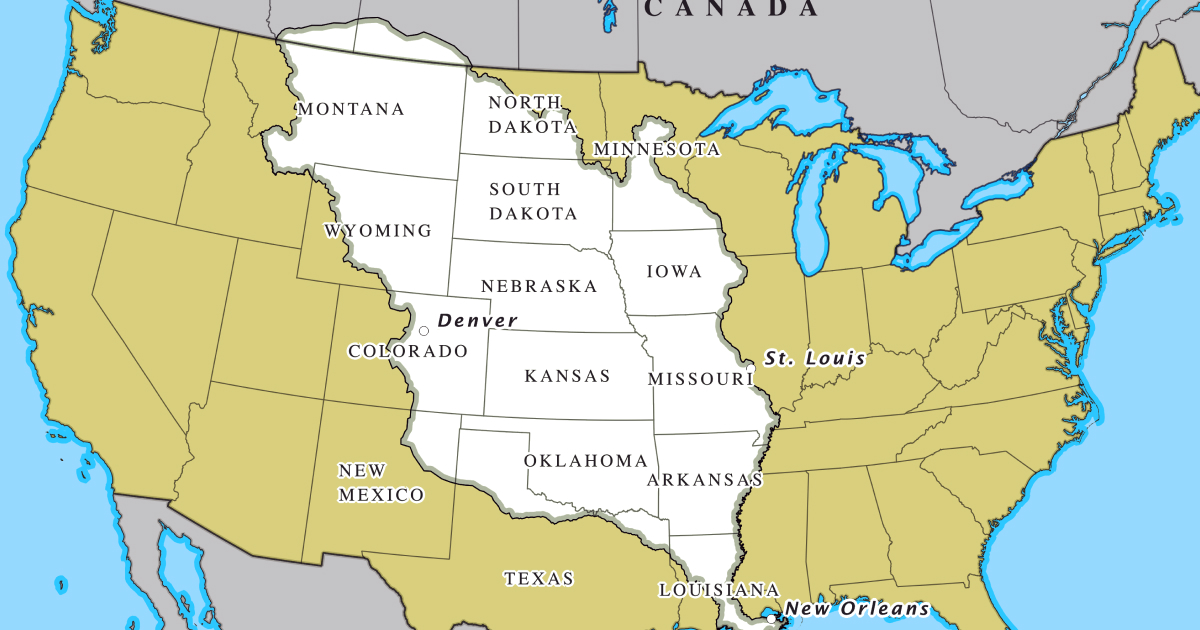
Thomas Jefferson sent James Monroe and Robert Livingston to Paris in 1803 to negotiate the purchase of New Orleans alone, with $10 million authorized. Napoleon, having lost his army to yellow fever in Haiti and needing money to finance the war he was about to lose to Britain, offered the entire Louisiana Territory instead. The treaty was signed April 30, 1803. The price was $15 million — roughly three cents per acre — for 828,000 square miles, doubling the United States. Neither government consulted the nations who already lived on the land.
“There is on the globe one single spot, the possessor of which is our natural and habitual enemy. It is New Orleans, through which the produce of three-eighths of our territory must pass to market.”
— Thomas Jefferson to Robert Livingston, U.S. Minister to France, April 18, 1802
Napoleon’s decision to sell was forced by a slave revolt. The French sugar colony of Saint-Domingue — modern Haiti — had been the richest colony in the world, generating more revenue for France than all thirteen American colonies had generated for Britain. In 1791 the enslaved population revolted under the leadership of Toussaint Louverture. Napoleon sent an army of 30,000 in 1802 to reconquer the colony. Yellow fever killed most of them. By early 1803, Napoleon had lost his Caribbean army, his New World ambitions, and his need for the Louisiana territory that was meant to supply the colonies. He needed cash for the European war that was about to resume. He offered to sell.
What France could legally sell was its claim to Louisiana — not the land itself. The territory included the homelands of the Caddo, Osage, Pawnee, Mandan, Hidatsa, Arikara, Lakota, Comanche, Wichita, and dozens of other nations who had governed the basin of the Missouri and the southern Plains for centuries. None of them were consulted. None of them recognized any French sovereignty to transfer. The transaction was an exchange of paper claims among European empires; the actual incorporation of the land into the United States would take another century of treaties, broken treaties, removals, and military campaigns.
Jefferson struggled with the constitutionality of the purchase. The Constitution gave the president no explicit power to acquire foreign territory. Some Federalists argued that Louisiana should be admitted only by constitutional amendment. Jefferson, who had spent his career as a strict constructionist of federal power, swallowed the contradiction and submitted the treaty to the Senate. The Senate ratified twenty-four to seven on October 20, 1803. The formal transfer took place at the Place d’Armes in New Orleans on December 20.
Jefferson commissioned Meriwether Lewis and William Clark to explore the new territory in 1804. The Corps of Discovery traveled with Sacagawea — a Lemhi Shoshone woman who guided and translated — to the Pacific and back over two years. Fifteen states were eventually carved from the Purchase: Louisiana, Arkansas, Missouri, Iowa, Minnesota (in part), the Dakotas, Nebraska, Kansas, Oklahoma, Texas (in part), New Mexico (in part), Colorado (in part), Wyoming (in part), and Montana (in part). The Louisiana Territory became the geographic heartland of the country.
Haiti, whose revolution had made the Purchase possible, declared independence on January 1, 1804 — the only successful slave revolt to produce a sovereign state. The United States refused to recognize Haiti until 1862, after the Confederate states seceded and the southern senators who had blocked recognition for nearly six decades were no longer in their seats. The country that doubled in size because of a Black republic’s revolution waited fifty-eight years to acknowledge that republic exists.
Between 1838 and 1839, the federal government forced 16,000 Cherokee from their ancestral lands to Indian Territory. Roughly 4,000 died on the 5,043-mile march.
Four years of war, roughly 750,000 dead — historian J. David Hacker’s revised estimate. Ended at Appomattox on April 9, 1865. Reconstruction lasted twelve.
On December 26, 1862, thirty-eight Dakota men were hanged simultaneously in Mankato on President Lincoln’s order — still the largest mass execution in American history.