The Louisiana Purchase
On April 30, 1803, France sold 828,000 square miles for $15 million. Napoleon needed cash; Jefferson doubled the country. The land was already inhabited by dozens of nations.
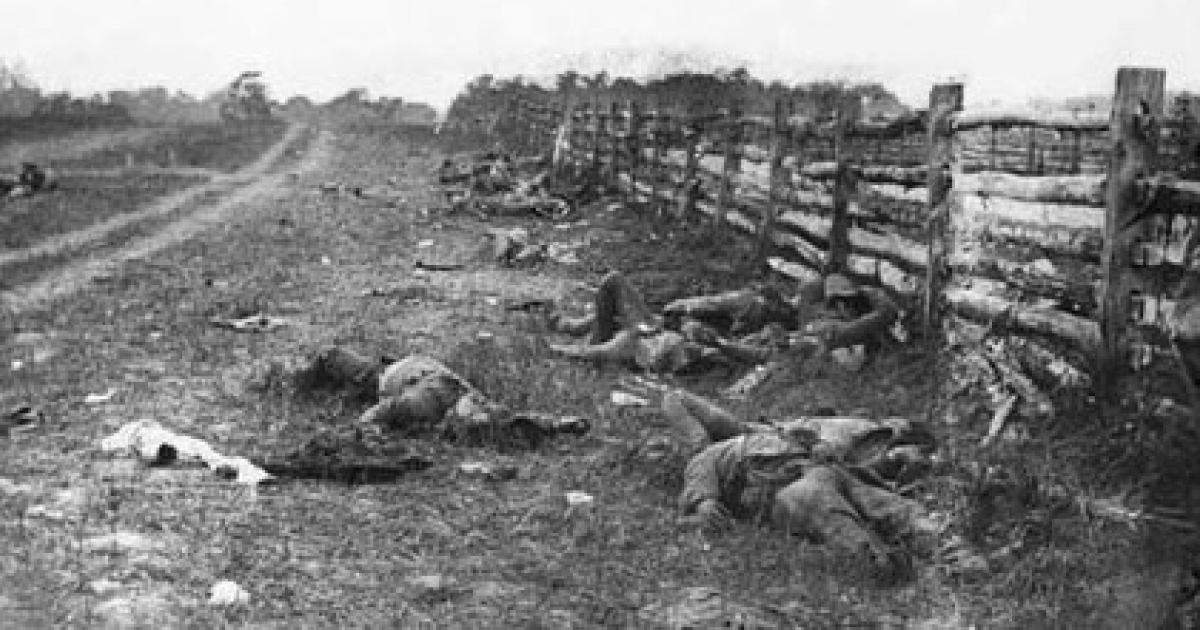
South Carolina seceded on December 20, 1860, six weeks after Abraham Lincoln’s election. Six more Deep South states followed by February 1861; four more, including Virginia, joined after the firing on Fort Sumter on April 12. The official cause was slavery — Mississippi’s secession declaration named it explicitly in its first paragraph, as did every other state that left. The war lasted four years and killed roughly 750,000 soldiers, plus an unknown number of civilians.
“Four score and seven years ago our fathers brought forth on this continent, a new nation, conceived in Liberty, and dedicated to the proposition that all men are created equal.”
— Abraham Lincoln, Gettysburg Address, November 19, 1863
The war’s cause was openly stated by the people who started it. The Mississippi declaration of secession, adopted January 9, 1861, opens: “Our position is thoroughly identified with the institution of slavery — the greatest material interest of the world.” The Georgia, Texas, and South Carolina declarations are equally explicit. Confederate Vice President Alexander Stephens’s “Cornerstone Speech” of March 21, 1861, named slavery as the foundation of the new government: “Its cornerstone rests upon the great truth that the negro is not equal to the white man.” The Lost Cause mythology that emerged in the late nineteenth century — recasting the war as a constitutional dispute over states’ rights — was a deliberate revision of what the seceding states had said about themselves.
The casualty figure of 750,000 comes from a 2011 demographic study by historian J. David Hacker of Binghamton University, who used census data and statistical modeling to revise the long-cited estimate of 620,000 upward. The traditional figure had counted military deaths from official rolls; Hacker accounted for soldiers who died after demobilization from war-related injuries and disease, and for the disrupted census records of the South. The 750,000 figure represents roughly 2.5 percent of the 1860 population — equivalent to about eight million Americans if scaled to current population.
The strategy that won the war was total — General William T. Sherman’s March to the Sea cut a 300-mile path of destruction from Atlanta to Savannah in November and December 1864, deliberately breaking the Confederate logistics and civilian will to fight. Black soldiers became central to the Union effort after the Emancipation Proclamation of January 1, 1863, which authorized their enlistment. Roughly 200,000 served in the United States Colored Troops by war’s end — about 10 percent of the Union Army — at higher casualty rates than white units and at lower pay until Congress equalized pay in 1864.
The war ended at Appomattox Court House in southern Virginia on April 9, 1865, when Robert E. Lee surrendered the Army of Northern Virginia to Ulysses S. Grant. Joseph E. Johnston surrendered his army in North Carolina seventeen days later. Confederate forces in the Trans-Mississippi did not surrender until June 2; news of emancipation did not reach enslaved people in Texas until June 19 (Juneteenth). Lincoln was shot at Ford’s Theatre on April 14 and died the next morning. Andrew Johnson, his successor, would prove a catastrophic choice for Reconstruction.
Reconstruction (1865-1877) saw the passage of the Thirteenth, Fourteenth, and Fifteenth amendments, the establishment of the Freedmen’s Bureau, the brief flowering of Black political participation in the South — sixteen Black members of Congress, two Black U.S. senators (both from Mississippi), hundreds of state legislators, sheriffs, mayors. The Compromise of 1877 ended it: federal troops were withdrawn from the South in exchange for Rutherford Hayes winning the disputed 1876 presidency. Jim Crow took ten years to fully consolidate. Lynchings reached their peak in the 1890s. The Fourteenth Amendment’s equal-protection clause would not be effectively enforced for nearly a century.
On April 30, 1803, France sold 828,000 square miles for $15 million. Napoleon needed cash; Jefferson doubled the country. The land was already inhabited by dozens of nations.
Between 1838 and 1839, the federal government forced 16,000 Cherokee from their ancestral lands to Indian Territory. Roughly 4,000 died on the 5,043-mile march.
On December 26, 1862, thirty-eight Dakota men were hanged simultaneously in Mankato on President Lincoln’s order — still the largest mass execution in American history.