1954

Brown v. Board of Education

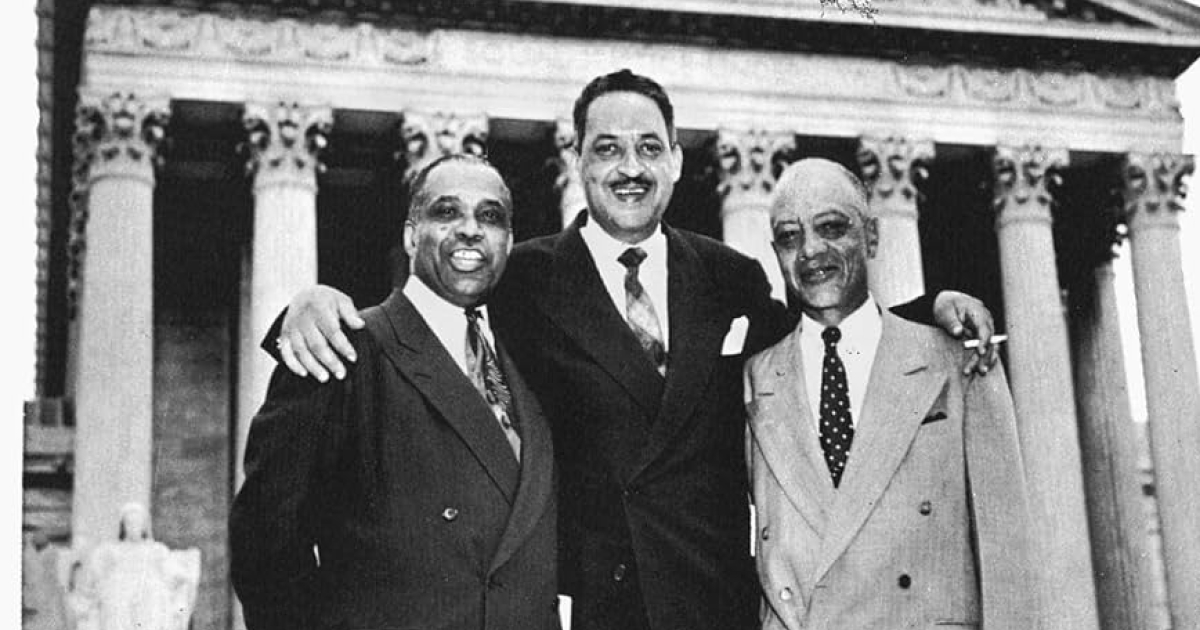
Oliver Brown was a welder and assistant pastor in Topeka, Kansas. His daughter Linda walked twenty-one blocks to the all-Black Monroe Elementary School each day, past an all-white school seven blocks from home. The NAACP Legal Defense and Educational Fund, led by Thurgood Marshall, consolidated her case with four others from South Carolina, Virginia, Delaware, and Washington, D.C. The Supreme Court heard arguments twice — once under Chief Justice Fred Vinson, again under Earl Warren after Vinson’s death.

Civil Rights & Society 3 min read · May 6, 2026 · Editorial Team

“We conclude that in the field of public education the doctrine of “separate but equal” has no place. Separate educational facilities are inherently unequal.”

— Chief Justice Earl Warren, opinion for a unanimous Court in Brown v. Board of Education, May 17, 1954

The NAACP had been litigating school segregation cases for two decades by 1954. Charles Hamilton Houston, who had built Howard Law School into a civil-rights litigation powerhouse, designed the strategy: attack the “equal” half of “separate but equal” first, forcing states to spend impossible sums equalizing facilities, then attack separation itself. Thurgood Marshall, Houston’s protégé, succeeded him as NAACP-LDF chief counsel in 1940. He won twenty-nine of thirty-two cases argued before the Supreme Court over the next two decades.

The five consolidated cases were: Brown v. Board of Education (Kansas, plaintiffs lived in a relatively integrated state and faced school segregation), Briggs v. Elliott (South Carolina, the lead case originally), Davis v. County School Board of Prince Edward County (Virginia, where high school students went on strike), Gebhart v. Belton (Delaware, the only case where the lower court had ruled for the plaintiffs), and Bolling v. Sharpe (Washington, D.C., decided under the Fifth Amendment because D.C. isn’t a state). Marshall argued that segregation produced measurable psychological harm to Black children.

The Court heard argument twice. The first argument was in December 1952, under Chief Justice Fred Vinson; the justices were divided and the case was carried over for reargument in 1953. Vinson died in September 1953. Earl Warren, the former California governor and Republican vice-presidential candidate, was appointed Chief Justice by President Eisenhower. Warren proved a remarkable consensus-builder; he wanted a unanimous ruling and worked the conservative justices privately for months to achieve it. The unanimous decision was delivered on May 17, 1954.

The implementation order — known as Brown II — was delivered a year later, on May 31, 1955. The phrase “with all deliberate speed” was Warren’s, chosen as compromise language that gave southern districts time but did not specify how much. Implementation took decades. The Southern Manifesto, signed by 101 congressmen in 1956, called the ruling unconstitutional and pledged resistance. Little Rock, Arkansas required federal troops in 1957 to enforce desegregation of Central High School. Virginia closed entire school districts rather than integrate. Mississippi resisted until federal court orders in the 1970s.

Linda Brown grew up to see her case partially dismantled by the Court that decided it. The Supreme Court’s 2007 Parents Involved in Community Schools v. Seattle School District No. 1 ruling, written by Chief Justice John Roberts, struck down voluntary school integration plans on the grounds that they classified students by race. By 2024, U.S. public schools were more racially segregated than they had been in 1968. The legal architecture Brown built was never matched by the political will to enforce it. Thurgood Marshall, who argued the case as NAACP counsel, was appointed to the Supreme Court in 1967 — the first Black justice. He served until 1991.

Historical Record
Period
1954
Category
Civil Rights & Society
Archive
America 250 — 1776–2026
Share this story
Continue Reading

More from Civil Rights & Society

All Civil Rights & Society →
1848–1920

Seneca Falls and the Long Suffrage

On July 19, 1848, three hundred delegates met in upstate New York and demanded the vote. Seventy-two years later, the Nineteenth Amendment was ratified.

1863

Emancipation Proclaimed

On January 1, 1863, Lincoln declared enslaved people in rebellious states “forever free.” The proclamation freed no one immediately. The army that came after did.

1963

The March on Washington

A. Philip Randolph called for it in 1941; Bayard Rustin organized it in 1963. Two hundred and fifty thousand people gathered on August 28. King delivered his speech that afternoon.

Explore More Stories