Seneca Falls and the Long Suffrage
On July 19, 1848, three hundred delegates met in upstate New York and demanded the vote. Seventy-two years later, the Nineteenth Amendment was ratified.
A. Philip Randolph, head of the Brotherhood of Sleeping Car Porters, had first proposed a march on Washington in 1941 to demand fair employment in the defense industry. Roosevelt issued Executive Order 8802 days before the planned march; Randolph called it off. He revived the idea twenty-two years later. Bayard Rustin — a Black, gay, Quaker pacifist who had spent the 1940s organizing nonviolent resistance — was the chief organizer.
“We march today for jobs and freedom, but we have nothing to be proud of, for hundreds and thousands of our brothers are not here, for they have no money for their transportation, for they are receiving starvation wages, or no wages at all.”
— John Lewis, SNCC Chairman, original draft of speech delivered at the March on Washington, August 28, 1963
The march’s six sponsoring organizations — the “Big Six” — were the NAACP, the Urban League, the Congress of Racial Equality (CORE), the Southern Christian Leadership Conference (SCLC), the Student Nonviolent Coordinating Committee (SNCC), and the Brotherhood of Sleeping Car Porters. Their leaders — Roy Wilkins, Whitney Young, James Farmer, Martin Luther King Jr., John Lewis, and A. Philip Randolph — represented every major faction of the civil rights movement. Bayard Rustin, whom Randolph trusted from their 1941 collaboration, was deputy director and the operational organizer.
Rustin ran the operation from a Harlem office at 170 West 130th Street. He coordinated buses from every major American city, water stations along the route, portable toilets, sound systems, parking, security, and logistics for the 250,000 attendees. He worked sixteen-hour days for two months. His sexuality, his Communist Party membership in 1936-41, and his draft resistance during World War II made him a target for FBI surveillance and political vulnerability. Senator Strom Thurmond denounced him from the Senate floor a few weeks before the march, reading FBI files into the record.
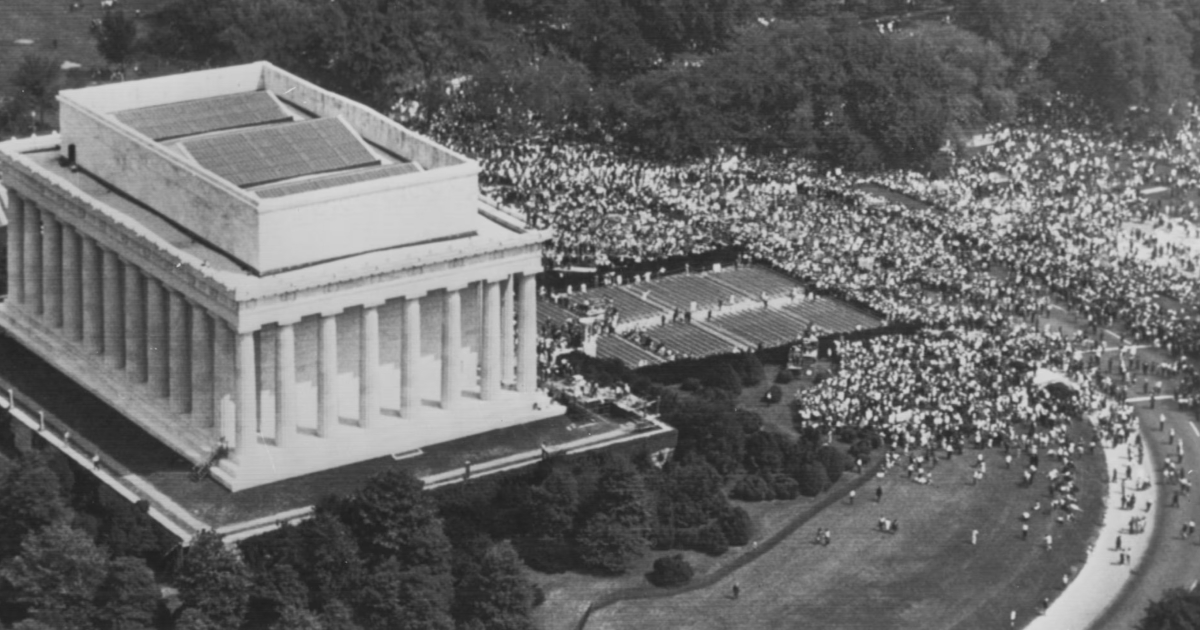
The march took place on Wednesday, August 28, 1963. The crowd at the Lincoln Memorial Reflecting Pool was estimated at 250,000 — larger than any previous Washington demonstration. Marian Anderson, who had famously sung at the same memorial in 1939 after being barred from Constitution Hall, opened with “He’s Got the Whole World in His Hands.” Mahalia Jackson, Joan Baez, Bob Dylan, and Peter, Paul and Mary all performed. The speakers were strictly time-limited; the Big Six leaders each spoke, with King reserved for last.
John Lewis, then 23, had drafted a speech criticizing the Kennedy administration’s civil rights bill as too weak and asking, “Where is our government?” when four Black girls would soon be killed at the 16th Street Baptist Church bombing in Birmingham (which happened on September 15, eighteen days later). Older organizers — particularly Archbishop Patrick O’Boyle of Washington, who threatened to withdraw the Catholic Church’s endorsement — demanded Lewis soften the speech. He removed phrases about “scorched earth” and rewrote the passage about Kennedy’s bill. The version he delivered was still the most radical speech of the day.
King delivered his speech that afternoon at 3:13 p.m. The prepared text was about the unfulfilled promise of America. Toward the end, Mahalia Jackson — who had heard him give it before — called from behind the podium: “Tell them about the dream, Martin.” King set aside his notes and improvised the “I have a dream” passage. The Civil Rights Act passed July 2, 1964 — ten months later. The Voting Rights Act came August 6, 1965. Rustin lived until 1987 and was awarded the Presidential Medal of Freedom posthumously by President Obama in 2013. The country had taken half a century to honor the man who had built the day.
On July 19, 1848, three hundred delegates met in upstate New York and demanded the vote. Seventy-two years later, the Nineteenth Amendment was ratified.
On January 1, 1863, Lincoln declared enslaved people in rebellious states “forever free.” The proclamation freed no one immediately. The army that came after did.
On May 17, 1954, the Supreme Court ruled unanimously that “separate but equal” had no place in public schools. Linda Brown was in third grade. Implementation took decades.