The Birth of Jazz at Congo Square
In an open square in New Orleans, enslaved Africans were permitted to gather on Sundays. Their music — call-and-response, polyrhythm, improvisation — became jazz a century later.
Ellis Island opened as a federal immigration station on January 1, 1892. The first arrival processed was Annie Moore, a fifteen-year-old from Cork, Ireland. Over the next sixty-two years, roughly twelve million people passed through. About two percent were turned away — for disease, for political views, for lacking the means to support themselves. Most processing took three to seven hours. The peak year was 1907, with 1.25 million arrivals.
“Give me your tired, your poor, / Your huddled masses yearning to breathe free, / The wretched refuse of your teeming shore. / Send these, the homeless, tempest-tossed to me, / I lift my lamp beside the golden door!”
— Emma Lazarus, “The New Colossus,” 1883, engraved at the Statue of Liberty pedestal, 1903
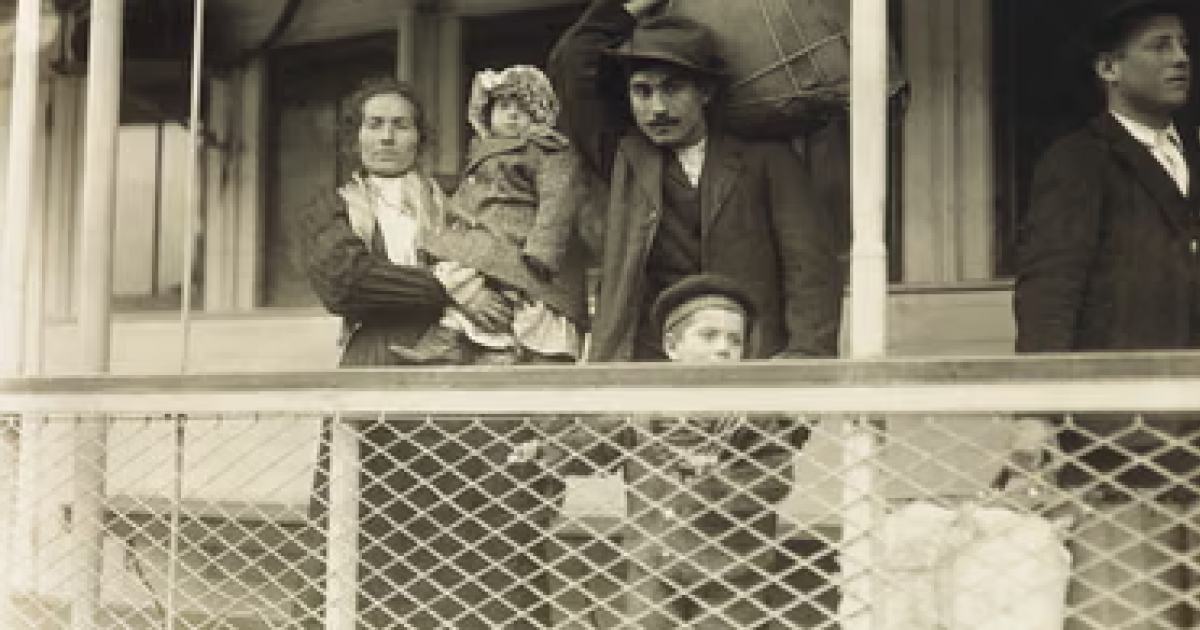
Most arrivals came in steerage — the lowest, cheapest class of passage, below decks with no windows and shared bunks. Ships arrived at the New York Harbor quarantine station first; cabin-class passengers were processed onboard and released. Only steerage passengers came through Ellis Island. They arrived by ferry from the ships anchored off Manhattan, were tagged with manifest numbers, and walked through the Great Hall registry room. Inspectors at desks asked twenty-nine questions in two minutes: name, age, occupation, marital status, destination, who paid the passage, whether they had ever been in prison or an almshouse, whether they were anarchists.
The medical inspection was the most feared part of processing. Doctors with chalk marked the coats of those they suspected of disease: H for heart, X for mental defect, F for face rash, E for eye disease. Trachoma — a contagious eye infection — was the most common cause of deportation, because it was easy to detect and often considered grounds for exclusion. Roughly twenty percent of arrivals were detained for additional inspection; about two percent were ultimately turned away. Those rejected were returned at the steamship company’s expense.
The composition of arrivals shifted dramatically between 1880 and 1924. The earlier waves had come predominantly from Northern and Western Europe — Germans, Irish, English, Scandinavians. From the 1880s onward the source shifted to Southern and Eastern Europe — Italians fleeing rural poverty, Jews fleeing pogroms in the Russian Empire, Poles, Slovaks, Hungarians, Greeks. Nativist sentiment in the United States — concentrated in groups like the Immigration Restriction League and the second Ku Klux Klan — built political pressure for restriction.
The 1924 Johnson-Reed Immigration Act imposed the National Origins Formula, which set quotas at 2 percent of each nationality present in the 1890 census. The 1890 date was chosen deliberately, before the Southern and Eastern European wave; the formula was designed by its drafter, Senator David Reed of Pennsylvania, to “preserve, as nearly as possible, the racial status quo in the United States.” The Act banned all immigration from Asia outright. The Western Hemisphere was unrestricted, which allowed Mexican migration to continue. The 1924 Act sharply reduced Ellis Island’s function; most subsequent arrivals were processed at consular offices abroad and admitted directly.
The 1924 quotas remained in effect for forty-one years, until the Hart-Celler Act of 1965 replaced national-origin quotas with preference categories based on family reunification and employment skills. The descendants of those twelve million Ellis Island arrivals now number more than one hundred million Americans. Ellis Island was closed in 1954, restored as a museum and reopened in 1990. The current debate over immigration runs along the same fault lines — assimilation versus exclusion, who counts as “us” — that the 1924 Act exploited and the 1965 Act partially closed.
In an open square in New Orleans, enslaved Africans were permitted to gather on Sundays. Their music — call-and-response, polyrhythm, improvisation — became jazz a century later.
James Marshall found gold at Sutter’s Mill on January 24, 1848. Three hundred thousand people arrived in two years. California became a state on September 9, 1850.
Six million Black Americans left the South between 1916 and 1970, remaking the cities of the North and West. Jacob Lawrence painted them in sixty panels.