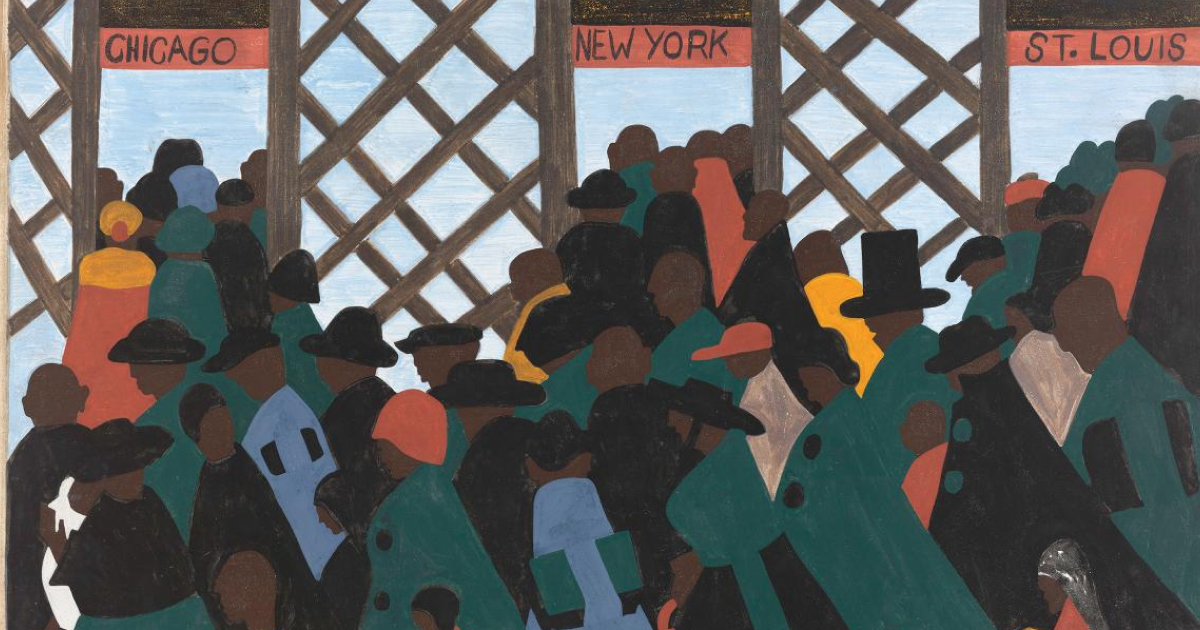
1916–1970

The Great Migration

The First Great Migration began during World War I, when northern factories suddenly needed labor and southern Black Americans began boarding trains for Chicago, Detroit, Cleveland, Pittsburgh, and New York. The Second Great Migration, after World War II, took even more people west to Los Angeles, Oakland, and Seattle. Over six decades, roughly six million people moved. The Chicago Defender — a Black-owned newspaper distributed in the South by Pullman porters — printed train schedules and editorials urging migration.

States & Culture 3 min read · May 3, 2026 · Editorial Team

“Get out of the South while the getting is good.”

— Chicago Defender editorial urging Black migration, 1917

The push factors were specific. Sharecropping had locked most southern Black farmers into debt peonage by the early twentieth century — the landlord owned the land, sold the seed and tools on credit, took half the crop at harvest, and kept the books. Lynchings reached their peak in the 1890s; the Equal Justice Initiative has documented at least 4,400 racial-terror lynchings between 1877 and 1950. The boll weevil arrived from Mexico in 1892 and reached Mississippi by 1907, destroying cotton crops and the agrarian economy they supported. The Great Mississippi Flood of 1927 displaced hundreds of thousands more.

The pull factors were as specific. Northern industry, cut off from European immigration by World War I and then by the 1924 Immigration Act, faced an acute labor shortage. Ford’s Highland Park plant in Detroit, the Pullman Company in Chicago, the steel mills of Pittsburgh, the slaughterhouses of Chicago’s South Side, the shipyards of Norfolk and Newport News — all began actively recruiting Black workers in the South. The wages were better, the legal regime less violent, and the cultural infrastructure — Black newspapers, Black churches, Black political clubs — already existed in the destination cities.

White employers in the South organized to stop the recruitment. Mississippi, Alabama, and Georgia passed anti-enticement laws that made it a crime to recruit Black workers across state lines. Pullman porters distributing the Chicago Defender risked arrest. Some southern cities banned the paper outright. None of it worked. Chain migration meant that each family pulled relatives north. Memphis lost a third of its Black population in the 1910s. Mississippi lost over 800,000 Black residents between 1910 and 1970 — about a third of its Black population.

The migration remade American culture. Jazz traveled with Louis Armstrong from New Orleans to Chicago to New York. The blues came up the Mississippi from the Delta to Chicago (Muddy Waters, Howlin’ Wolf) and to Detroit. Gospel was developed in the storefront churches of the urban North. The Harlem Renaissance of the 1920s — Langston Hughes, Zora Neale Hurston, Duke Ellington, Aaron Douglas — was its first cultural flowering. The Motown sound of the 1960s came from the children of migrants in Detroit. Hip-hop, born in the Bronx in the 1970s, was the music of the migrants’ grandchildren.

Jacob Lawrence, the son of two migrants, painted *The Migration Series* in 1940-41 — sixty small tempera panels documenting the journey. Half are at the Museum of Modern Art in New York; half are at the Phillips Collection in Washington. By 1970 the migration had slowed and then reversed. The New Great Migration, from 1970 to the present, has seen Black Americans returning to the South — to Atlanta, Houston, Charlotte, Raleigh-Durham — for the same reasons their grandparents left in the opposite direction. The country’s demographic geography would be unrecognizable without either movement.

Historical Record
Period
1916–1970
Category
States & Culture
Archive
America 250 — 1776–2026
Share this story
Continue Reading

More from States & Culture

All States & Culture →
1817 onward

The Birth of Jazz at Congo Square

In an open square in New Orleans, enslaved Africans were permitted to gather on Sundays. Their music — call-and-response, polyrhythm, improvisation — became jazz a century later.

1848–1850

The Gold Rush and California Statehood

James Marshall found gold at Sutter’s Mill on January 24, 1848. Three hundred thousand people arrived in two years. California became a state on September 9, 1850.

1892–1954

Ellis Island and the Immigration Century

Twelve million arrivals passed through Ellis Island between 1892 and 1954. The 1924 Immigration Act closed the gates for the next forty years.

Explore More Stories