The Birth of Jazz at Congo Square
In an open square in New Orleans, enslaved Africans were permitted to gather on Sundays. Their music — call-and-response, polyrhythm, improvisation — became jazz a century later.
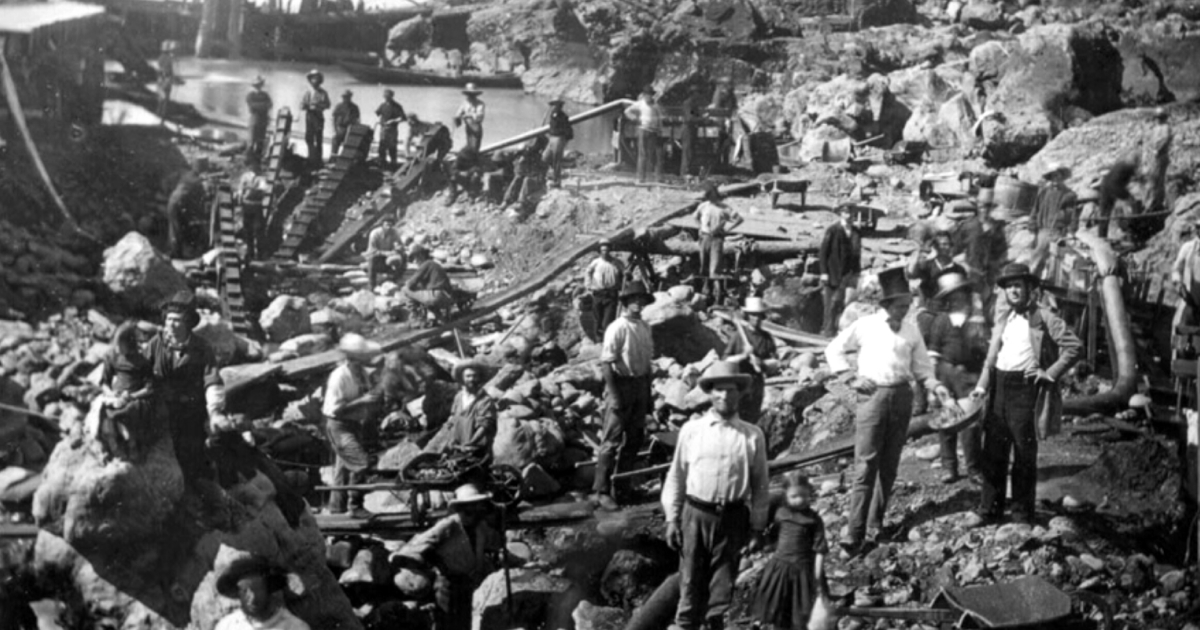
California had been Mexican territory for twenty-seven years when the Treaty of Guadalupe Hidalgo transferred it to the United States in February 1848 — eight days after James Marshall had noticed a flake of gold in the millrace at John Sutter’s lumber operation on the American River. By the end of 1849, eighty thousand people had arrived from every continent. By 1852, three hundred thousand. The Indigenous population of California, roughly 150,000 in 1848, dropped to about 30,000 by 1870 — the steepest decline in American history.
“That a war of extermination will continue to be waged between the two races until the Indian race becomes extinct must be expected. While we cannot anticipate this result but with painful regret, the inevitable destiny of the race is beyond the power and wisdom of man to avert.”
— California Governor Peter Burnett, State of the State address, January 6, 1851
The Forty-Niners came from every continent. Mining camps in the Sierra Nevada foothills filled with Chileans, Australians, Chinese, French, Mexicans, and Americans from the East Coast and South. San Francisco grew from a town of 200 in 1846 to a city of 25,000 by 1849. Most of the arrivals never struck enough gold to pay their passage; about eighty percent left empty-handed or did not return at all. The wealth flowed instead to the merchants who supplied them — Levi Strauss sold dry goods in San Francisco from 1853; the Crocker, Hopkins, Huntington, and Stanford families built the fortunes that financed the transcontinental railroad sixteen years later.
California’s Indigenous population had been roughly 150,000 in 1848 — a survival from the pre-contact estimate of perhaps 310,000, after decades of Spanish mission mortality. By 1870 the population was about 30,000. By 1900 it had reached its low point of around 16,000. The decline was the steepest in American history. Disease killed many; the destruction of food sources by mining and ranching killed many more; outright violence killed thousands. Governor Peter Burnett, in his 1851 message to the legislature, openly named the policy: “a war of extermination.” California paid bounties to militia companies that conducted campaigns against Indigenous communities. Historian Benjamin Madley’s 2016 book An American Genocide documents the state’s role in detail.
The Mexican Californios — the families who had received Spanish and Mexican land grants and run California’s cattle economy for generations — lost most of their land to American legal manipulation. The 1851 California Land Act required them to prove their titles before a federal commission, with the burden of proof on the Mexican claimants and the legal proceedings conducted entirely in English. Most claims took fifteen years to litigate; many cost more in legal fees than the land was worth. The Mexican Californio families that had owned most of southern California in 1848 had been largely dispossessed by 1880.
California became a state on September 9, 1850 — the only state admitted as part of the Compromise of 1850. The Compromise had several components. California entered as a free state, balanced against the Fugitive Slave Act, which deputized northern citizens to assist in returning escaped enslaved people to their owners. New Mexico and Utah territories were organized with “popular sovereignty” on slavery, leaving the question to local voters. The slave trade — but not slavery — was abolished in the District of Columbia. The Compromise held the Union together for ten years. The Fugitive Slave Act radicalized northern abolitionists, who began the Underground Railroad in earnest, and made compromise on slavery increasingly impossible.
Sutter’s Mill is preserved as a state park in Coloma. A bronze statue of James Marshall stands where he found the gold. The mill itself burned in 1856; a replica was built in 1968. The Yokuts and Maidu peoples whose villages had stood along the American River — and were destroyed first by the mill and then by the Gold Rush — are represented today by the Wilton Rancheria, the United Auburn Indian Community, and other federally recognized bands. California issued a formal apology for the genocide in June 2019.
In an open square in New Orleans, enslaved Africans were permitted to gather on Sundays. Their music — call-and-response, polyrhythm, improvisation — became jazz a century later.
Twelve million arrivals passed through Ellis Island between 1892 and 1954. The 1924 Immigration Act closed the gates for the next forty years.
Six million Black Americans left the South between 1916 and 1970, remaking the cities of the North and West. Jacob Lawrence painted them in sixty panels.