The Gold Rush and California Statehood
James Marshall found gold at Sutter’s Mill on January 24, 1848. Three hundred thousand people arrived in two years. California became a state on September 9, 1850.
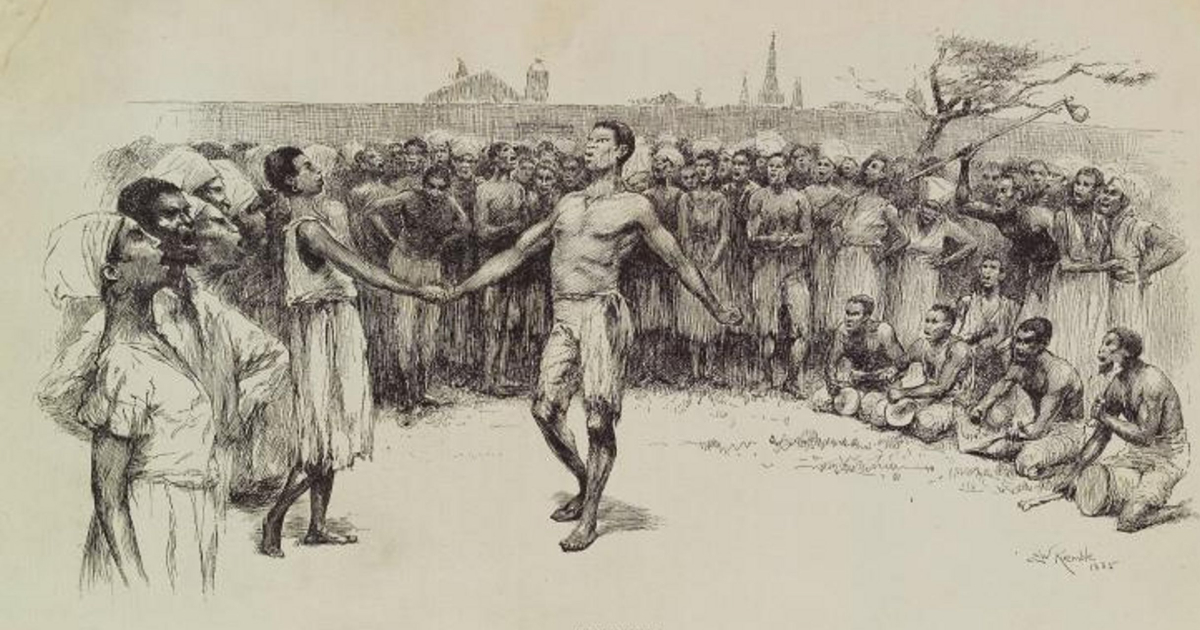
New Orleans was the only American city that permitted enslaved Africans to congregate publicly. From 1817 onward, by city ordinance, the gathering was confined to Sunday afternoons in an open lot called Place Congo, on the north side of the French Quarter near the city’s gunpowder magazine. Hundreds — sometimes more than a thousand — gathered to play bamboulas, drums covered in goatskin, banzas (the ancestor of the banjo), and to dance in styles that traced to the Kongo, Yoruba, Dahomey, and Fon homelands of the people enslaved there.
“Jazz started in New Orleans, and it’s nothing more or less than a combination of all the different forms of music that came to New Orleans.”
— Jelly Roll Morton, Library of Congress recordings, 1938
The 1817 ordinance was not an act of compassion. New Orleans had recently passed from French and Spanish rule to American, and the new authorities wanted enslaved gatherings visible and controlled rather than clandestine and dispersed. Sunday afternoons were the one period when most plantations allowed enslaved people not to work; the city set aside Place Congo and a few smaller squares for the day. White spectators came to watch what they considered exotic; foreign visitors recorded the gatherings in journals; the Anglo-American architect Benjamin Latrobe described them in detail in February 1819, the first detailed Western record of the music that would become jazz.
The instruments and rhythms were African. The bamboula was a Kongo drum; the banza was a West African plucked instrument that became the banjo. The dances — the kalenda, the bamboula, the chica — came directly from West and Central Africa. The vocal style of call-and-response, with a leader’s line answered by a chorus, traced to communal work songs and religious chants across the African diaspora. The rhythmic structure — multiple overlapping rhythms played simultaneously, a structure musicologists call polyrhythm — distinguished African music from the European traditions of single dominant meter.
The Civil War ended the gatherings. By the 1880s the square was being used for circuses and minstrel shows. But the music had absorbed into the city. The post-emancipation generation found work as musicians in brass bands and in the new fixtures of New Orleans nightlife: Storyville, the city’s sanctioned red-light district from 1897 to 1917, hired Black musicians by the dozen. Buddy Bolden, a cornet player who never recorded but is widely credited as the first jazz musician, played the streets of Storyville from the 1890s until a 1907 psychotic break ended his career. He died in a state asylum in 1931.
The word “jass” appeared in print around 1915, “jazz” by 1917. The Original Dixieland Jass Band, an all-white group, made the first jazz recording on February 26, 1917. The Black musicians who had created the music — King Oliver, Sidney Bechet, Louis Armstrong — recorded later and rarely on the same terms. Storyville closed in 1917 when the Department of the Navy ordered it shut as a corruption hazard to sailors. New Orleans musicians scattered north: Oliver and Armstrong to Chicago, where the Great Migration was creating Black urban audiences who wanted the music of home.
Louis Armstrong was born five blocks from Congo Square on August 4, 1901. He left New Orleans for Chicago at twenty-one. The square itself was renamed Beauregard Square in 1893 for a Confederate general, then renamed again in 2011 as Congo Square within Louis Armstrong Park. Jazz Fest is held there every spring. The drums never quite stopped.
James Marshall found gold at Sutter’s Mill on January 24, 1848. Three hundred thousand people arrived in two years. California became a state on September 9, 1850.
Twelve million arrivals passed through Ellis Island between 1892 and 1954. The 1924 Immigration Act closed the gates for the next forty years.
Six million Black Americans left the South between 1916 and 1970, remaking the cities of the North and West. Jacob Lawrence painted them in sixty panels.