Seneca Falls and the Long Suffrage
On July 19, 1848, three hundred delegates met in upstate New York and demanded the vote. Seventy-two years later, the Nineteenth Amendment was ratified.
The Stonewall Inn at 53 Christopher Street in Greenwich Village had been a Mafia-owned bar serving New York’s gay, lesbian, trans, and drag-queen communities since 1967. The Public Morals Squad of the New York Police Department raided it routinely — usually once a month, usually on a weeknight, usually with enough warning that the bar’s owners could close up and reopen the next day. The raid that began at 1:20 a.m. on Saturday, June 28, 1969, was different. The patrons did not disperse. Some of them fought back. The crowd outside grew to several hundred. By morning, the country had changed.
“Gay power exploded with a vengeance Saturday night.”
— Lucian Truscott IV, The Village Voice, July 3, 1969, on the Stonewall demonstrations
Eight officers led by Deputy Inspector Seymour Pine entered the bar at 1:20 a.m. to confiscate liquor and arrest anyone in violation of New York’s gender-impersonation statute, which made it illegal to wear fewer than three articles of clothing “belonging to one’s gender.” Patrons were lined up to have their IDs checked. The crowd outside grew. When a woman — long identified in oral history as Stormé DeLarverie, a Black lesbian club entertainer — was struck by an officer and asked the crowd, “Why don’t you guys do something?” a bottle hit the wall behind the police. By 1:30 a.m. the Tactical Patrol Force was being called in.
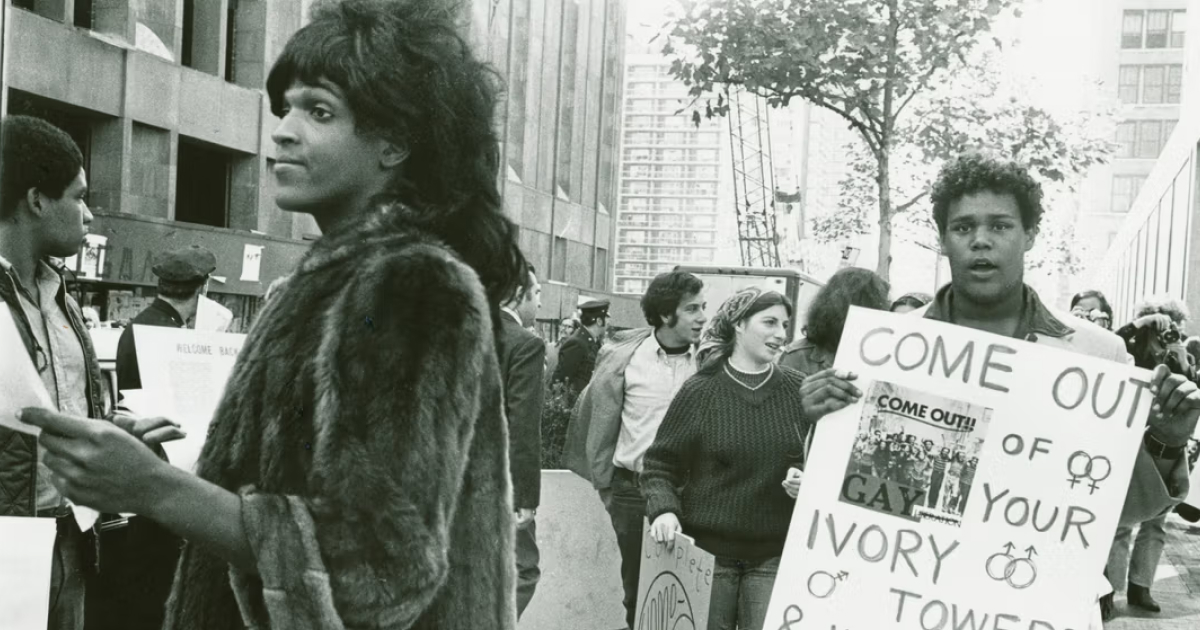
The Stonewall crowd reflected the actual demographics of New York’s queer underground in 1969 — disproportionately Black and Latino, disproportionately poor, disproportionately trans women and drag queens. Marsha P. Johnson, a Black trans woman from Elizabeth, New Jersey, was there. Sylvia Rivera, a 17-year-old Latina trans activist, was there. Stormé DeLarverie, a 49-year-old Black mixed-race entertainer, was there. The mostly white middle-class gay rights organizations of the 1950s and 1960s — the Mattachine Society, the Daughters of Bilitis — had argued for assimilation and respectability. The people at Stonewall did not have the option.
The first night’s confrontation lasted until roughly 4 a.m. The Tactical Patrol Force, in riot gear, retreated under bottles and bricks; the bar was set on fire and barricaded. The crowd reassembled the next night and the night after that — six nights of demonstrations through Greenwich Village, drawing thousands. The Village Voice covered it as a news event rather than a vice story. The Mattachine Society held an emergency meeting in early July and split over whether to align with the new radicalism. Two new organizations — the Gay Liberation Front and the Gay Activists Alliance — formed within the next year.
On June 28, 1970, the first anniversary of the raid, the Christopher Street Liberation Day March stepped off from the Stonewall Inn and walked uptown to Central Park. Roughly 5,000 marchers participated. Simultaneous marches were held in Los Angeles and Chicago. They became the first Pride parades. Marsha P. Johnson and Sylvia Rivera co-founded Street Transvestite Action Revolutionaries (STAR) in 1970, the first organization explicitly dedicated to trans and homeless queer youth. Both died in the 1990s, both poor.
The Stonewall Inn was designated a National Historic Landmark in 2000 and a National Monument by President Obama in 2016. The bar is still open. The block remains a pilgrimage site. The Christopher Street Liberation Day March became Pride; Pride became an industry; the radicalism of the original demonstration became contested terrain within the movement itself. The state-level fight over trans rights, public-accommodation laws, and gender-marker recognition continues in legislatures across the country — fifty-five years after a Black lesbian asked a crowd why they weren’t doing anything.
On July 19, 1848, three hundred delegates met in upstate New York and demanded the vote. Seventy-two years later, the Nineteenth Amendment was ratified.
On January 1, 1863, Lincoln declared enslaved people in rebellious states “forever free.” The proclamation freed no one immediately. The army that came after did.
On May 17, 1954, the Supreme Court ruled unanimously that “separate but equal” had no place in public schools. Linda Brown was in third grade. Implementation took decades.