1930s

The Dust Bowl and the New Deal

A decade of plowing the southern Plains for wheat had stripped the topsoil of its native grass cover. When drought returned in 1931, the wind picked the soil up. Between 1933 and 1939, the Dust Bowl region — western Oklahoma, the Texas Panhandle, southwestern Kansas, southeastern Colorado, northeastern New Mexico — was hit by hundreds of dust storms. The largest, Black Sunday on April 14, 1935, darkened the sky from the Dakotas to Texas and dropped soil on the U.S. Capitol the next day.

States & Culture 3 min read · May 4, 2026 · Editorial Team

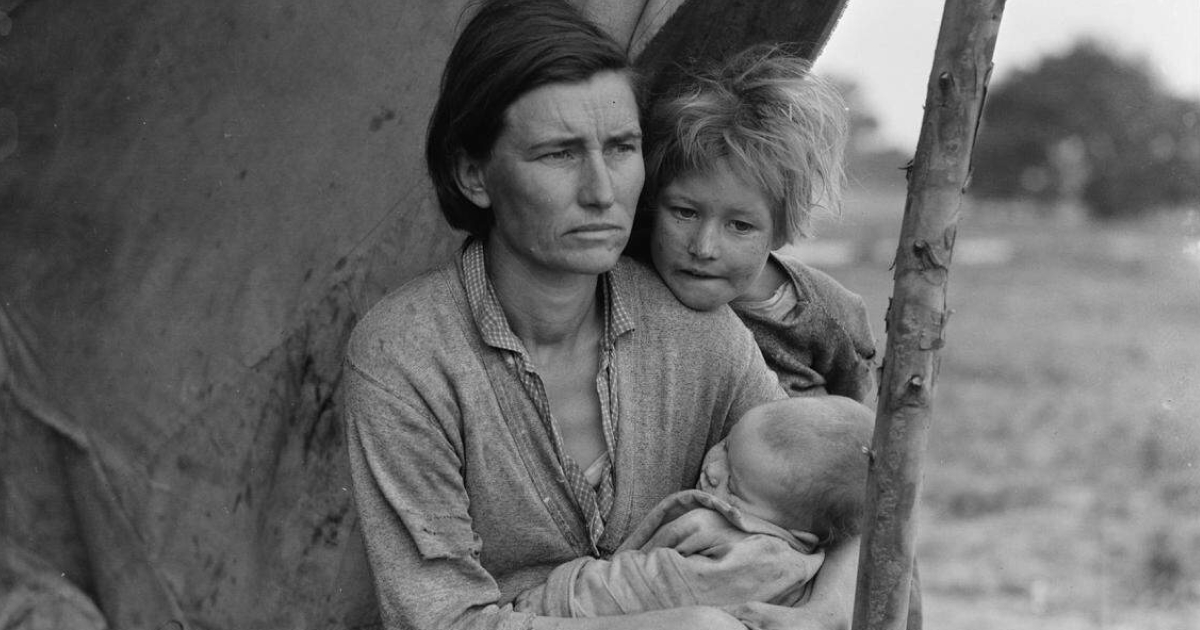
“Destitute pea pickers in California. Mother of seven children. Age thirty-two. Nipomo, California.”

— Dorothea Lange’s field caption for “Migrant Mother,” March 1936

The federal homestead laws of the late nineteenth century had encouraged wheat farming on the southern Plains, marginal land that had been buffalo range and short-grass prairie. Railroad promoters and land speculators advanced the doctrine that “rain follows the plow” — that breaking the sod would change the climate. World War I demand for wheat drove plow-up of millions of additional acres of grassland between 1914 and 1918. When wheat prices collapsed in the 1920s and drought returned in 1931, the dry topsoil — no longer held by grass roots — lifted in the wind.

The storms were enormous. The April 14, 1935 storm, Black Sunday, raised a wall of dust 200 miles wide moving at 65 miles per hour from the Dakotas to the Gulf of Mexico. It darkened skies as far east as the Atlantic seaboard; soil from Oklahoma and Texas was deposited on ships 300 miles off the Atlantic coast and on the Capitol steps in Washington the next day. Pneumonia from dust inhalation — “dust pneumonia” — killed an unknown number of people, mostly children and the elderly. The storms continued through 1939, ending only when normal rainfall returned.

Approximately 2.5 million people left the affected region. Most headed for California, lured by handbills promising agricultural jobs. They became known collectively as “Okies,” though only about one in five was actually from Oklahoma; the rest came from Texas, Arkansas, Missouri, and Kansas. California received them with hostility. The Los Angeles Police Department’s “Bum Blockade” of 1936 deputized officers at the state line to turn back arrivals without visible means of support. California Highway Patrol officers were sent to county lines to do the same.

The New Deal’s response was unprecedented in federal scale. Franklin Roosevelt’s administration created the Soil Conservation Service in April 1935, immediately after Black Sunday, to teach contour plowing, crop rotation, and shelterbelts. The Civilian Conservation Corps planted three billion trees across the Plains between 1933 and 1942. The Resettlement Administration (later the Farm Security Administration) bought up marginal land and helped displaced farmers relocate to better ground. Its Historical Section, led by Roy Stryker, hired Dorothea Lange, Walker Evans, Arthur Rothstein, Russell Lee, and Marion Post Wolcott to document the Depression in photographs that defined how Americans saw the era.

The Dust Bowl region’s topsoil never fully recovered; the practices learned then prevented a second Dust Bowl when drought returned in the 1950s. Center-pivot irrigation, introduced in the 1950s, has since allowed industrial farming of the southern Plains by tapping the Ogallala Aquifer — fossil water from the last Ice Age, being drawn down 8 inches per year, projected to be functionally depleted in parts of Kansas and Texas within 50 years. The Soil Conservation Service still exists, renamed the Natural Resources Conservation Service. So does the drought, which has returned each decade since.

Historical Record
Period
1930s
Category
States & Culture
Archive
America 250 — 1776–2026
Share this story
Continue Reading

More from States & Culture

All States & Culture →
1817 onward

The Birth of Jazz at Congo Square

In an open square in New Orleans, enslaved Africans were permitted to gather on Sundays. Their music — call-and-response, polyrhythm, improvisation — became jazz a century later.

1848–1850

The Gold Rush and California Statehood

James Marshall found gold at Sutter’s Mill on January 24, 1848. Three hundred thousand people arrived in two years. California became a state on September 9, 1850.

1892–1954

Ellis Island and the Immigration Century

Twelve million arrivals passed through Ellis Island between 1892 and 1954. The 1924 Immigration Act closed the gates for the next forty years.

Explore More Stories