The Wright Brothers’ First Flight
On December 17, 1903, at Kill Devil Hills near Kitty Hawk, Orville Wright lifted off the sands for twelve seconds and 120 feet. Five years later, Wilbur flew for over an hour.
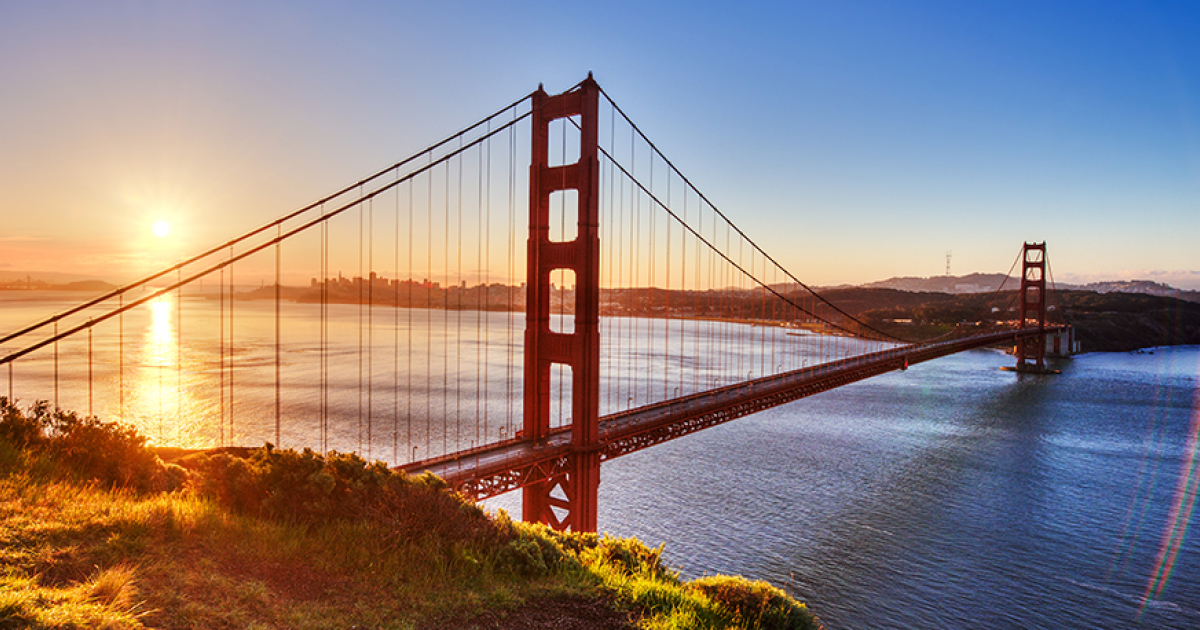
On the morning of May 27, 1937, roughly 200,000 people walked across the Golden Gate Bridge before a single car was allowed through. They had waited years for this. The bridge had been called impossible — too wide a strait, too powerful a current, too dense a fog, too dangerous a seabed. Chief engineer Joseph Strauss had heard every objection and built the bridge anyway. When it opened to vehicles the following day, May 28, it was the longest suspension bridge in the world. It held that record for 27 years.
“The coldest winter I ever spent was a summer in San Francisco.”
— Attributed to Mark Twain
The idea of a bridge across the Golden Gate strait had been floated for decades before anyone took it seriously. The U.S. Army opposed it — the strait was the entrance to San Francisco Bay and a strategic military channel. Engineers said the currents were too powerful, the depth too great, the fog too constant. San Francisco ferry companies, which operated a profitable fleet across the bay, lobbied against it. The estimated cost kept rising. When Joseph Strauss first proposed the bridge in 1921, he was largely dismissed.
The politics shifted in the late 1920s. A bond measure passed in 1930, backed by the counties of the North Bay who wanted direct road access to San Francisco. The bonds were personally guaranteed by A.P. Giannini of Bank of America when no Wall Street firm would touch them during the Depression. Construction began on January 5, 1933, with 6,500 workers at its peak — men who had come from across the country during the worst unemployment crisis in American history, willing to work at dizzying heights above a freezing, fast-moving strait for $4 a day.
The engineering was unprecedented. The two towers rise 746 feet above the water — taller than any structure on the West Coast at the time. The main cables are each 7,650 feet long and contain 27,572 individual wire strands. The Art Deco towers were the result of a last-minute intervention: sculptor Irving Morrow convinced Strauss to abandon plain steel in favor of a designed silhouette. Morrow also chose the color — International Orange — because it complemented the natural surroundings and remained visible in fog. The U.S. Navy had wanted it painted black and yellow for visibility. Morrow won.
Safety on the construction site was unusually rigorous for the era. Strauss required hard hats, safety lines, and a net suspended beneath the bridge — a "life net" that caught 19 men who fell during construction. They called themselves the Halfway to Hell Club. Eleven men died anyway, ten of them in a single scaffolding collapse on February 17, 1940, after the main construction was complete.
The bridge opened to pedestrians on May 27, 1937. Approximately 200,000 people crossed on foot, on roller skates, and on stilts. President Franklin D. Roosevelt pressed a telegraph key in Washington to signal the official opening to vehicles on May 28. The final cost was $35 million — $27 million under the original estimate. The bonds were paid off in 1971. The bridge has been repainted continuously since it opened; the paint crew finishes one end and starts over at the other.
It has been the site of more than 1,700 confirmed suicides since it opened — a number that led, after decades of political resistance, to the installation of a suicide deterrent net completed in 2023. It has survived the 1989 Loma Prieta earthquake, which closed the Bay Bridge for a month. On its 50th anniversary in 1987, the bridge was closed to vehicles and opened to pedestrians — so many came that the center span deflected seven feet under the weight of the crowd, briefly flattening its characteristic arc. The bridge held.
Today roughly 10 million vehicles cross the Golden Gate each year. The bridge appears in more photographs than almost any other structure on earth. It has been destroyed in dozens of films. It remains, 87 years after it opened, the entry point to one of the most consequential cities in American history — and the most immediately recognizable piece of infrastructure the United States has ever built.
On December 17, 1903, at Kill Devil Hills near Kitty Hawk, Orville Wright lifted off the sands for twelve seconds and 120 feet. Five years later, Wilbur flew for over an hour.
In secret across 30 sites and 600,000 workers between 1939 and 1945, the United States built the first nuclear weapons. Trinity, July 16. Hiroshima, August 6. Nagasaki, August 9.
On July 20, 1969, at 4:17 p.m. EDT, Apollo 11 landed in the Sea of Tranquility. The race that put a flag there began with a Cold War deficit and ended with one footprint.