1990–2003

The Human Genome Project

The Human Genome Project was launched in October 1990 by the Department of Energy and the National Institutes of Health, with international partners in the United Kingdom, France, Germany, Japan, and China. James Watson, who had co-discovered the DNA double helix in 1953, was the first director. Francis Collins took over in 1993. The goal was to sequence all three billion base pairs of the human genome — a thousand-fold scale-up from anything that had been done.

Innovation & Progress 3 min read · May 11, 2026 · Editorial Team

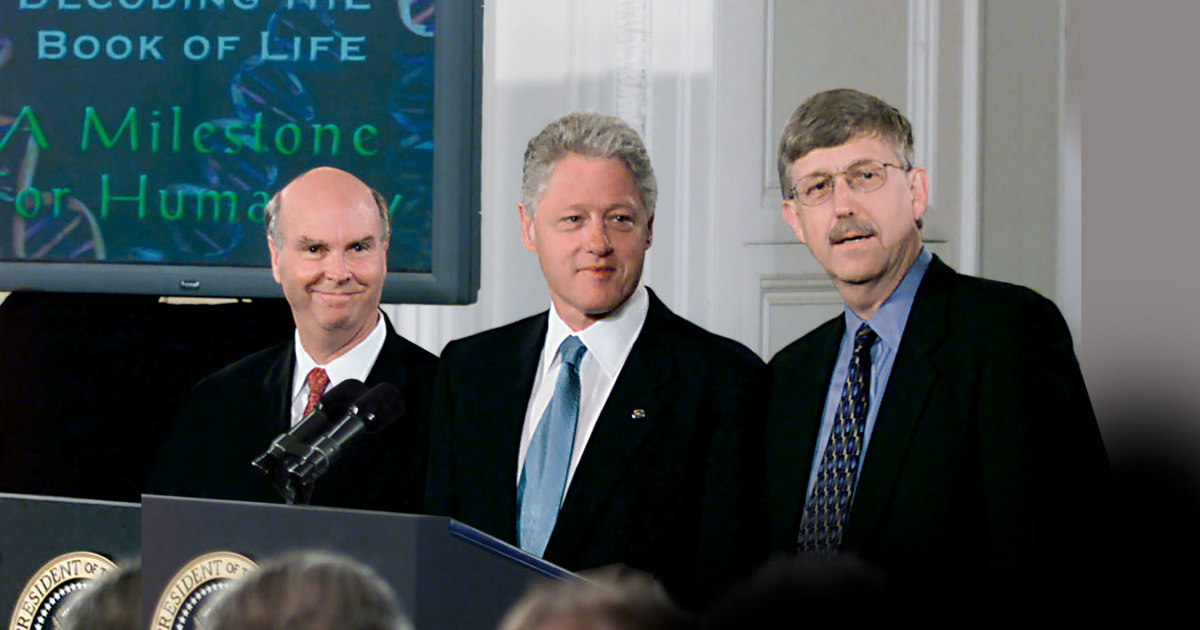
“Today we are learning the language in which God created life.”

— President Bill Clinton, White House announcement of the working draft of the Human Genome, June 26, 2000

The project nearly was outpaced by Craig Venter’s private company Celera Genomics, founded in 1998 with $300 million in venture funding and the explicit goal of sequencing the genome faster than the public project and patenting commercially valuable genes. Celera used whole-genome shotgun sequencing — randomly cutting the genome into fragments, sequencing them, and reassembling — while the public consortium had been doing slower hierarchical mapping. The competition accelerated both timelines but threatened the public-domain principle the consortium had built the project on.

President Clinton and U.K. Prime Minister Tony Blair intervened on March 14, 2000 with a joint statement declaring that “raw fundamental data on the human genome… should be made freely available to scientists everywhere.” The statement crashed biotech stocks for two days. Three months later, on June 26, 2000, Clinton, Collins, and Venter announced a joint working draft at the White House. The data — both the public consortium’s and Celera’s — went into the public domain. Celera’s gene patents were preempted before they were granted.

The full sequence was published April 14, 2003 — fifty years to the day after Watson and Crick’s paper in Nature describing the DNA double helix. The genome was 99.99 percent complete; the remaining gaps were filled by the Telomere-to-Telomere consortium in 2022. The project had cost $2.7 billion over thirteen years. The data revealed surprises: humans have only about 20,000 protein-coding genes (far fewer than the 100,000 some had predicted); humans share 99.9 percent of their DNA with each other; most of the genome is regulatory or non-coding rather than gene-coding; the concept of biological race has no genetic basis as a discrete category.

The technology spun out of the project transformed medicine over the next twenty years. Targeted cancer therapies based on tumor genetic profiling now exist for many cancers. Rare disease diagnosis — once a years-long odyssey — can be resolved in days with whole-genome sequencing. Pharmacogenomics tailors drug dosages to genetic metabolism profiles. CRISPR-Cas9 gene editing, developed by Jennifer Doudna and Emmanuelle Charpentier in 2012 (Nobel 2020), made gene editing precise enough for medical applications. Consumer genealogy companies like 23andMe and Ancestry have sequenced more than thirty million individual genomes.

The first human genome cost $2.7 billion and took 13 years. By 2024, a complete human genome could be sequenced in under a day for less than $200. The Genetic Information Nondiscrimination Act of 2008 protects Americans against genetic discrimination by health insurers and employers, but not by life insurers or long-term care providers. The ethical questions the project anticipated — privacy, discrimination, eugenic gene selection, designer babies — have outpaced the policy responses. The Human Genome Project’s data was placed in the public domain. The technology that uses it mostly was not.

Historical Record
Period
1990–2003
Category
Innovation & Progress
Archive
America 250 — 1776–2026
Share this story
Continue Reading

More from Innovation & Progress

All Innovation & Progress →
1903

The Wright Brothers’ First Flight

On December 17, 1903, at Kill Devil Hills near Kitty Hawk, Orville Wright lifted off the sands for twelve seconds and 120 feet. Five years later, Wilbur flew for over an hour.

1939–1945

The Manhattan Project

In secret across 30 sites and 600,000 workers between 1939 and 1945, the United States built the first nuclear weapons. Trinity, July 16. Hiroshima, August 6. Nagasaki, August 9.

1969

Apollo 11 and the Moon Landing

On July 20, 1969, at 4:17 p.m. EDT, Apollo 11 landed in the Sea of Tranquility. The race that put a flag there began with a Cold War deficit and ended with one footprint.

Explore More Stories