1869

The Transcontinental Railroad

The Pacific Railway Act of 1862 authorized two private companies to build a transcontinental line from Omaha west and from Sacramento east, each subsidized with federal land grants and government bonds per mile of track. The Union Pacific employed mostly Irish immigrants and Civil War veterans. The Central Pacific, working east from California into the Sierra Nevada, ran out of white laborers and began recruiting Chinese workers in 1865.

Conflict & Transformation 3 min read · April 30, 2026 · Editorial Team

“May God continue the unity of our country as this Railroad unites the two great Oceans of the world.”

— Inscription on the Golden Spike driven at Promontory Summit, May 10, 1869

About fifteen thousand Chinese laborers — most recruited from Guangdong province through labor contractors — built the western half. They blasted tunnels through Sierra Nevada granite, working in winter snow drifts that buried camps for weeks. They handled the nitroglycerine that proved more dangerous and less controllable than dynamite, which had not yet been invented. They were paid $26 to $35 a month, less than the $30-35 plus housing and food received by white workers. They lived separately in their own camps. Estimates of Chinese deaths during construction range from 1,200 to over 3,000, though the records are incomplete because the company did not consistently report Chinese casualties.

The Central Pacific’s Big Four — Leland Stanford, Collis Huntington, Mark Hopkins, and Charles Crocker — became among the richest men in the country. Stanford, who had also been California’s wartime governor, founded the university that bears his name on the wealth the railroad produced. Crocker, the construction boss, openly defended Chinese labor against the racist objections of his white workforce and Sacramento politicians: “Chinamen built the Great Wall, the biggest piece of masonry in the world.” This defense was strategic, not principled; he later supported the Chinese Exclusion Act that ended Chinese immigration entirely.

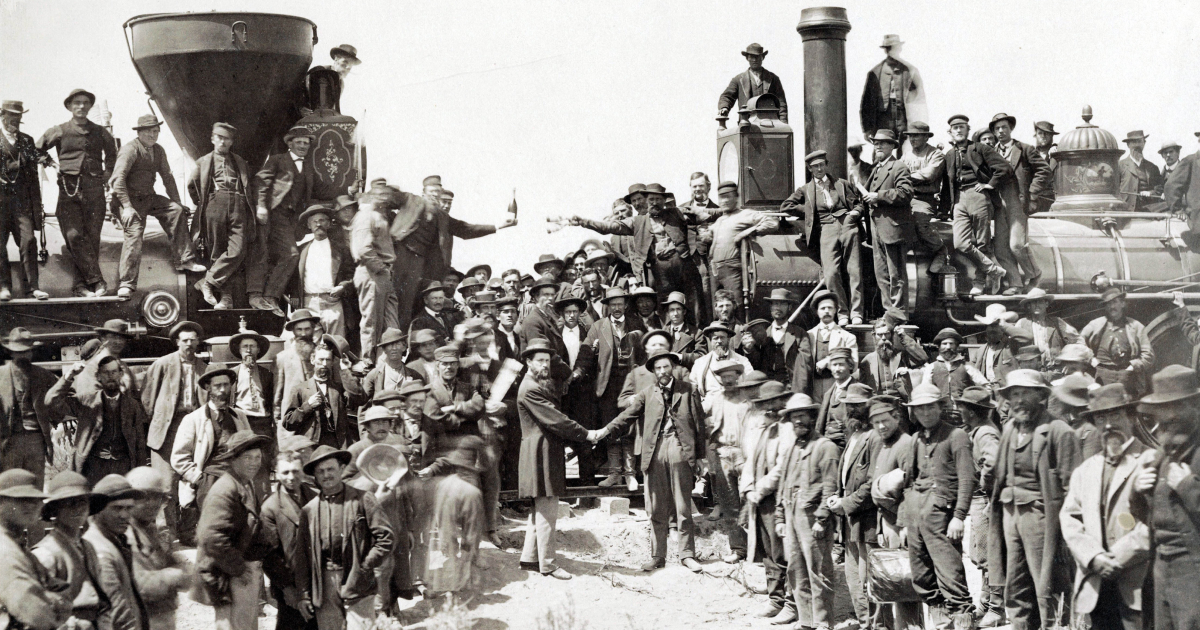
The Union Pacific, building west from Omaha, had its own labor force of Irish immigrants and Civil War veterans, plus Black workers and Mormons hired in Utah. The two lines met at Promontory Summit, Utah, on May 10, 1869 — about 70 miles north of Salt Lake City. The Golden Spike ceremony at noon was a transcontinental event, with the telegraph operators tapping out “DONE” the moment the spike was struck. Cannons were fired in Washington; bells rang in San Francisco; church services were held across the country.

Andrew J. Russell’s photograph of the ceremony — “East and West Shaking Hands at Laying of Last Rail” — became the iconic image. Two locomotives face each other across the joined track; engineers shake hands across the boiler; Stanford and other dignitaries stand around. The hundreds of Chinese laborers who had laid the final ten miles of track in a single day (a Central Pacific stunt to win a bet) are not in the photograph. They had been moved out of the frame.

The Chinese Exclusion Act of 1882 was the first federal law to ban immigration by nationality. It was not repealed until 1943, when China became a U.S. ally in World War II. The U.S. Senate formally apologized in 2011, the House in 2012, for the exclusion era. The Golden Spike at Promontory was driven 156 years ago. The Chinese laborers’ names are mostly still missing from the Stanford archives, the federal records, and the famous photograph.

Historical Record
Period
1869
Category
Conflict & Transformation
Archive
America 250 — 1776–2026
Share this story
Continue Reading

More from Conflict & Transformation

All Conflict & Transformation →
1803

The Louisiana Purchase

On April 30, 1803, France sold 828,000 square miles for $15 million. Napoleon needed cash; Jefferson doubled the country. The land was already inhabited by dozens of nations.

1838–1839

The Trail of Tears

Between 1838 and 1839, the federal government forced 16,000 Cherokee from their ancestral lands to Indian Territory. Roughly 4,000 died on the 5,043-mile march.

1861–1865

The Civil War

Four years of war, roughly 750,000 dead — historian J. David Hacker’s revised estimate. Ended at Appomattox on April 9, 1865. Reconstruction lasted twelve.

Explore More Stories