1892

Homer Plessy

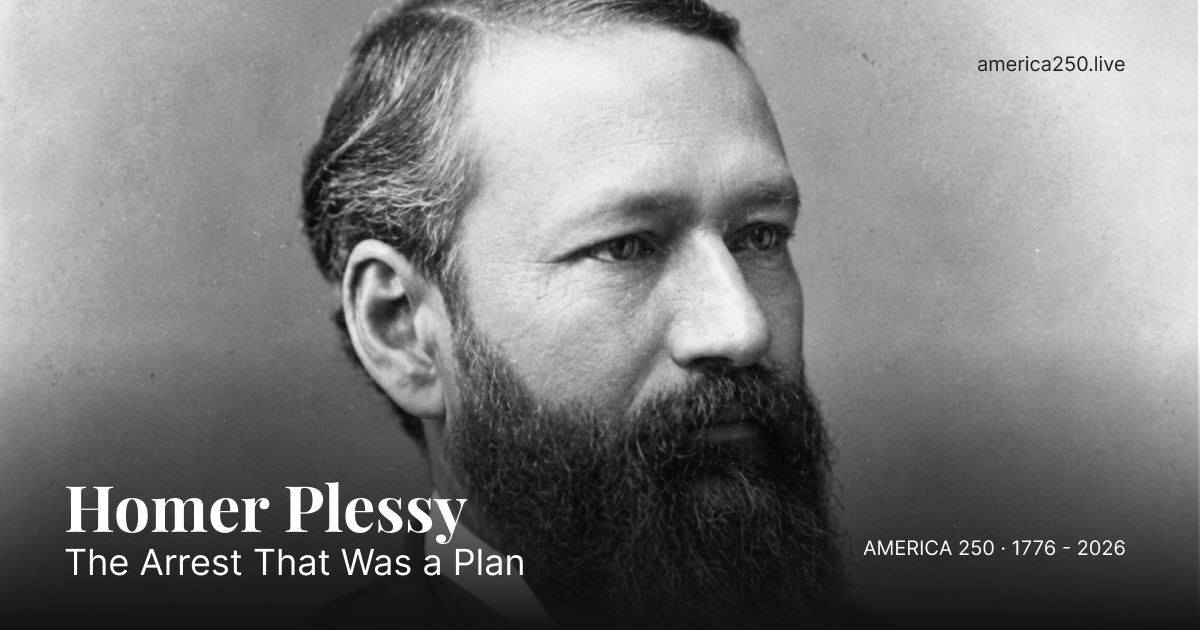
Homer Adolph Plessy was born on March 17, 1863, in New Orleans, a free man of color in a city with a long Creole tradition of mixed ancestry. By trade he was a shoemaker. By the racial arithmetic of Louisiana law he was seven-eighths white and one-eighth Black, which under the Separate Car Act of 1890 made him Black. On June 7, 1892, at the age of 29, he boarded the East Louisiana Railroad Number 8 train at the Press Street Depot in New Orleans and sat in a car reserved for whites. He had been recruited to do exactly that. The arrest that followed was arranged in advance, down to the detective who made it.

Civil Rights & Society 5 min read · June 5, 2026 · Editorial Team

“Our Constitution is color-blind, and neither knows nor tolerates classes among citizens.”

— Justice John Marshall Harlan, dissenting, Plessy v. Ferguson, 1896

New Orleans after the Civil War had been, briefly, one of the more integrated cities in America. Its Creole community — French-speaking, Catholic, often of mixed race and long free — had voted, held office, and ridden the streetcars beside white passengers during Reconstruction. Then the federal troops withdrew, Reconstruction ended, and the South set about rebuilding the racial order the war had supposedly destroyed. In 1890 the Louisiana legislature passed the Separate Car Act, requiring railroads to provide "equal but separate" cars for white and Black passengers. It was one law among hundreds going up across the South — the architecture of what would come to be called Jim Crow.

A group of New Orleanians decided to fight it before it hardened. They called themselves the Comité des Citoyens — the Citizens' Committee — and they were exactly the people the new laws were meant to put back in their place: educated Creoles, newspapermen, veterans, professionals. They published a newspaper, The Crusader. They raised money. They engaged one of the most prominent civil rights lawyers in the country, Albion Tourgée, a white Radical Republican novelist and judge, who took the case without fee. And they planned a test — a deliberate, controlled violation of the law, designed to climb all the way to the Supreme Court.

They needed the right defendant. They chose Homer Plessy in part because of how he looked: his skin was light enough that he could buy a first-class ticket and take a whites-only seat without being stopped at the door, which meant the case would turn cleanly on the law itself and not on whether anyone could tell. The committee arranged everything. They notified the railroad in advance — the railroads disliked the Separate Car Act because running extra cars cost them money. They hired a private detective, Christopher Cain, to make the arrest, and to charge Plessy specifically under the Separate Car Act, so that the case would test that statute and no other.

On June 7, 1892, Plessy bought his ticket, boarded the train bound for Covington, and took his seat. The conductor asked whether he was a colored man. Plessy said he was. He was told to move to the colored car. He refused, saying he was an American citizen who had paid for a first-class seat and intended to keep it. The conductor stopped the train. Detective Cain boarded, arrested him, and removed him from the car. The whole thing went exactly as it had been designed to go. Plessy spent a night in jail; the committee posted a 500-dollar bond.

The legal machine the committee had built then did its slow work. Plessy was convicted in the criminal court of Orleans Parish before Judge John Howard Ferguson, who ruled that Louisiana had the power to regulate railroads operating within its own borders. Plessy's name and Ferguson's were joined in the case that climbed, over four years, to Washington. On May 18, 1896, the Supreme Court of the United States ruled, seven to one, that the Separate Car Act was constitutional. Segregation, the Court held, did not violate the Fourteenth Amendment's guarantee of equal protection so long as the separate facilities were equal. The doctrine now had a name: separate but equal.

One justice dissented. John Marshall Harlan — a former slaveholder from Kentucky who had come to believe the opposite of nearly everything his class believed — wrote that the Constitution was color-blind and recognized no caste among citizens. He predicted almost exactly what the decision would do: that it would let the states defeat the purpose of the Civil War amendments, and that it would plant the seeds of racial hatred under the cover of law. He was alone. His dissent persuaded no one on the Court that day and became, decades later, one of the most quoted opinions in American history — because he was right, and the majority was wrong.

The cost of being wrong was measured in lifetimes. Separate but equal stood as the law of the land for fifty-eight years. It justified segregated schools, hospitals, theaters, water fountains, and cemeteries — an entire civilization built on the legal fiction that separate could be equal, when the entire point of it was that it was not. It was not overturned until May 17, 1954, when the Court ruled in Brown v. Board of Education that separate educational facilities are inherently unequal. By then Homer Plessy had been dead for nearly thirty years. He died in New Orleans in 1925, having lived out a quiet life as an insurance agent, his part in history mostly forgotten by the city around him.

In 2022, the state of Louisiana posthumously pardoned him — 130 years after he sat down in the wrong car on purpose. There is a marker now at Press and Royal Streets, where the train stopped. The men who organized his arrest lost their case and won the argument; it only took six decades and a second Supreme Court to admit it. The promise the founders wrote down and did not keep — that all are created equal — has never once enforced itself. In two hundred and fifty years it has only ever been made real the way Homer Plessy tried to make it real: by ordinary people willing to be arrested for the distance between what the country wrote and what it did.

Historical Record
Period
1892
Category
Civil Rights & Society
Archive
America 250 — 1776–2026
Share this story
Continue Reading

More from Civil Rights & Society

All Civil Rights & Society →
1848–1920

Seneca Falls and the Long Suffrage

On July 19, 1848, three hundred delegates met in upstate New York and demanded the vote. Seventy-two years later, the Nineteenth Amendment was ratified.

1863

Emancipation Proclaimed

On January 1, 1863, Lincoln declared enslaved people in rebellious states “forever free.” The proclamation freed no one immediately. The army that came after did.

1954

Brown v. Board of Education

On May 17, 1954, the Supreme Court ruled unanimously that “separate but equal” had no place in public schools. Linda Brown was in third grade. Implementation took decades.

Explore More Stories