1791

The Bill of Rights

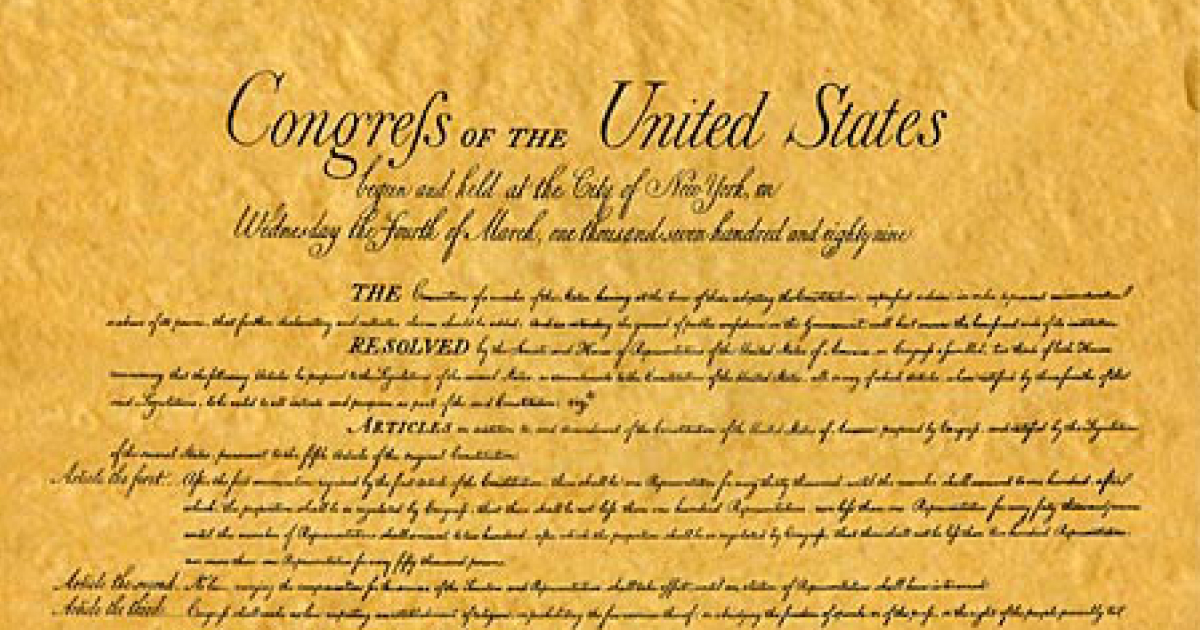
The Constitution drafted in 1787 had no enumerated rights. Anti-Federalists led by George Mason refused to ratify without one; the ratification of Massachusetts and Virginia turned on the promise of amendments to follow. James Madison drafted twelve in 1789, drawing from the Virginia Declaration of Rights and the English Bill of Rights of 1689. Congress sent ten to the states. Virginia, the eleventh of fourteen states, ratified the package on December 15, 1791.

Founding Era 3 min read · April 21, 2026 · Editorial Team

“Congress shall make no law respecting an establishment of religion, or prohibiting the free exercise thereof; or abridging the freedom of speech, or of the press; or the right of the people peaceably to assemble, and to petition the Government for a redress of grievances.”

— First Amendment to the U.S. Constitution, ratified December 15, 1791

The ten amendments cover: speech, press, religion, assembly, and petition (1); the right to bear arms (2); no quartering of soldiers in private homes (3); no unreasonable search or seizure (4); due process, no double jeopardy, no self-incrimination (5); speedy public trial by jury, right to confront witnesses, right to counsel (6); civil jury trial for disputes over twenty dollars (7); no excessive bail or cruel and unusual punishment (8); unenumerated rights retained by the people (9); powers not delegated to the federal government reserved to the states or to the people (10).

The Bill of Rights originally applied only to the federal government. State governments could establish churches, restrict speech, search homes without warrants, and impose religious tests for office. Several New England states had state-established Congregational churches into the 1830s. The Fifth Amendment’s due-process clause did not bind state courts until 1925. The First Amendment’s free-speech clause was first applied to a state law — and struck it down — in Gitlow v. New York that same year. The process of “incorporating” the Bill of Rights against state action through the Fourteenth Amendment took decades and is in some areas still incomplete.

The Second Amendment’s meaning was litigated continuously. For most of the country’s history it was interpreted as a collective right tied to militia service. In District of Columbia v. Heller (2008), the Supreme Court ruled five to four that it protects an individual right to keep arms in the home for self-defense, and in McDonald v. Chicago (2010) incorporated that right against the states. The dispute over what arms, in what contexts, for whom, remains active in every federal circuit.

The Fourth Amendment’s exclusionary rule — that evidence obtained in an unconstitutional search cannot be used against a defendant — was applied to federal cases in 1914 and extended to state cases by Mapp v. Ohio in 1961. The Sixth Amendment’s right to counsel for indigent defendants in felony cases was finally guaranteed by Gideon v. Wainwright in 1963, 172 years after ratification. The Eighth Amendment’s prohibition of “cruel and unusual punishment” has been applied to states since Robinson v. California (1962); its meaning is still litigated in capital and excessive-sentence cases.

Of the twelve amendments Madison drafted in 1789, ten were ratified in 1791. One — limiting congressional pay raises — finally ratified in 1992, after more than two hundred years, as the Twenty-Seventh Amendment. One — apportioning the House of Representatives — was never ratified and is technically still pending. The Bill of Rights is not closed. The American constitutional argument is not done.

Historical Record
Period
1791
Category
Founding Era
Archive
America 250 — 1776–2026
Share this story
Continue Reading

More from Founding Era

All Founding Era →
1619

The First Enslaved Africans Arrive

August 20, 1619: the White Lion landed at Point Comfort with twenty Angolans aboard — the first documented enslaved Africans in English North America.

pre-1776

The Haudenosaunee Influence on American Democracy

The Six Nations of the Haudenosaunee Confederacy — Mohawk, Oneida, Onondaga, Cayuga, Seneca, Tuscarora — governed by a constitution older than the country that borrowed from it.

1776

The Declaration of Independence

On July 4, 1776, fifty-six delegates signed a document declaring that government draws its just powers from the consent of the governed. Many of them held people in bondage.

Explore More Stories