The First Enslaved Africans Arrive
August 20, 1619: the White Lion landed at Point Comfort with twenty Angolans aboard — the first documented enslaved Africans in English North America.
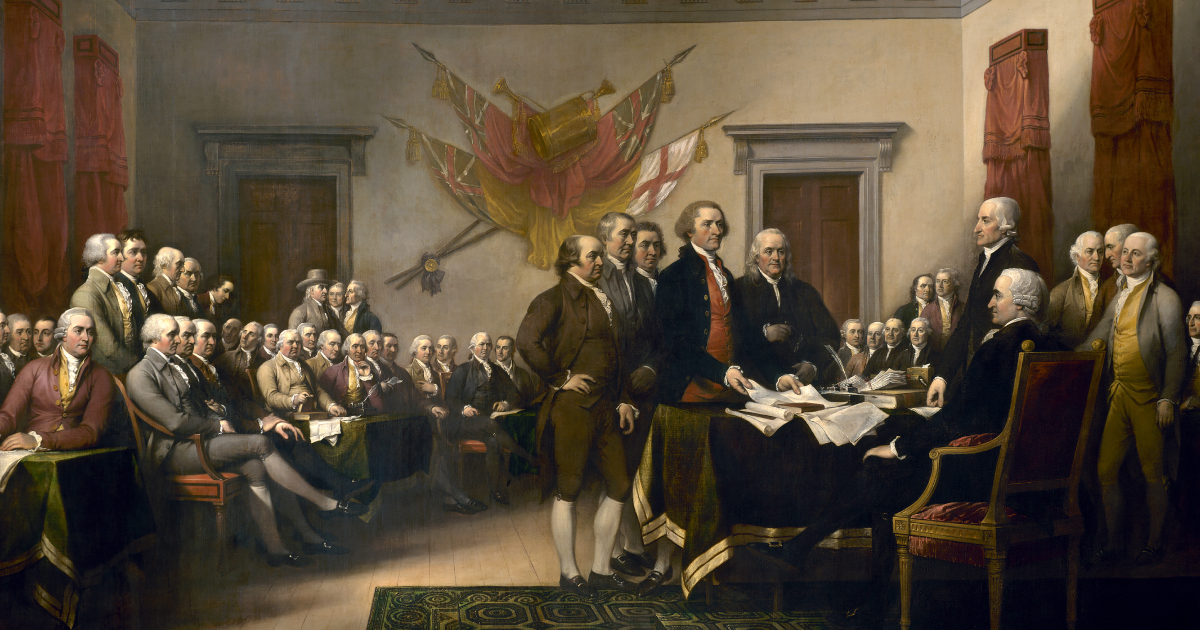
Thomas Jefferson drafted the Declaration over seventeen days in late June 1776, working alone in a rented Philadelphia parlor. The Continental Congress edited it for two days, removing among other passages Jefferson’s attempt to blame King George III for the slave trade — a clause the southern delegations refused to allow. The final text was approved on July 2 and adopted on July 4. The signing happened later, mostly on August 2. Thirty-four of the fifty-six signers enslaved other human beings at some point in their lives.
“We hold these truths to be self-evident, that all men are created equal, that they are endowed by their Creator with certain unalienable Rights, that among these are Life, Liberty and the pursuit of Happiness.”
— The Declaration of Independence, July 4, 1776
The Second Continental Congress had been meeting in Philadelphia since May 1775. By June 1776, Richard Henry Lee of Virginia had introduced a resolution for independence. Congress appointed a Committee of Five to draft the document — John Adams of Massachusetts, Benjamin Franklin of Pennsylvania, Roger Sherman of Connecticut, Robert Livingston of New York, and Jefferson of Virginia. The other four delegated the writing to the thirty-three-year-old Jefferson, who took a desk at Jacob Graff’s house at Seventh and Market and produced a draft in just over two weeks.
The committee edited Jefferson’s text lightly, then sent it to the full Congress. Congress edited it heavily over the days of July 2-4, cutting roughly a quarter. The single largest deletion was Jefferson’s clause blaming King George for the transatlantic slave trade — a passage that referred to the trade as “this execrable commerce” and “piratical warfare.” The South Carolina and Georgia delegations objected; some northern delegates whose commerce depended on the trade objected. The clause was struck. Jefferson, who himself enslaved more than 600 people over his lifetime, never publicly defended the cut.
Independence was approved on July 2, 1776, by a vote of twelve colonies in favor — New York abstained, then ratified on July 9. The Declaration’s text was adopted on July 4. John Adams predicted that July 2 would be the date Americans remembered. He was wrong by two days. Most signers did not sign on July 4; the engrossed parchment was prepared in early August, and most delegates signed it on August 2. Some never signed at all.
The Declaration was printed that night by John Dunlap, a Philadelphia broadsides printer. Roughly 200 copies were distributed; about 26 survive today. The text was read aloud in Philadelphia on July 8 and at the head of George Washington’s army on July 9. It reached London newspapers by mid-August. King George’s response was to commit additional troops to the American war; he had committed thirty thousand by 1778, and lost the war anyway by 1781.
The Declaration’s claim of universal human equality has been the standard against which every American civil rights movement has measured itself: Seneca Falls in 1848 echoed its language directly; Frederick Douglass’s 1852 “What to the Slave Is the Fourth of July?” address held the country to its words; the Civil Rights Movement, Stonewall, and the disability rights movement all returned to “all men are created equal.” The contradiction the Continental Congress edited out — that the men who wrote it owned human beings — has been the country’s central argument ever since.
August 20, 1619: the White Lion landed at Point Comfort with twenty Angolans aboard — the first documented enslaved Africans in English North America.
The Six Nations of the Haudenosaunee Confederacy — Mohawk, Oneida, Onondaga, Cayuga, Seneca, Tuscarora — governed by a constitution older than the country that borrowed from it.
Drafted in Philadelphia over four months in 1787, ratified by nine states in 1788. The oldest written national charter still in force — and the three-fifths compromise was in its original text.