The First Enslaved Africans Arrive
August 20, 1619: the White Lion landed at Point Comfort with twenty Angolans aboard — the first documented enslaved Africans in English North America.
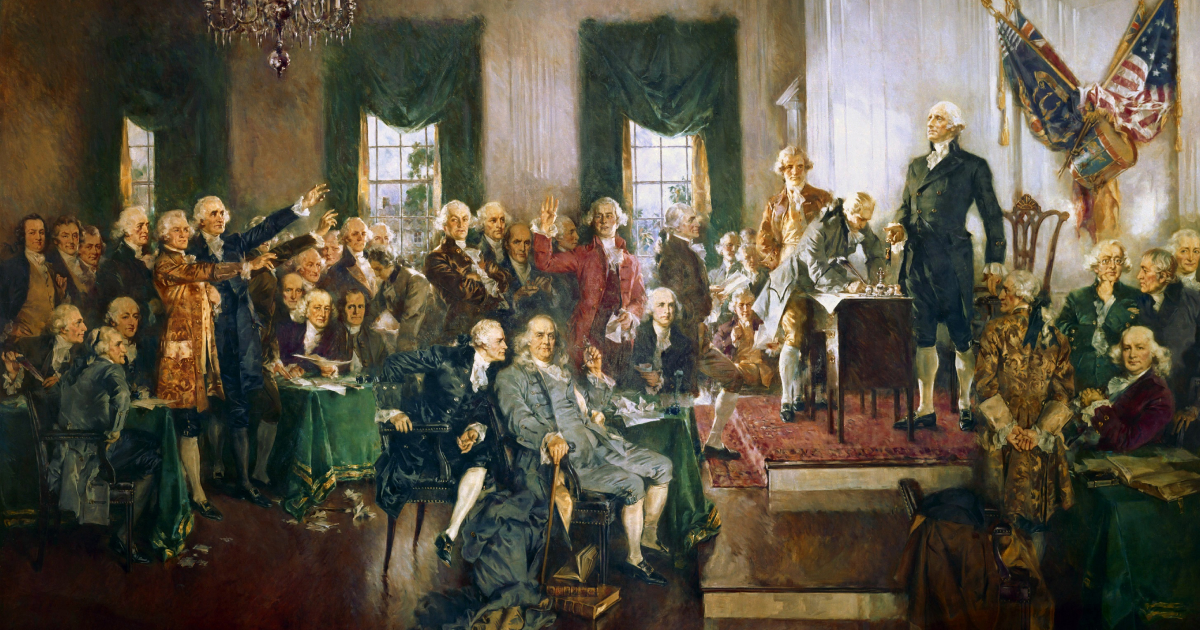
Fifty-five delegates met at Independence Hall from May to September 1787 to revise the Articles of Confederation. They scrapped them instead and wrote a new charter. James Madison kept the notes; the room was kept secret; the windows were closed in summer heat to prevent eavesdropping. The convention closed September 17. The Constitution they produced has been amended twenty-seven times in 234 years, but never replaced.
“We the People of the United States, in Order to form a more perfect Union, establish Justice, insure domestic Tranquility, provide for the common defence, promote the general Welfare, and secure the Blessings of Liberty to ourselves and our Posterity, do ordain and establish this Constitution for the United States of America.”
— Preamble to the Constitution of the United States, September 17, 1787
The Articles of Confederation had been ratified in 1781 and had immediately proven inadequate. Congress could not tax, could not regulate commerce among states, and could not enforce its own treaties. Shays’ Rebellion in western Massachusetts in 1786-87 — armed farmers protesting debt collection — convinced delegates from twelve states (Rhode Island boycotted) that a stronger central government was necessary. The Convention’s formal charge was to amend the Articles. Within a week, the Virginia Plan introduced by James Madison proposed scrapping them entirely. The delegates agreed, then debated for four months over what to build instead.
The Connecticut Compromise of July 16 resolved the large-state/small-state dispute by creating two chambers: a House apportioned by population (favored by Virginia and Pennsylvania) and a Senate with equal representation by state (favored by Delaware and New Jersey). The three-fifths compromise resolved the slaveholding-state dispute by counting enslaved people as three-fifths of a person for purposes of congressional apportionment — without giving them any rights, vote, or recognition. The provision boosted southern political power for the next seventy-eight years; it was nullified by the Fourteenth Amendment in 1868.
The Electoral College, which appears in Article II, was a compromise between direct popular election (favored by James Wilson and a few others) and election by Congress (favored by most delegates). It also reflected the slave-state advantage: electors were apportioned by total congressional representation, which already included the three-fifths counting of enslaved people. Five of the first ten presidents were Virginia slaveholders. The Electoral College has produced five presidents who lost the popular vote, most recently in 2016.
Ratification was uncertain. The Federalist Papers — eighty-five essays by Alexander Hamilton, James Madison, and John Jay, published in New York newspapers in 1787-88 — were the most influential argument for adoption. Anti-Federalist opponents, led by George Mason and Patrick Henry, demanded a bill of rights as a condition of ratification. Delaware ratified first on December 7, 1787. New Hampshire became the ninth state on June 21, 1788, making the document operational. Virginia and New York followed within a month. Rhode Island held out until May 1790, and only ratified after the new federal government threatened a trade embargo.
Twenty-seven amendments in 234 years. The three-fifths compromise was nullified by the Thirteenth, Fourteenth, and Fifteenth amendments after the Civil War. The document’s original text — four pages of parchment in James Madison’s handwriting and that of his assistant — is now sealed behind argon-filled bulletproof glass at the National Archives. Its provisions are still being argued in federal court every term. The text has not been replaced. The argument has not ended.
August 20, 1619: the White Lion landed at Point Comfort with twenty Angolans aboard — the first documented enslaved Africans in English North America.
The Six Nations of the Haudenosaunee Confederacy — Mohawk, Oneida, Onondaga, Cayuga, Seneca, Tuscarora — governed by a constitution older than the country that borrowed from it.
On July 4, 1776, fifty-six delegates signed a document declaring that government draws its just powers from the consent of the governed. Many of them held people in bondage.