The First Enslaved Africans Arrive
August 20, 1619: the White Lion landed at Point Comfort with twenty Angolans aboard — the first documented enslaved Africans in English North America.
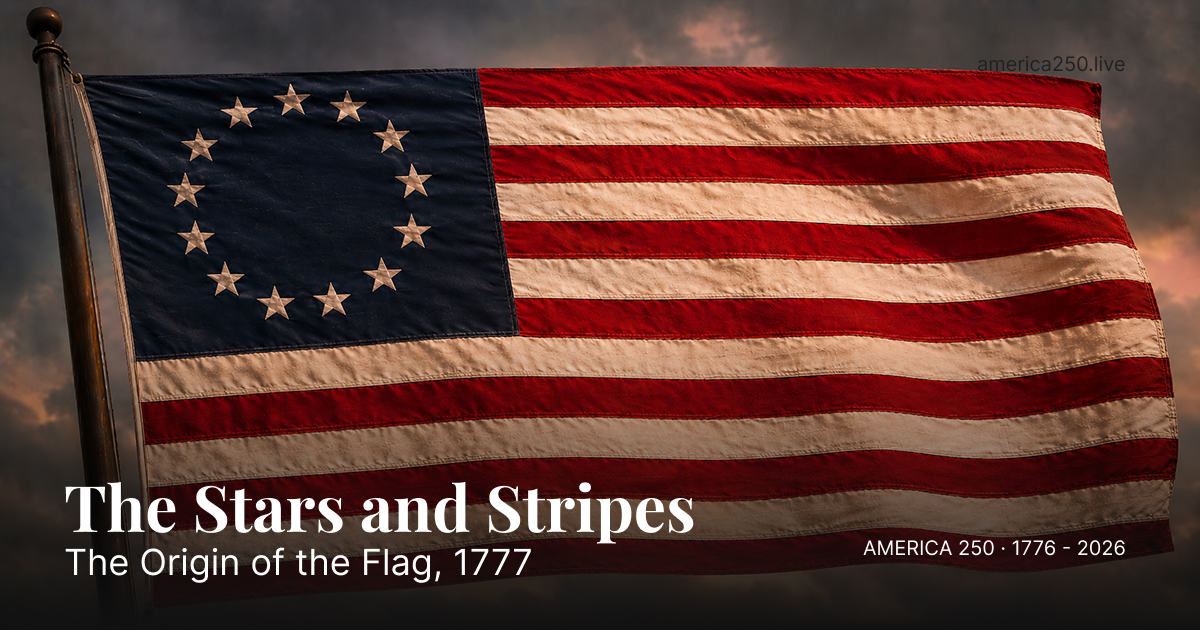
On June 14, 1777, the Second Continental Congress passed a resolution describing, for the first time, a flag for the United States: thirteen stripes of red and white, and thirteen white stars on a field of blue, representing a new constellation. It was a minor item of business in a desperate year, passed without fanfare among naval orders. The resolution named no designer, specified no arrangement of the stars, and was not made public for months. The flag it described would be sewn a hundred different ways, claimed by people who never made it, and redrawn again and again as the country it represented kept changing shape.
“Resolved, That the flag of the thirteen United States be thirteen stripes, alternate red and white; that the union be thirteen stars, white in a blue field, representing a new constellation.”
— The Flag Resolution of the Second Continental Congress, June 14, 1777
The resolution was three lines long, and it was not the most important thing the Congress did that day. The Second Continental Congress, meeting in Philadelphia in the third year of a war it was losing, passed the Flag Resolution between items of naval business — it sat in the records beside orders about ships’ captains and prize money. It named no designer. It did not say how the stars should be arranged, how many points they should have, or how the flag should be made. It was not announced to the public for nearly three months. The country had declared its independence eleven months earlier; only now did it describe a banner to fly over it.
That silence on the details meant the early flag had no single form. Flagmakers arranged the thirteen stars however they liked — in rows, in a circle, in a square with one in the center, scattered across the blue like an actual constellation. Stars had five points or six. The famous ring of thirteen stars associated with Betsy Ross was one pattern among many, no more official than the rest. For the first forty years of its existence, the American flag was less a fixed design than a set of loose instructions, executed differently by every hand that sewed one.
Betsy Ross herself is the most famous flagmaker in American history and the least documented. The story that she sewed the first Stars and Stripes — that George Washington visited her Philadelphia upholstery shop in 1776, and that she suggested the five-pointed star — comes entirely from her grandson, William Canby, who told it to the Historical Society of Pennsylvania in 1870. That was thirty-four years after Ross died and ninety-three years after the flag resolution, and Canby produced no contemporary evidence for any of it. Ross was real, and she did make flags — she was paid for sewing ship’s colors for the Pennsylvania navy in 1777. What she almost certainly did not do is design the national flag. The legend was assembled a century later, by a family that remembered it that way.
The one person with a documented claim was a signer of the Declaration. Francis Hopkinson, a New Jersey delegate, lawyer, and composer, billed Congress in 1780 for designing the flag — along with the Great Seal and other devices of the new government. He first asked to be paid in a quarter-cask of public wine, then in cash. Congress declined, on the grounds that Hopkinson was not the only person consulted and that the designs were the work of many hands. He is the only individual who claimed the flag in his own lifetime, in writing, to the body that had adopted it — and he was turned down for the fee. The likeliest designer of the American flag was a congressman, and the country never paid him.
The flag changed as the country did, and twice it nearly got away from its makers. When Vermont and Kentucky joined the Union, the Flag Act of 1794 added two stars and two stripes — fifteen of each. That fifteen-star, fifteen-stripe flag was the one Francis Scott Key watched survive a night of British bombardment over Fort McHenry in September 1814, the flag that moved him to write the poem that became, more than a century later, the national anthem. But adding a stripe for every new state was visibly unworkable, and in 1818 Congress fixed the stripes at thirteen — one for each original colony — and ruled that a single star would be added for each new state, taking effect the Fourth of July after it was admitted. Stars would multiply; stripes would not. That rule still governs the flag today.
The flag Americans now salute was designed, by the most common account, by a seventeen-year-old. In 1958, anticipating that Alaska and Hawaii would soon become states, Robert G. Heft, a high-school student in Lancaster, Ohio, sewed a fifty-star flag for a class project, arranging the stars in nine offset rows. His teacher gave it a B-minus. Heft mailed the flag to his congressman; when Hawaii became the fiftieth state, the arrangement he had submitted — the same one many others had independently arrived at — was made official by executive order on the Fourth of July, 1960. The teacher, the story goes, changed the grade to an A. The fifty-star flag has now flown longer than any version before it — more than sixty-five years, through everything the country has done under it.
Flag Day itself was the work of people with no power to declare one. A Wisconsin schoolteacher named Bernard Cigrand began promoting June 14 as a day to honor the flag in 1885; it took thirty-one years for a president, Woodrow Wilson, to mark it by proclamation in 1916, and another thirty-three before Harry Truman signed it into law in 1949. It is, by design, not a federal holiday: no day off, no closures, nothing to buy. June 14 carries one other anniversary — the United States Army, which Congress created in 1775, exactly two years to the day before it gave that army a flag. Two hundred and fifty years on, the banner is still a year younger than the country it stands for. It began as thirteen stars and a new constellation, and it has been redesigned twenty-seven times since — exactly as many times as the Constitution has been amended. The flag was never meant to be finished. Neither was the country.
August 20, 1619: the White Lion landed at Point Comfort with twenty Angolans aboard — the first documented enslaved Africans in English North America.
The Six Nations of the Haudenosaunee Confederacy — Mohawk, Oneida, Onondaga, Cayuga, Seneca, Tuscarora — governed by a constitution older than the country that borrowed from it.
On July 4, 1776, the Continental Congress adopted a document declaring that government draws its just powers from the consent of the governed — most of the fifty-six delegates signed it that August. Many of them held people in bondage.