The First Enslaved Africans Arrive
August 20, 1619: the White Lion landed at Point Comfort with twenty Angolans aboard — the first documented enslaved Africans in English North America.
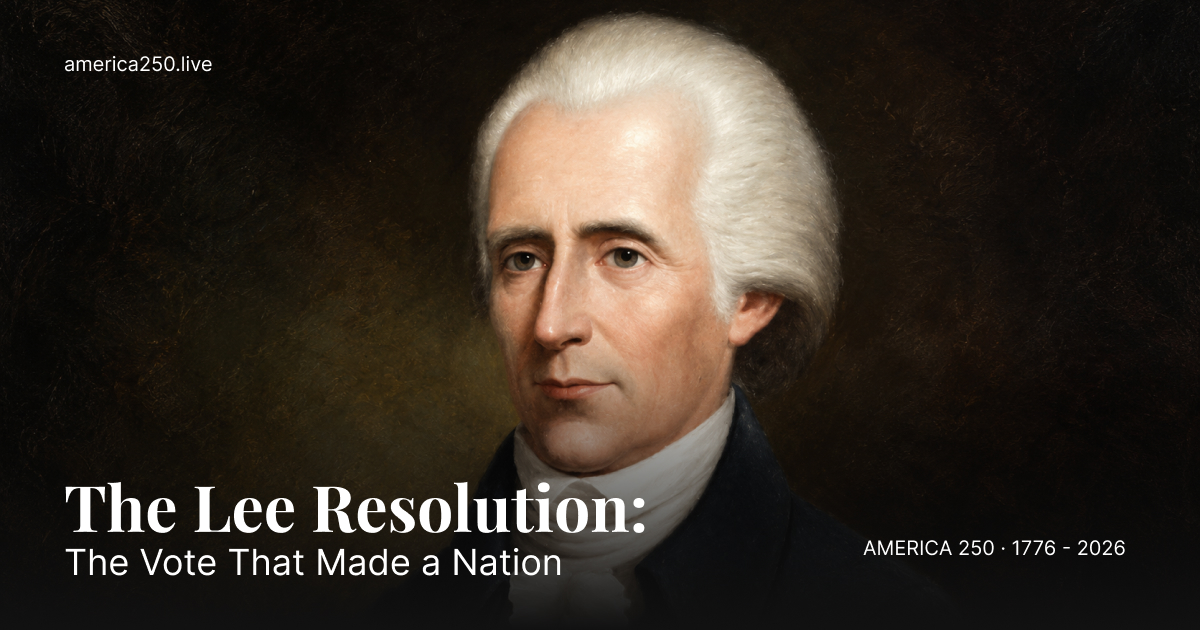
Richard Henry Lee was born on January 20, 1732, at Stratford Hall in Westmoreland County, Virginia, into one of the colony’s most powerful families. On June 7, 1776, acting on instructions from the Virginia Convention, he introduced three resolutions to the Second Continental Congress in Philadelphia. The first declared independence. John Adams seconded the motion. Congress did not vote that day, nor the next. It would take until July 2 for the colonies to agree, and another two days to approve the words now read every Fourth of July. Lee was 44. He would not draft the document his motion set in motion.
“That these United Colonies are, and of right ought to be, free and independent States.”
— The Lee Resolution, introduced to the Continental Congress, June 7, 1776
The men in the Pennsylvania State House had been at war for more than a year before any of them voted to leave the empire they were fighting. Blood had been spilled at Lexington and Concord in April 1775. Washington had been named commander-in-chief. An army was in the field. And yet, as a legal matter, the colonies were still British — subjects in rebellion, petitioning a king they had not formally renounced. Independence was the obvious destination and the unspeakable word. Someone had to say it on the floor.
On May 15, 1776, the Virginia Convention meeting in Williamsburg instructed its delegates in Philadelphia to propose exactly that. The task fell to Richard Henry Lee, a tall, austere orator from a family that had been governing Virginia for generations. Contemporaries called him the American Cicero. He had lost the use of his left hand in a hunting accident years before and kept it wrapped in a black silk handkerchief, which he moved as he spoke. On June 7, 1776, he rose and offered three resolutions.
The first was the one that mattered. It declared "That these United Colonies are, and of right ought to be, free and independent States, that they are absolved from all allegiance to the British Crown." The second called for forming alliances with foreign powers — which meant France. The third proposed a confederation to bind the colonies together. Lee's motion did three things at once: it declared the colonies free, it sought the help they would need to stay free, and it began the work of making them one country. Independence, in other words, was not only a break from Britain. It was a plan to survive the break.
John Adams of Massachusetts seconded the motion at once. But the Congress was not ready. Delegations from New York, New Jersey, Pennsylvania, Delaware, Maryland, and South Carolina either lacked authority from home or were unwilling to commit. Congress did the cautious thing and postponed the vote until the first week of July, to give the reluctant colonies time to consult their constituents. So that no time would be lost if the vote then succeeded, it appointed a committee to draft a formal declaration in the meantime.
The committee had five members: John Adams, Benjamin Franklin, Roger Sherman, Robert R. Livingston, and Thomas Jefferson. By rights, the drafting might have gone to Lee — it was his motion. But in mid-June, Lee was called home to Virginia, where his wife had fallen gravely ill. The committee handed the pen instead to its youngest member, the 33-year-old Jefferson, who was known to write far better than he spoke. Over about two weeks in a rented room on Market Street, Jefferson wrote the document that made Lee's resolution beautiful.
On July 1, debate resumed. On July 2, 1776, twelve colonies voted in favor of Lee's resolution for independence; New York abstained, still awaiting instructions. That was the legal moment the United States came into being — the vote, not the document. John Adams wrote to his wife Abigail that the Second of July would be celebrated by future generations as "the great anniversary Festival," with pomp, parades, and bonfires. He was off by two days. Congress spent July 3 and 4 editing Jefferson's draft — cutting, among other passages, one that condemned the slave trade — and adopted the final text on July 4. The date on the parchment won.
Lee signed the Declaration when he returned to Congress, and he spent the rest of his career as one of the young republic's great worriers. He opposed the Constitution of 1787 because it created a national government he feared would swallow the states, and because it contained no guarantee of individual rights. From the floor of the first Senate he pressed for the amendments that became the Bill of Rights — free exercise of religion, freedom of the press, trial by jury, protection against unreasonable searches. The man who had moved for independence spent his last years making sure independence came with limits on power. He died at his estate, Chantilly, in Virginia, on June 19, 1794.
Almost no one remembers June 7. The country celebrates the document, not the motion; the writer, not the man who stood up first. But every signature on the Declaration of Independence is an answer to a question Richard Henry Lee asked out loud on a Friday in June, when saying it could still have gotten him hanged. Two hundred and fifty years later, the answer is a country. The question was his.
August 20, 1619: the White Lion landed at Point Comfort with twenty Angolans aboard — the first documented enslaved Africans in English North America.
The Six Nations of the Haudenosaunee Confederacy — Mohawk, Oneida, Onondaga, Cayuga, Seneca, Tuscarora — governed by a constitution older than the country that borrowed from it.
On July 4, 1776, fifty-six delegates signed a document declaring that government draws its just powers from the consent of the governed. Many of them held people in bondage.